
- Date
- 3963 BBY
- World
- Dagary Minor
- Known veterans
- Meetra Surik, Xaart
- Outcome
- Mandalorian victory
- Primary evidence
- KOTOR II dialogue
Historical narrative and evidence
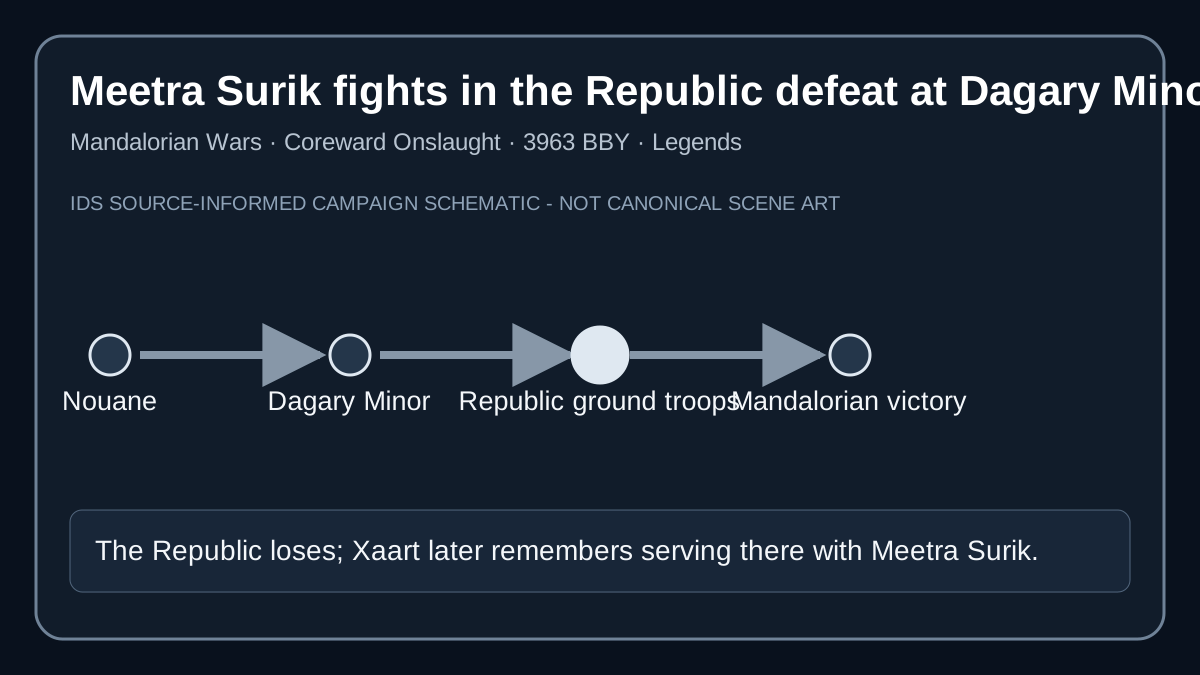
The battle on Dagary Minor took place in 3963 BBY while the Mandalorian invasion was driving through Republic territory. Republic ground forces, including the Jedi who would later be known as Meetra Surik and a soldier named Xaart, fought there and lost. Years afterward, Xaart recognized Meetra on Onderon and reminded her that they had served together at Dagary Minor.
A battle remembered by a veteran
Dagary Minor is valuable because its evidence comes partly through a participant rather than only a campaign map. Xaart does not deliver a heroic speech or a strategic summary. He remembers that he and Meetra were ground troops in a battle the Republic did not win.
That small exchange places Meetra inside the ordinary military experience of the war before later events at Dxun and Malachor V made her a figure of much greater historical importance.
The early invasion keeps moving
The loss followed the fall of Nouane and preceded fighting around Omonoth. In this phase, Republic forces were being forced to respond to several advancing Mandalorian corridors at once. Dagary Minor was one more local defeat that allowed the larger offensive to keep its momentum.
Anthropological assessment
Xaart's recollection shows how veterans organize history differently from campaign maps. A military archive may preserve Dagary Minor as a point between two systems. A participant remembers who stood nearby and whether they won.
The difference matters because institutional histories often center commanders and outcomes, while personal memory preserves relationships and embodied experience. Dagary Minor survives through both scales, and neither should be substituted for the other.
Evidence check
What is firmly established?
The date or range, continuity, broad combatants, outcome, and campaign placement are included only where the sources below support them.
What has IDS deliberately not invented?
Unnamed commanders, exact force sizes, casualty totals, tactical phases, dialogue, and civilian experiences remain unknown unless a cited source establishes them.
Why use a schematic?
The visual is an original IDS reconstruction used where verified event-specific artwork is unavailable or rights status is unclear. It is labeled so it cannot be mistaken for canonical scene art.
Historical judgment · Legends · Source literacy
Test your interpretation of this battle
Answer both questions for a score, specific corrections and an explanation of what the record can establish.
Source method: This assessment follows the references in this entry. A later campaign map can document a system and a result without documenting conversations, exact numbers or undocumented motives.
3963 BBY · Legends · Source-sensitive dossier
Dagary Minor: a veteran remembers the Republic defeat
The documented event
Republic ground forces were defeated at Dagary Minor during the Mandalorian offensive in 3963 BBY. The event is unusual because one later source preserves a soldier's memory: Xaart recognized Meetra Surik years afterward and recalled serving alongside her during the unsuccessful engagement. This provides a connection between a brief battle entry and the ordinary soldiers who experienced it. Meetra's later role as the Jedi Exile should not be treated as a command assignment that she held at Dagary Minor.
Anthropological and institutional interpretation
Military chronologies arrange battles geographically and according to strategic results. Veterans may instead remember the people they fought beside, the danger of a particular day and whether the unit survived or retreated. Xaart's recognition of Meetra belongs to this second form of historical evidence. It gives a relationship and a loss without establishing the location of every formation. A character who later became central to galaxy-wide events could participate earlier as one member of an ordinary ground force. That distinction makes the human scale of the campaign clearer.
Limits and corrections
The conversation in Knights of the Old Republic II does not give a full order of battle, exact casualty total or the details of every action Meetra undertook in the engagement.
Historical judgment: Did Xaart recall Dagary Minor as a Republic victory?
Explanation: No. He remembered fighting with Meetra in a battle the Republic lost.
Sources: Knights of the Old Republic II: The Sith Lords, Xaart's Onderon dialogue; The Essential Atlas. Historical reference and bibliography ↗. Original page citations are under audit.
Sources and further reading
- Star Wars: Knights of the Old Republic II: The Sith Lords (2004), Xaart's conversation with the Jedi Exile.
- The Essential Atlas (2009), campaign placement.
About these links: Publisher and Lucasfilm records identify the referenced editions. A book description or game listing is not a scene-by-scene record of this battle; map placements, dialogue, casualty claims and historical interpretations must be checked against the original pages or gameplay.