
Around 8000 BBY, the star Colu expanded enough to consume Clak'dor I, the innermost planet of the Colu system. Unlike the wars, migrations, and political changes surrounding it in the chronology, this event was astronomical. A world disappeared because of stellar evolution rather than sentient action.
A stellar catastrophe
Colu was a large white A-type star. Its expansion eventually reached the orbit of Clak'dor I.
The planet ceased to exist as an independent world and later references treated its former orbit as part of the system's deep history.
The Colu system survives
Other planets in the system remained, including the worlds associated with the Bith.
One destroyed planet did not mean the destruction of the entire star system.
A lost world in later maps
Later astronomical records preserved the name Clak'dor I despite the planet's destruction.
Naming allows a place to remain historically legible after its physical disappearance.
Anthropological assessment
Clak'dor I is a reminder that galactic history includes environmental and astronomical change that no government can negotiate with or defeat.
Its sparse record also shows how a vanished world can survive mainly as a coordinate in later scientific memory.
c. 8000 BBY · Legends · source and cultural analysis
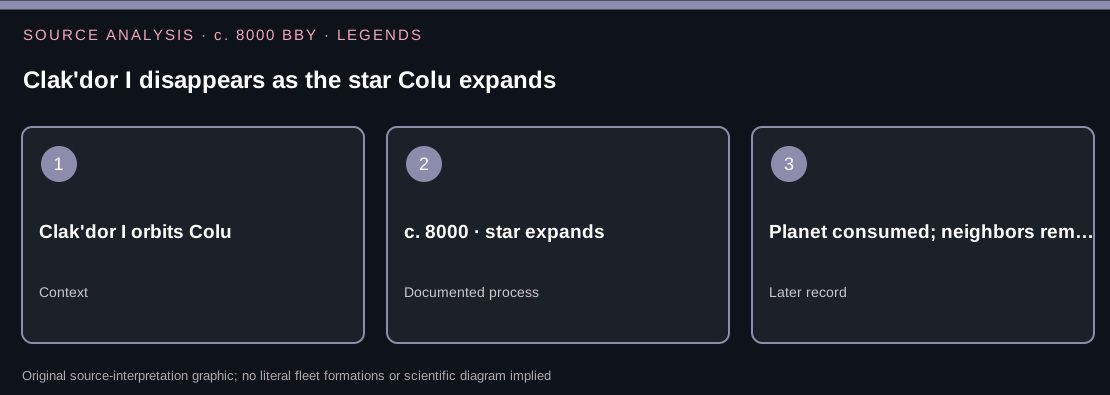
Clak'dor I disappears as the star Colu expands
What the sources establish
Legends planetary records state that the star Colu grew large enough to consume its innermost planet, Clak'dor I, around 8000 BBY. The Clak'dor system retained other planets, including Clak'dor II, the later homeworld of the Bith. This is an astronomical event that belongs in the same chronology as political events without being explained as a Jedi or Sith attack.
Institutions and material life
A change in the physical environment can remove places from a cultural landscape even when written memory of their existence survives. In this case the source gives no population on Clak'dor I at the moment of destruction. An ethical historical summary should therefore avoid inventing the deaths of imagined settlers or attributing the event to warfare.
What remains uncertain
The source does not establish an eyewitness report, exact stellar expansion timescale, or pre-destruction population. The phrase around 8000 BBY is approximate, and the fate of the innermost planet must not be mistaken for the destruction of all worlds in the system.
Historical judgment: Did the star's expansion destroy the Bith homeworld Clak'dor II in 8000 BBY?
Answer and explanation: No. The source identifies the innermost Clak'dor I as destroyed, not Clak'dor II.
Source record: Geonosis and the Outer Rim Worlds (2004), Colu system overview. Read published evidence / bibliography →.
Sources and further reading
- Geonosis and the Outer Rim Worlds.
- Clak’dor I, Wookieepedia