
In 13,649 BBY, the Defence of Drogheda took place during the Fourth Alsakan Conflict. It is the first specifically dated engagement known from a war that had already been underway for roughly a century and a half. The surviving record is extraordinarily thin. We know the name, the year, and the larger conflict. We do not know who commanded, what forces fought, what was being defended, how long the action lasted, or which side ultimately held the field.
A battle preserved mostly as a name
Drogheda survives because a later military history chose to list the engagement. That creates an unusual historical object: a named event with almost no narrative attached to it.
For a timeline archive, the correct response is not to fill the silence with plausible warfare. The absence itself is part of the evidence.
Inside the Fourth Alsakan Conflict
The battle occurred during the conflict between Coruscant and Alsakan that lasted approximately from 13,800 to 13,200 BBY. The war was part of the much longer Alsakan sequence over political power within the Republic.
By the time of Drogheda, people had already lived several generations under renewed conflict.
What the word “Defence” tells us
The conventional battle name implies that some force was defending a position associated with Drogheda. It does not tell us whether the defended target was a planet, system, station, route junction, colony, fleet anchorage, or political center.
Nor does it securely identify which faction was defending. Battle names can be applied retrospectively and do not always preserve the terminology used by participants.
Why so little survives
The Fourth Alsakan Conflict spans six centuries but has only a small number of specifically named engagements in surviving reference material. That discrepancy shows how selective the fictional historical archive is.
Military chronologies often preserve turning points and labels while losing ordinary operations, civilian experience, and administrative history.
What is missing
No named commander is securely attached to Drogheda. No fleet strength, casualty count, tactical map, weapon system, or decisive outcome is provided. No source explains whether the engagement changed the wider course of the war.
Those omissions keep the page short on tactical detail but make it useful as a case study in evidence discipline.
The larger theater matters more than a fictional battlefield reconstruction
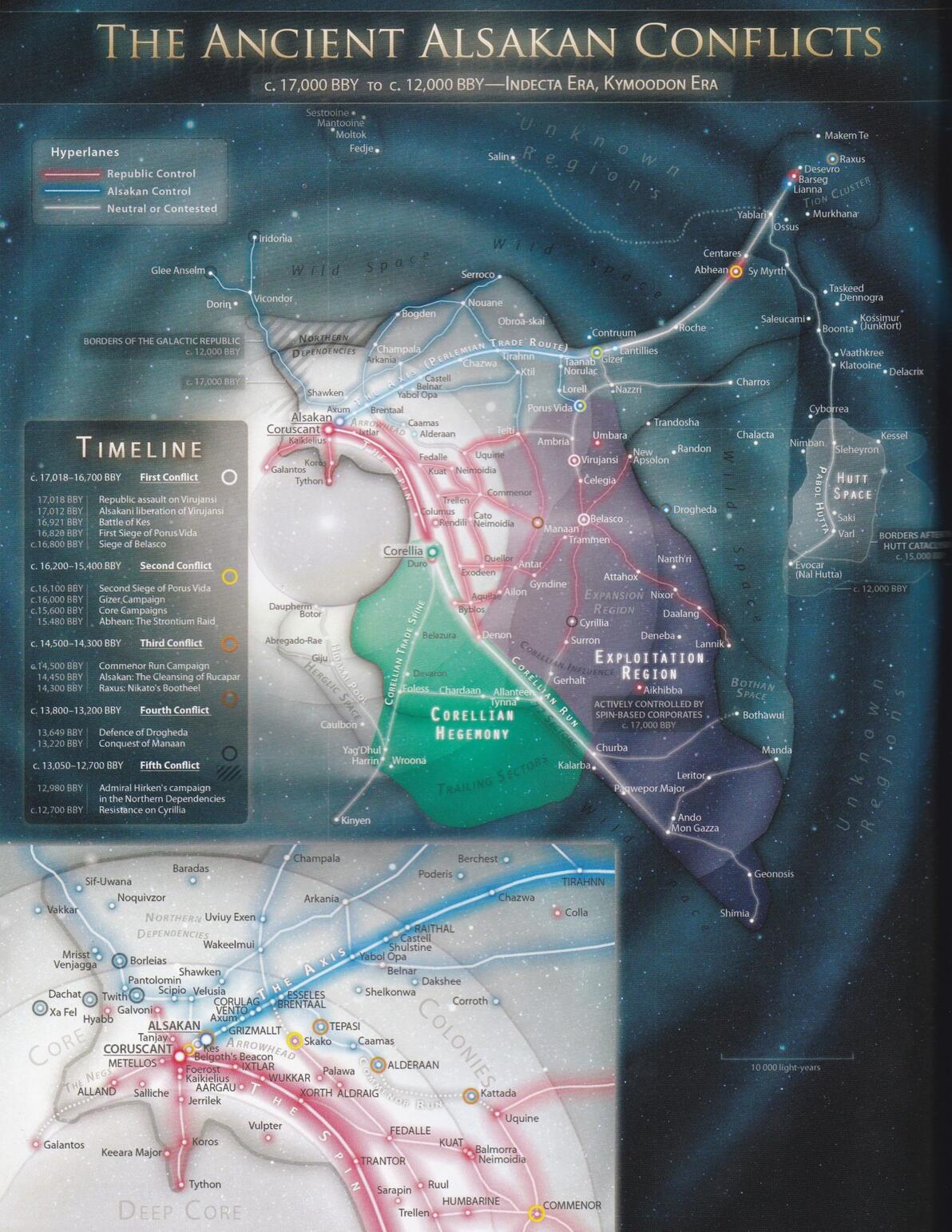
The map of the Alsakan Conflicts shows a Republic divided by political alignments, colonial networks, and hyperspace corridors. Drogheda belongs to that wider spatial struggle even if its local tactical geography remains obscure.
Anthropological assessment
Drogheda demonstrates how historical memory can preserve labels after context disappears. A community may remember that a place was “defended” long after the identities, motives, and experiences of the participants become inaccessible.
The event also warns against treating a military timeline as a complete social history. A six-century war would have affected migration, trade, family life, settlement, taxation, and political identity. The surviving battle name preserves almost none of that human scale.
What the sources establish
Sources and further reading
- Jason Fry with Paul R. Urquhart, Star Wars: The Essential Guide to Warfare, Del Rey, 2012.
- Fourth Alsakan Conflict, Wookieepedia