
Original IDS symbolic art, not a verified source image.
Around 4300 BBY in current canon, an unidentified enemy had conquered nearly every Chiss world and driven the Ascendancy back to its capital, Csilla. Facing extinction, the Chiss deployed an ancient alien weapon called Starflash. Twenty Mitth warriors volunteered for the suicide mission. The weapon annihilated the enemy fleet and saved the Ascendancy, but its effect on Csilla's star began a long cooling process that eventually forced most surface life underground.
A last stand for species survival
The enemy had already overrun the Ascendancy's outer worlds.
Csilla was the final major defensive position.
The Starflash
The weapon sent energy into the star and produced a catastrophic return burst.
Its use required the certain death of the twenty Chiss operating it.
The Mitth sacrifice changes Chiss politics
Four sons of Mitth Patriarch Thomoro were among the volunteers.
The family's sacrifice helped elevate the Mitth to Ruling Family status.
Victory damages the Chiss homeworld
The Starflash disrupted Csilla's sun deeply enough that it cooled over subsequent decades.
A weapon that prevented immediate extinction created a slower environmental crisis.
Anthropological assessment
The Final Assault shows how societies convert collective sacrifice into political legitimacy.
It also presents a classic survival dilemma: the technology that saves a population in the short term can permanently alter the environment on which that population depends.
Canon · Chiss prehistory
A Canon victory whose cost reshaped the homeworld
The Final Assault on Csilla belongs to the current Canon account of the Chiss Ascendancy's deep history, not to the Legends Sith Wars occurring around comparable dates. In the novel Thrawn Ascendancy: Lesser Evil, later Chiss describe an enemy that seized outlying worlds and drove the Defense Force back to the capital. With defeat threatening the survival of the Ascendancy, a weapon known as Starflash was brought from secure storage. The Stybla family had preserved it despite the terrible instructions attached to its use. Its activation required twenty operators and offered no prospect of their survival.
The Mitth family supplied volunteers, including four sons of the family patriarch, as the device was carried into the hostile fleet. The Starflash sent energy toward Csilla's star and triggered a devastating returning discharge. The attackers and the volunteers were destroyed, ending the immediate threat. The Chiss had survived, but the weapon's effect started the long cooling of their homeworld and eventually changed where they could live. Star Wars: Timelines places this ancient event around 4300 BBY, while the novel conveys it through a later recollection, not as a scene directly witnessed by the story's present-day characters.
Victory and environmental displacement
The defense of Csilla accomplished its immediate purpose while creating a long-term ecological cost. The later movement of settlements underground resulted from environmental change following the weapon's use. Survival was therefore not a one-time military outcome but a process of adapting institutions and ordinary life to a transformed homeworld.
Family prestige built upon sacrifice
The volunteers' deaths entered Chiss political memory and contributed to the Mitth family's later standing. The story demonstrates how a society may convert collective sacrifice into recognized status across generations. That later recognition does not give us the private thoughts of each person who volunteered.
Is the Starflash battle a Legends account of Sith warfare?
No. It is a Canon event told through the Thrawn Ascendancy novels and dated in Star Wars: Timelines. The enemy's identity remains unspecified in the account.
Source evidence: Timothy Zahn, Thrawn Ascendancy: Lesser Evil (2021); Star Wars: Timelines (2023). Lucasfilm introduction to the source novel →. Explanatory analysis is distinguished from events established by published sources.
c. 4300 BBY · Canon
Starflash saves Csilla at a terrible cost
- The Ascendancy faces annihilation
An enemy whose identity remains unnamed in Canon overran the Chiss Ascendancy's outer worlds, leaving Csilla facing a final assault. The Stybla family guarded an ancient alien weapon called Starflash but knew its activation could cause terrible harm. Its possible use became a political dilemma: save the Chiss in the immediate battle while accepting the risk of lasting damage to their home system.
- Twenty Mitth volunteers die operating the weapon
The Starflash required twenty operators on a mission known to be fatal. Twenty Mitth warriors, including four sons of Patriarch Mitth'omo'ross, volunteered to activate it within the opposing fleet. Its discharge toward Csilla's sun produced a return burst that destroyed the enemy ships and killed the operators. The sacrifice later affected the family’s political standing and memory.
- Victory changes Csilla permanently
Starflash damaged the sun and contributed to a prolonged cooling of Csilla, eventually driving much of the population underground. The later narrative preserves the memory of those who saved the Ascendancy and the cost of their intervention. This event is Canon, unlike the nearby Legends events involving the Beast Wars, Chamma and the Third Great Schism. The date is a retrospective chronology estimate.
Is this battle part of the Legends Third Great Schism?
No. The Final Assault on Csilla is Canon, described in Thrawn Ascendancy: Lesser Evil. The Third Great Schism is a separate Legends event.
Source basis: Thrawn Ascendancy: Lesser Evil; Star Wars: Timelines. Compiled source bibliography. Primary edition page references and official art review are outstanding.
c. 4300 BBY · Canon · Evidence lab
Csilla: a successful defense with lasting damage
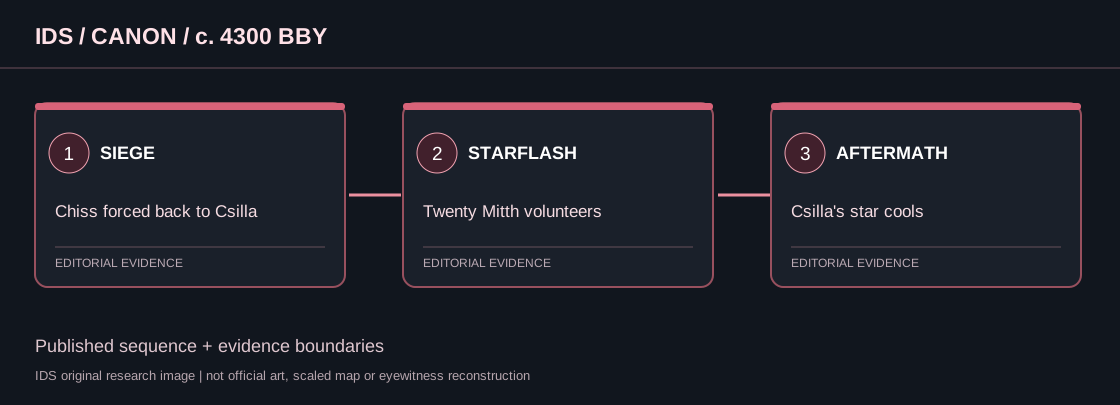
What the record establishes
Timothy Zahn's Thrawn Ascendancy: Lesser Evil preserves a Chiss account of an unidentified enemy forcing their defense back to the homeworld Csilla. Twenty Mitth volunteers, including four sons of the family patriarch, activated Starflash, a one-use alien weapon. Its discharge into Csilla's sun triggered a return burst that destroyed the enemy fleet and killed the operators. The weapon saved the Ascendancy but began the star's cooling over the following decades.
Anthropological assessment
Victory in battle and long-term security are not equivalent outcomes. The Chiss prevented immediate conquest, but the damage to their sun later changed the material conditions of life on their homeworld. The volunteers' deaths also shaped the Mitth family's institutional standing and collective memory. Both the political honor and the environmental loss belong to the story's aftermath.
Evidence limits
The hostile power's identity is not established. The date is a retrospective Canon placement rather than dialogue from the battle itself. The planet's climate did not collapse instantly when the weapon was fired. This Canon episode should not be blended into adjacent Legends histories.
Check your historical judgment: Did Starflash immediately freeze Csilla when it defeated the invaders?
Correction: No. The Chiss defeated the fleet, but harm to Csilla's sun caused cooling over a longer period.
Source trail: Timothy Zahn, Thrawn Ascendancy: Lesser Evil; Star Wars: Timelines. Bibliography and reference history ↗. Printed page verification remains open.
Sources and further reading
- Timothy Zahn, Thrawn Ascendancy: Lesser Evil.
- Star Wars: Timelines.
- Final Assault on Csilla, Wookieepedia