
Original IDS symbolic art, not a verified source image.
In 4350 BBY, the long hostility between Iziz and the wilderness communities of Onderon entered the period conventionally dated as the Beast Wars. The Naddist regime had used exile beyond the city walls as punishment. Instead of dying, exiles learned to tame the enormous creatures of Onderon's wilderness and built a rival social order known as the Beast Riders.
Exiles become a second civilization
People expelled from Iziz adapted rather than disappearing.
Taming beasts converted a punishment landscape into a source of mobility and military strength.
The city and wilderness become political opposites
Iziz associated walls, technology, and Naddist authority with civilization.
Beast Riders created their own identity outside the city's definition of legitimate society.
A conflict lasting roughly 350 years
The wars continued through generations of Naddist rulers and Beast Rider leaders.
The final Battle of Iziz in 4000 BBY ended the long conflict.
Anthropological assessment
The Beast Wars show how exclusion can create the political opponent a regime hoped to eliminate.
By surviving in the wilderness, the exiles turned stigma into a collective identity and eventually challenged the state's monopoly on civilization itself.
Legends chronology / primary-source discussion
An expulsion becomes generations of conflict
The period conventionally identified as the Beast Wars began around 4350 BBY. The underlying conflict was older: Freedon Nadd had established a form of royal government in Iziz that punished unwanted people by sending them outside the walls. Exile had been intended as exclusion from protection and political life. But groups that survived adapted to Onderon's wilderness and learned to use the enormous creatures living there. The Beast Riders became a separate armed community able to challenge the city's assumptions about safety and civilized identity.
By the time generations had passed, neither side experienced the dispute only as a punishment imposed by one long-dead king. Families inherited grievances and obligations and could be born into an established conflict. The rulers of Iziz used the imagery of dangerous outsiders to support their authority; the Beast Riders could point to the inherited experience of banishment and resistance. The conflict did not conclude with Nadd's death. It continued under later Naddist rulers until the political crisis of 4000 BBY, when Princess Galia's relationship with Oron Kira and the fall of Queen Amanoa created an opportunity for a different settlement.
Identity can emerge from a place of exclusion
People marked as outside legitimate society can build their own alliances, methods of subsistence and forms of leadership. The Beast Riders' animals were more than mounts. Their knowledge of those creatures enabled mobility and turned a dangerous environment into a source of collective strength.
An inherited war becomes hard to settle
When a dispute lasts centuries, its original causes may become inseparable from newer losses, stories and family relations. The Onderonian case explains why an alliance between members of the two governing circles could carry political meaning that a single battle victory could not.
Was the final Battle of Iziz fought in 4350 BBY?
No. The beginning of the long Beast Wars is dated to about 4350 BBY; the conflict ended around 4000 BBY, after generations of fighting.
Evidence used: Tales of the Jedi Companion; Tales of the Jedi issues 1–2; Star Wars Insider, historical guide to Tales of the Jedi. Reference and chronology cross-check →. The source and this editorial interpretation are not interchangeable; unsupported tactical and technical details have been omitted.
Ancient Republic · Legends · Historical field note
Interpreting The Beast Wars of Onderon
Conflict between Iziz and beast-rider communities illustrates how settlements can define outsiders as threats.
Research distinction: The documented event anchors this article. Its political and cultural implications are analytical observations, not invented scenes or claims about undocumented participants.
Open the historian's evidence question
What is directly established by the cited account, and what is an interpretation of its significance? Avoid treating an approximate date or a short reference entry as evidence for exact dialogue, motives or casualty totals.
4350 BBY · Legends
The Beast Wars reshape Onderon
- Exiles create a second community
The rulers of Iziz forced condemned people outside the city walls, where dangerous animals were expected to kill them. Some exiles instead survived by learning how to live alongside and tame the beasts. The Beast Riders developed new ways of moving through the wilderness and formed political ties independent of Iziz. Exile thus created a rival social world rather than erasing all former residents from history.
- A conflict lasts generations
Legends chronology dates the beginning of the Beast Wars to about 4350 BBY. Rivalries between the Beast Riders and the Naddist monarchy persisted until around 4000 BBY. That interval is not a documented record of constant battle on every day. Rather, successive generations inherited exclusion, local identities, military tactics and territorial claims from those who first fought.
- The famous ending belongs centuries later
The Battle of Iziz belongs at the end of the conflict, not at its beginning. A useful historical account separates the initial expulsion policies, the beginning of organized conflict and the later peace process. The surviving stories describe royal leaders and Jedi more fully than ordinary families, which leaves the social histories of both communities partly unknown.
Did the famous Battle of Iziz take place in 4350 BBY?
No. The Beast Wars are dated from approximately 4350 to 4000 BBY. The best-known Battle of Iziz belongs to the conflict's conclusion.
Source basis: Star Wars Insider 26; Tales of the Jedi Companion. Compiled source bibliography. Primary edition page references and official art review are outstanding.
c. 4350 BBY · Legends · Evidence lab
Onderon: exclusion produces a rival society
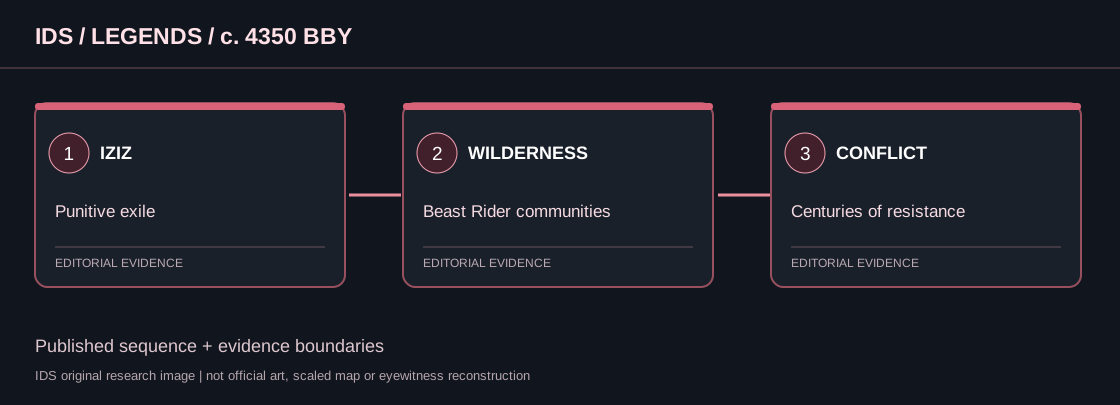
What the record establishes
Legends timelines place the start of the Beast Wars on Onderon at about 4350 BBY. The rulers of Iziz banished people into dangerous wilderness outside the city walls. Survivors learned to ride local beasts and developed new communities capable of resisting Iziz's Naddist rulers. This is the beginning of a long conflict, not the date of the Battle of Iziz or the final settlement near 4000 BBY.
Anthropological assessment
The city used exclusion to remove people from its political community. Yet survival in the wilderness allowed those people and their descendants to establish a separate political identity. Riding beasts became a source of mobility, defense and prestige rather than evidence of cultural inferiority. Histories told only from the walled city's viewpoint risk representing the Beast Riders as outsiders who appeared without a prior connection to Iziz.
Evidence limits
A conventional 350-year historical span is not evidence of uninterrupted daily combat. The final Jedi interventions occurred centuries after the start date. The source record is much richer for elite rulers than for ordinary families.
Check your historical judgment: Were Beast Riders an entirely separate invading people?
Correction: No. Their communities included descendants of Iziz exiles, which makes political exclusion central to the conflict's origin.
Source trail: Tales of the Jedi Companion; Beast Wars Legends chronology. Bibliography and reference history ↗. Printed page verification remains open.
c. 4350 BBY · Legends · Source-critical reading
The origin of the conflict is not the identity of its participants
The Beast Wars are often described as a battle between the fortified city of Iziz and the wild lands outside it. This is only the spatial expression of a political history. Later Legends records describe an exile system through which a Naddist monarchy placed unwanted people beyond the city walls. Those people and their descendants could acquire shelter, relationships, transport animals and leadership of their own. Treating the Beast Riders as naturally savage would repeat the royal classification without testing it.
The approximate 4350 BBY start is a later reference-date marker. The 1993 comic opens near the end of the conflict around 4000 BBY, when Arca Jeth sends Ulic, Cay and Tott to investigate. Marvel's retrospective describes Arca briefing the Jedi on a longstanding struggle, Queen Amanoa expecting the visitors to fight for Iziz, and Galia revealing an alternative account of the outsiders. This makes the difference between a retrospective start date and a directly dramatized confrontation clear.
Anthropologically, Iziz and the Beast Rider settlements were not two societies frozen for three and a half centuries. Their conflict formed and transformed identities through marriage, exclusion and warfare. The later Galia–Oron relationship demonstrates the existence of political connections across the boundary. It would be unsound to infer an unbroken chain of particular Beast Lords or an exact annual casualty rate from the broad traditional duration.
Historical judgment: Were the Beast Riders simply an unrelated invading species attacking Iziz?
Explanation: No. They included descendants of people expelled from Iziz. The conflict involved political membership and exile as well as physical fighting.
Compare all nine connected Onderon dossiers →
Source comparison: Marvel's 2017 history of the 1993 Tales of the Jedi; Tales of the Jedi Companion for earlier Legends chronology. The publisher retrospective is not a substitute for precise print-page verification of reference-only dates.
Sources and further reading
- Tales of the Jedi Companion.
- Beast Wars, Wookieepedia