
Original IDS symbolic illustration, not source artwork. Original-story source trail →
Around 4400 BBY, Jedi Knight Chamma joined a team sent to investigate a distress call from Athiss, a world associated with ancient Sith devotees. The mission turned violent. During the encounter, Chamma fell to the dark side. Ashamed by his failure, he abandoned active Jedi service and entered self-imposed exile on H'ratth.
A distress call on a Sith world
The Jedi arrived as investigators rather than conquerors.
Contact with Sith devotees transformed the mission into a spiritual and military crisis.
Failure followed by withdrawal
Chamma's response to falling was not to build a new Sith faction.
He isolated himself on H'ratth, treating exile as a form of penance.
An exile that lasts roughly a century
Chamma remained on H'ratth until 4300 BBY.
Miraluka Jedi Master Noab Hulis later persuaded him to return to the light.
Anthropological assessment
Chamma's story shows exile functioning as moral self-punishment rather than a state-imposed sentence.
It also presents Jedi identity as recoverable: a fall to the dark side did not necessarily become a permanent social category.
Legends chronology / contextual study
A failed investigation leads to a century of self-exile
The Devaronian Jedi Knight Chamma traveled with other Jedi to Athiss after a distress call associated with the ancient Sith world. The mission encountered danger from Sith devotees, and Chamma fell to the dark side during the crisis. Rather than establish a rival Sith school, he withdrew to H'ratth and remained apart from normal Jedi life. The usual placement around 4400 BBY is approximate, based on Legends companion chronology rather than a surviving day-by-day record.
The episode provides an alternative to a simplified account in which any Jedi who falls automatically becomes a committed Sith ruler. Chamma's response was shame, withdrawal and an attempt to separate himself from a past failure. By contrast with a formal sentence imposed by a Council, he chose his own isolation. That choice did not remove his knowledge, nor did it resolve the moral conflict. He remained away for roughly a century before Noab Hulis reached him and encouraged a return to the light.
A distress call is not evidence of safety
Jedi service often required investigation of people or places in danger. Entering an unfamiliar site connected to Sith practices created risks for both physical security and beliefs about authority. The available source establishes the fall, but not a full tactical history of every member of the investigation team.
Self-punishment as a social rupture
Exile can be imposed by rulers or chosen as penance. Chamma's case emphasizes the latter. Withdrawal denied him ordinary relationships of instruction and responsibility, making the later return to community a distinct event rather than an automatic consequence of surviving.
Did Chamma form a new dark-side order during his exile?
The preserved Legends account describes withdrawal on H'ratth and eventual persuasion back to the light, not the founding of a new Sith organization.
Published source basis: Tales of the Jedi Companion; StarWars.com and Legends reference chronology. Chronology cross-check →. No unseen statements, exact casualty totals or unsupported battle locations have been inferred.
Ancient Republic · Legends · Historical field note
Interpreting Chamma's fall on Athiss
A Jedi's change in allegiance illustrates the tension between individual belief and institutional expectations.
Research distinction: The documented event anchors this article. Its political and cultural implications are analytical observations, not invented scenes or claims about undocumented participants.
Open the historian's evidence question
What is directly established by the cited account, and what is an interpretation of its significance? Avoid treating an approximate date or a short reference entry as evidence for exact dialogue, motives or casualty totals.
c. 4400 BBY · Legends · Text and context
Chamma's failure on Athiss and exile
- A Jedi team answers a distress call
The Legends account begins with Chamma and two fellow Jedi responding to a distress signal from Athiss, a world associated with dangerous Sith influence. Instead of a routine rescue, the mission brought the party into a confrontation with dark-side devotees and deceptive forces. The characters did not possess a complete explanation of the threat at the moment they arrived. That limitation helps explain how what looked like a conventional Jedi assignment turned into a crisis of identity and trust.
- Anger becomes a source of immediate power
During the confrontation Chamma was frightened and felt cut off from the Force. He defeated an opponent by drawing on anger and dark-side power, then understood the victory as a profound violation of his training. The sources tell the story through his moral experience, not as a quantified debate about the measurable amount of power used. The event marks a temporary fall into dark-side action, not his formal appointment to a Sith office or proof that all Jedi involved adopted his views.
- Self-exile is the start of a much longer story
Chamma withdrew to the deserts of H'ratth and remained isolated for about a century. Later Jedi intervention helped him reinterpret the incident and eventually rejoin Jedi life. His subsequent return to teaching belongs to a much later point in his biography. This entry therefore records the original Athiss disaster and the beginning of exile. The larger anthropology question concerns shame and religious belonging: the institution's response, the person's self-judgment and later reconciliation are distinct phases.
Did Chamma remain a Sith ruler after his experience on Athiss?
No. He withdrew from active Jedi service, spent roughly a century in exile and later returned to Jedi teaching after intervention and reflection. The episode should not be mislabeled a lasting Sith career.
Source tradition: Tales of the Jedi Sourcebook; Chamma's Legends background. Compiled reference and cited bibliography →. Chronological caution: The record of his later redemption and academy founding belongs to the following century or beyond, not to the day of his first mission. Exact page references and rights-cleared story imagery still need verification.
Ancient records · c. 4400 BBY · Legends
Chamma: Athiss versus H'ratth
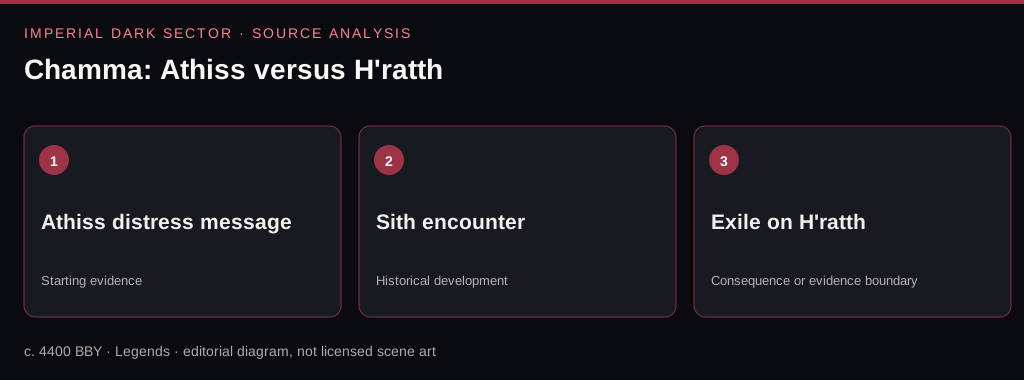
Documented history
The Companion's opening Chamma mission account places the distress signal and Sith encounter at Athiss in the Loro Babis system. Its later biography refers inconsistently to H'ratth, the location of Chamma's subsequent exile.
Limits of the evidence
The internally conflicting geographical reference must remain an explicit editorial note rather than being silently harmonized. The 4400 BBY dating is retrospective, not a scene timestamp.
Historical judgment: Which world was the actual distress-call mission on?
Athiss according to the Companion’s initial account; Chamma's later exile is on H'ratth.
Sources and further reading
- Tales of the Jedi Companion (1996), Chamma biography. Athiss mission versus H’ratth exile: verify original account when revising any conflicting later date or place.
- Tales of the Jedi Companion.
- Post-Manderon period, Wookieepedia