
Original IDS symbolic illustration, not source artwork. Original-story source trail →
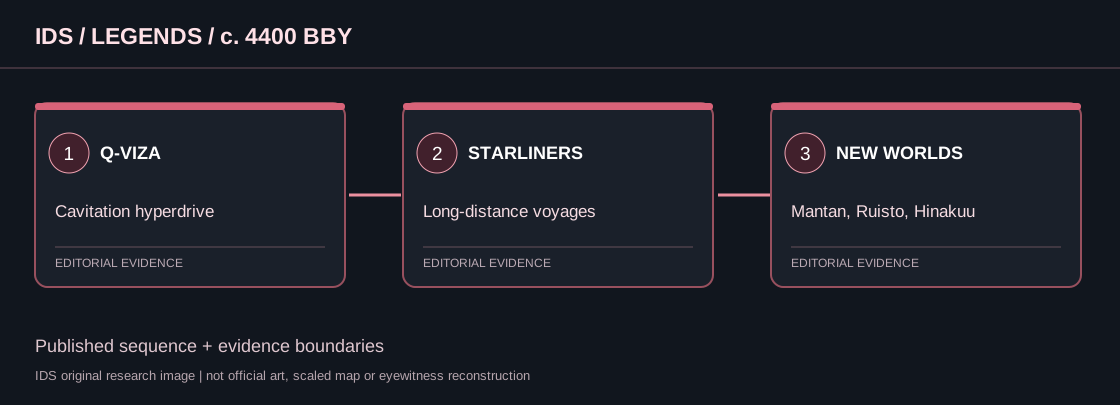
Around 4400 BBY, the Mon Calamari of Dac began launching starliners to colonize nearby planets. Their mathematician Q-Viza had developed a cavitation hyperdrive that was slower than standard Corellian technology but sufficient for independent expansion. Over the next two centuries, Mon Calamari settlements appeared on worlds including Mantan, Ruisto, and Hinakuu, while Quarren communities established colonies of their own.
An independently developed hyperdrive tradition
The cavitation drive emerged from local Mon Calamari mathematics and engineering.
Its slower speed constrained expansion but did not prevent Dac from building a regional interstellar network.
Mon Calamari and Quarren expansion
Both peoples participated in offworld settlement, though not always through the same colonies or institutions.
Expansion therefore extended Dac's internal political relationship into surrounding systems.
The beginning of Mon Calamari Space
Colonies created a recognizable regional sphere around Dac.
Later Republic contact encountered a multiworld civilization rather than one isolated homeworld.
Anthropological assessment
Mon Calamari expansion demonstrates that major hyperspace technologies could be invented independently outside the Republic's Core-centered technological tradition.
The resulting colonies also show how planetary identities can become regional identities once migration extends a society across several worlds.
Exploration and first contact / Legends
A starfaring society develops beyond Republic institutions
Around 4400 BBY, Mon Calamari explorers began building a regional interstellar network from their homeworld Dac. That history did not begin with Republic contact. Their own science and mathematics had produced the cavitation hyperdrive, associated in Legends sources with the work of Q-Viza. The drive was slower than the systems common in the Republic Core, but it was effective enough for local voyages. The Mon Calamari and Quarren could develop their own routes, surveys, ships and settlement patterns without receiving a ready-made space program from outside.
The early colonies on Ruisto, Mantan and Hinakuu developed across approximately two centuries. Not every site has an exact founding year, and the entire period should not be compressed into a single launch. Quarren communities also organized their own offworld activity, including resource extraction and settlement. The two peoples shared Dac while retaining histories of conflict, cooperation and different ecological livelihoods. Their ventures into space extended those complex relationships into neighboring systems. By the time Republic scouts reached Mon Calamari vessels, they encountered a functioning multiworld civilization rather than one newly discovered planet waiting to learn spaceflight.
Technologies can have independent histories
A slower hyperdrive was not evidence of intellectual dependence or failure. The cavitation system met the needs of exploration within local constraints. Comparing it to Corellian engineering should not erase the choices and knowledge of its inventors.
Colonies construct a regional identity
Routes between Dac, Ruisto and neighboring systems made cultural and economic relationships possible beyond the homeworld. A region becomes recognizable not simply when someone draws a border but through regular traffic, habitation and shared institutions.
Did the Republic introduce interstellar flight to the Mon Calamari in 4166 BBY?
No. Their early cavitation-drive network and colonies preceded Republic contact by centuries. The two timelines must be kept separate.
Evidence base: The Essential Atlas (2009); Legends Calamari sector and Mon Calamari exploration history. Reference and date cross-check →. This is Legends history; speculative motives, ceremonies, names and nonexistent earlier settlements have not been added.
c. 4400 BBY · Legends · Text and context
Mon Calamari interstellar expansion begins
- Local science produces an independent route to space
Dac's Mon Calamari, working within a society that also included Quarren communities, experimented with orbital habitats, laboratories and independent propulsion before establishing nearby colonies. The mathematician Q-Viza is credited with the cavitation hyperdrive. Legends sources characterize it as much slower than common Corellian hyperdrive technology. Slower does not mean useless: it made regional exploration and settlement possible without assuming that the people of Dac had first joined Republic institutions.
- A two-century frontier forms around Dac
From around 4400 to 4200 BBY the Mon Calamari launched starliners toward worlds including Mantan, Ruisto and Hinakuu. These places gradually formed the early territory later recognized as Mon Calamari Space. Quarren colonists developed projects of their own, including work in asteroid mining and metal refining. The summary identifies a process lasting generations, not a single launch that instantly established fully developed cities on three worlds.
- Technology creates different kinds of dependency
The expansion depended on propulsion, food systems, settlers, specialized labor and relations among Mon Calamari and Quarren groups. Technology thus helped shape political arrangements beyond Dac as well as physical transportation. A colony could depend on its homeworld, neighboring settlements and local resource extraction in different ways. The source establishes the names and broad dates; it does not provide a complete civic charter for each settlement or prove that every participant supported expansion.
Had Republic scouts already brought Dac into the Republic before these starliners launched?
Not according to the relevant Legends chronology. The Mon Calamari developed their own routes first; Republic contact with their sector is placed later. The first colonies should be understood as independent expansion.
Source tradition: The Essential Atlas (2009); Strongholds of Resistance (2015). Compiled reference and cited bibliography →. Chronological caution: The first departures around 4400 BBY start a two-century expansion period. Individual colony founding years and Q-Viza's exact construction dates are not fully established. Exact page references and rights-cleared story imagery still need verification.
c. 4400 BBY · Legends · Evidence lab
Dac: independent propulsion enables expansion
What the record establishes
In Legends, Mon Calamari expansion from Dac began around 4400 BBY with starliners powered by a cavitation-drive approach attributed to the mathematician Q-Viza. The drive was slower than the hyperspace technology common in parts of the Core, but it allowed regional travel. Over generations, Mon Calamari and Quarren settlement projects helped connect worlds later associated with Mon Calamari Space, including Mantan, Ruisto and Hinakuu.
Anthropological assessment
A region can build its own travel infrastructure without waiting for sponsorship from the Galactic Republic. Vessel design alone did not establish colonies. The enterprise also depended on labor, supplies, local politics and cooperation or disagreement among Dac's communities. The pattern is one of sustained mobility and settlement, not instant domination of several star systems in one year.
Evidence limits
The approximate beginning of expansion does not supply simultaneous founding dates for all listed destinations. Exact itineraries, fleet sizes, passenger numbers and every colonial charter are not documented here. This page follows Legends rather than treating Canon as identical.
Check your historical judgment: Did a slower drive prevent Mon Calamari settlers from founding nearby colonies?
Correction: No. It shaped the reach and pace of expansion but did not make interstellar settlement impossible.
Source trail: The Essential Atlas; Strongholds of Resistance; Mon Calamari Legends reference bibliography. Bibliography and reference history ↗. Printed page verification remains open.
Sources and further reading
- Daniel Wallace and Jason Fry, The Essential Atlas, 2009.
- Strongholds of Resistance.
- Mon Calamari/Legends, Wookieepedia