
In 4070 BBY, Amanoa was born on Onderon into a wealthy noble family. She later married King Ommin and became Queen of Iziz. Her life would connect the final generation of Freedon Nadd's royal dynasty to the last phase of the Beast Wars and the Jedi intervention of 4000 BBY.
Born into the Iziz elite
Amanoa grew up inside the protected aristocratic society of the walled city.
Her social position placed her close to the Naddist monarchy before she became part of it.
A life shaped by inherited political tradition
Amanoa married Ommin and became entangled in Freedon Nadd's Sith legacy.
Her later choices cannot be separated from a dynasty that had governed Onderon for centuries.
Anthropological assessment
Amanoa's biography shows how political systems reproduce themselves through marriage, inheritance, and elite socialization.
Individuals enter institutions already carrying expectations and histories that strongly shape which choices appear possible.
Tales of the Jedi / source-grounded Legends history
A noble child enters a society already divided
Amanoa was born around 4070 BBY into an elite Onderonian family. Iziz was a wealthy walled city whose government inherited traditions from Freedon Nadd, while people expelled beyond its walls formed the ancestors of the Beast Riders. Nothing in the birth record establishes that Amanoa already understood or supported Sith teaching. Her later involvement with the dynasty developed through adult choices and marriage to King Ommin. The dated entry should therefore describe the political world into which she was born rather than inventing episodes from childhood.
Her marriage placed her inside a royal household whose authority drew on a long history of exclusion and dark-side influence. Some Legends accounts describe her learning about Ommin's relationship with the spirit of Nadd only after their marriage. Her later conduct should not be assumed to have been present in exactly the same form from infancy. In 4000 BBY her reign ended after Jedi intervention and the Beast Rider victory, making the birth an origin point for a biography that later intersects with a much longer social conflict.
Elite status shapes opportunities, not destiny
Growing up near the protected center of Iziz gave Amanoa access to resources and relationships that most exiled people lacked. Those advantages helped determine her possible political roles. They did not mechanically determine every future belief or moral choice.
Family relationships transmit forms of power
Marriage to the royal line connected Amanoa to inherited religious authority and government institutions. The state reproduced itself through kinship as well as armed enforcement. Studying those connections helps explain the durability of Naddist rule across generations.
Can historians confidently describe Amanoa as an active Naddist sorceress in childhood?
No. The birth and later dynastic career are documented at different points. Projecting her adult allegiance backward would go beyond the available evidence.
Original reference: Tales of the Jedi, Onderon royal chronology and Amanoa character references. The chronology identifies published Legends accounts, separates an original event from later consequences and notes uncertain evidence rather than filling gaps.
Ancient Republic · Legends · Historical field note
Interpreting Amanoa's early life
The later ruler of Onderon belongs to a dynastic history in which family authority and dark-side traditions intersect.
Research distinction: The documented event anchors this article. Its political and cultural implications are analytical observations, not invented scenes or claims about undocumented participants.
Open the historian's evidence question
What is directly established by the cited account, and what is an interpretation of its significance? Avoid treating an approximate date or a short reference entry as evidence for exact dialogue, motives or casualty totals.
4070 BBY · Legends · Source and social history
Amanoa's origins are not the same as her later reign
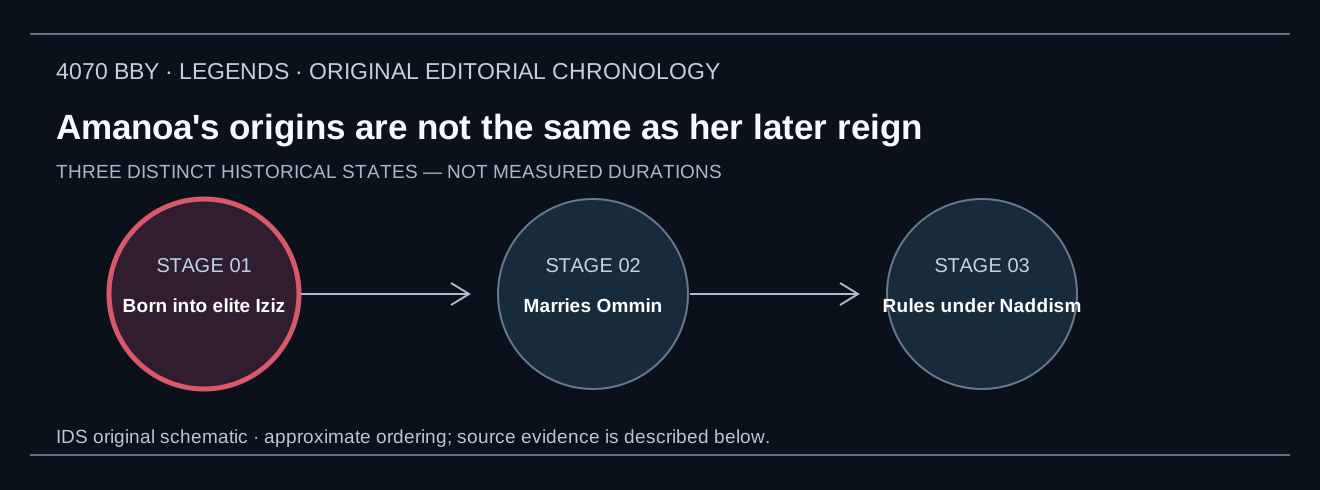
A retrospective date rather than a scene
Amanoa's birth in 4070 BBY is part of Legends biographical chronology. The original Tales of the Jedi comics and Marvel's retrospective instead focus on the Queen she later became and her role in the Beast Wars. The archive should make this source distinction visible: a precise date in a later reference chronology does not imply that an original issue contains a birth scene or detailed account of her parents and infancy. The name of a wealthy or noble family does not provide a reliable reconstruction of every element of childhood.
Elite membership precedes individual allegiance
Onderon's fortified city of Iziz had long used formal rule and exclusion to distinguish its residents from the Beast Riders beyond the walls. Amanoa later entered the ruling family through marriage to Ommin and presided over a regime tied to the Sith legacy of Freedon Nadd. Access to a court and later belief in a dead ruler's influence are analytically different stages. It is misleading to describe every noble child in Iziz as born a conscious adherent of the dark side.
The Queen is remembered through conflict
Amanoa's main narrative significance lies in her response to the Jedi mission, the alliance between Galia and Oron Kira, and the battle that brought her own rule to an end. Those events occur decades after her birth. Treating this article as a genealogical anchor keeps the timeline chronological without inventing an unreported childhood adventure. Further original-source evidence would be necessary to turn it into a detailed early-life biography.
Source judgment: Can an approximate childhood biography prove precisely when Amanoa became loyal to Freedon Nadd?
Explanation: No. The account of her early life does not give a complete record of religious choices. Her later political allegiance cannot be assigned to an invented moment in childhood.
Original publication context: Marvel's later Onderon court narrative. Public publisher summaries identify the story and creative edition, but precise birth years and off-panel histories often come from Legends reference chronology and require full print verification. Related timeline event →
4070 BBY · Legends · assessed sources
Amanoa's birth and the limits of the royal record
Evidence
Age-based Legends chronology places Amanoa's birth in 4070 BBY, but the comic primarily documents her adult role as Queen of Iziz. A later summary suggests 4068 BBY.
Anthropological interpretation
Amanoa was born into an unequal nobility. Her later rule and Naddist allegiance should not be attributed to a newborn child. This distinction separates biography from later political interpretation.
What remains uncertain
The historical record lacks a direct birth depiction, exact birthday and contemporary account of her early upbringing.
Historical judgment: Does her later allegiance prove her childhood beliefs?
Explanation: No. The sources describe the later queen rather than her thoughts at birth.
Source: Tales of the Jedi and Onderon chronology. Consult source record →.
c. 4070 BBY (alternate 4068 BBY) · Legends · Source and historical interpretation
Amanoa: a queen's reconstructed birth date and the Beast Wars chronology
What is directly established
The future Queen Amanoa of Onderon was born into a prominent local aristocratic family. A common timeline placement gives 4070 BBY, derived from her being described as seventy years old at the time of the events in the Tales of the Jedi comics around 4000 BBY. A later Star Wars Insider 26 reference instead assigns 4068 BBY, which creates a two-year disagreement. These are competing ways to date the same person's birth, not evidence that two different queens bore the same name. This article retains the conventional 4070 BBY placement while explicitly acknowledging that the available Legends sources disagree.
Later events in their proper order
As an adult, Amanoa married King Ommin and became queen of Iziz, with their daughter Galia standing in the succession. The royal house traced its legitimacy through the Naddist political order during Onderon's long conflict with the Beast Riders. Amanoa's later involvement with dark-side teaching associated with Freedon Nadd and her role in the closing stages of the war must remain separate from the circumstances of her birth. She was not born queen, and there is no reason to treat her adult religious convictions as established childhood beliefs.
Anthropological reading
The political significance of Amanoa's birth lies chiefly in her place within an elite social order that reproduced rank through family, marriage and inheritance. The personal beliefs and decisions of a ruler occur within institutions already in operation. Iziz's boundaries separated the royal city's inhabitants from wilderness communities in ways that reflected both coercion and ideas about legitimate society. Amanoa's life later became connected to the crisis of that system. A biography gains precision when it explains the social position inherited at birth without attributing future political agency to an infant or presenting one family's perspective as the history of Onderon as a whole.
Source disagreements and limitations
The alternate 4068 BBY birth date is reported in Star Wars Insider 26, while the 4070 BBY date follows the age stated in Tales of the Jedi. The article cannot resolve the discrepancy with an invented precise birthday. The details of Amanoa's adult reign are not direct evidence of her childhood experiences.
Evaluate the evidence: Does Amanoa's appearance as a seventy-year-old queen prove every reference agrees on her birth year?
Correction and explanation: No. The 4070 BBY inference is common, but a separate Insider reference gives 4068 BBY. The discrepancy should remain visible.
References: Tales of the Jedi: Ulic Qel-Droma and the Beast Wars of Onderon; Star Wars Insider 26; Amanoa notes. Source record and bibliography ↗. Original-edition pagination and image rights remain under review.
Sources and further reading
- Tales of the Jedi.
- Amanoa, Wookieepedia