
Around 4050 BBY, Drokko Kira openly challenged the dark-side legacy that had governed Iziz since Freedon Nadd's conquest. The ruling order branded him a criminal and banished him beyond the city's walls. He suffered a wound that never properly healed and fell silent for fifty years before reemerging among the Beast Riders during the final phase of the Beast Wars.
Political dissent becomes criminality
Kira's offense was challenging the legitimacy of Nadd's legacy.
The regime transformed ideological opposition into a basis for expulsion.
Fifty years of silence
Kira stopped speaking after his exile and injury.
His later return to speech coincided with renewed possibility of overthrowing the Naddist order.
Anthropological assessment
Drokko Kira shows how regimes police historical memory as well as behavior.
Challenging the official interpretation of a founding ruler can become a political act when legitimacy depends on inherited sacred history.
Tales of the Jedi / source-grounded Legends history
An exile whose dissent survived the regime
Drokko Kira was banished from Iziz after challenging the legacy of Freedon Nadd, whose descendants connected royal government to Sith authority. Around 4050 BBY, such opposition was not treated simply as a disagreement about historical interpretation. The regime could classify dissent as criminal conduct and force a critic outside the city walls. Drokko carried a grievous wound and ceased speaking for decades. His exile placed him among the Beast Rider communities, whose own history was rooted in people expelled from Iziz. The encounter between political dissent and a society of former outcasts would matter during the final generation of the Beast Wars.
When Galia and Oron Kira brought their alliance before the Jedi, Drokko returned to speech during a moment in which the old Naddist system could finally be challenged. His earlier silence should not be turned into an invented medical diagnosis or treated as proof that he had no political beliefs during those decades. It was part of how Legends narrated a life profoundly disrupted by punishment. The case helps connect a personal act of dissent to a changing political structure: his challenge did not overthrow the monarchy by itself, but it persisted as a form of memory in the communities the monarchy had excluded.
Punishment can create opposition networks
Sending political critics beyond a city's walls may remove them from official institutions but can also connect them with others harmed by the same system. The Beast Riders gave banished people a social world capable of coordinated action.
Controlling the past helps control the present
The legitimacy of the rulers of Iziz depended in part on how Freedon Nadd's rule was remembered. Disagreeing with the dynasty's sacred history thus threatened more than an old story. It challenged the authority of people governing the present.
Did Drokko disappear from Onderon's politics permanently after exile?
No. Legends places him with the Beast Riders and connects his renewed speech and participation to the crisis surrounding Galia, Oron Kira and the final confrontation with Amanoa.
Original reference: Tales of the Jedi: Ulic Qel-Droma and the Beast Wars of Onderon; Tales of the Jedi Companion. The chronology identifies published Legends accounts, separates an original event from later consequences and notes uncertain evidence rather than filling gaps.
Ancient Republic · Legends · Historical field note
Interpreting Drokko Kira's banishment
Exile is a political and social punishment that changes membership in a community without necessarily ending a family's influence.
Research distinction: The documented event anchors this article. Its political and cultural implications are analytical observations, not invented scenes or claims about undocumented participants.
Open the historian's evidence question
What is directly established by the cited account, and what is an interpretation of its significance? Avoid treating an approximate date or a short reference entry as evidence for exact dialogue, motives or casualty totals.
c. 4050 BBY · Legends · Historical source and institutions
Drokko Kira's exile exposes the boundaries of citizenship
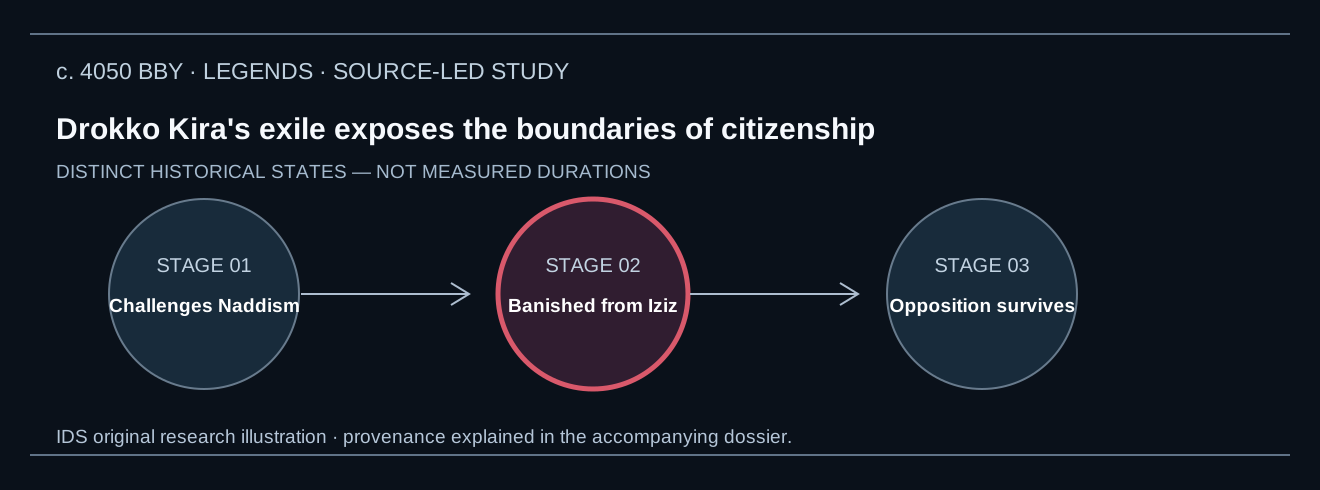
Dissent and criminality are not interchangeable
Legends reference chronology places Drokko Kira's challenge to the Naddist court around 4050 BBY. The narrative describes a critic of the ruling order who was cast outside the defended city of Iziz. The offense is political in its context: questioning the dark-side practices of a hereditary monarchy was treated as a threat to public order. A sentence of banishment does not independently verify that the person's beliefs were harmful or false. The early date derives from later reference history rather than an original comic panel showing an exact day in a royal court.
Life beyond the wall was not cultural disappearance
Iziz's fortifications marked a boundary between those entitled to live within the royal city and those who had been expelled or descended from exiles. Drokko's fate belongs to that larger system of segregation and survival. Being made a political outsider is not the same thing as ceasing to belong to Onderon. The communities living with beasts in the wilderness developed distinct means of transport, defense and leadership, which the later Beast Wars brought into conflict with city rule.
A longer history than a single dissenter
By the time Jedi such as Ulic Qel-Droma encountered the conflict, generations of inhabitants had grown up under divergent social rules. Marvel's 1993 retrospective confirms the city-versus-Beast-Rider division but does not itself date Drokko's banishment. The event is therefore best treated as an early Legends example of how Naddist legitimacy could be enforced through expulsion, with the details and precise year subject to verification in the Tales of the Jedi reference tradition.
Source judgment: Did banishing Drokko erase his political ideas or prove his neighbors agreed with the court?
Explanation: No. Exile is a tool used by a government against a dissenter; it does not demonstrate that the wider population consented to the sentence or that his views disappeared.
Publication provenance: Marvel's original Onderon comic overview. The publicly available summaries are evidence of the source corpus and selected scenes; dates from later companion or reference chronology must be independently checked against print. Continue related event →
c. 4050 BBY · Legends · assessed sources
Drokko's exile: original comic versus Insider
Evidence
The original Tales of the Jedi places Drokko's exile about fifty years before the 4000 BBY Beast Wars conclusion, supporting c. 4050 BBY. Star Wars Insider 26 instead gives 4048 BBY.
Anthropological interpretation
Iziz's rulers labeled opposition to Naddist authority criminal and expelled dissenters. Drokko's story reveals how exile created communities beyond the city walls.
What remains uncertain
The exile is recalled later; no complete contemporary arrest record or detailed account of fifty years in exile survives.
Historical judgment: Why does IDS use circa 4050 BBY?
Explanation: It follows the original comic's fifty-year interval, while acknowledging Insider's competing 4048 BBY.
Source: Tales of the Jedi #2; Star Wars Insider 26. Consult source record →.
c. 4050 BBY · Legends · Source-critical reading
Banishment as a legal and political act
Drokko Kira's banishment belongs to an older generation of the Iziz–wilderness dispute, not to the 4000 BBY battle itself. A monarchy can describe resistance as crime while the people removed from a city remember it as the result of political disagreement. The existence of a Beast Rider lineage is evidence of a community persisting beyond the reach of the royal government, not proof that every exile held the same belief or joined a formal military command immediately.
The dating and the characterization of Drokko's exile come from the Legends reference tradition around Tales of the Jedi. Marvel's later summary directly verifies that the 1993 opening comic turns on Galia's desire to marry Oron Kira and the revelation that Amanoa's account of the Beast Riders was incomplete. It does not provide a fully documented judicial transcript for Drokko or a clear census of his followers decades earlier. Source-critical analysis must separate the older reference date from this later dramatic evidence.
The exile also helps explain why the proposed kinship tie between Galia and Oron was politically consequential. People who had been legally excluded were not reintroduced solely as defeated adversaries. A relationship connected the city household to a Beast Rider lineage and challenged the assumption that citizenship and legitimate ancestry existed only inside Iziz. That is a social interpretation, not a claim that one marriage resolved every grievance.
Historical judgment: Does Drokko's banishment establish that every Beast Rider shared a single party platform?
Explanation: No. A historical exile and the later existence of a lineage cannot document the beliefs of every descendant or settlement.
Compare all nine connected Onderon dossiers →
Source comparison: Marvel's 2017 history of the 1993 Tales of the Jedi; Tales of the Jedi Companion for earlier Legends chronology. The publisher retrospective is not a substitute for precise print-page verification of reference-only dates.
Sources and further reading
- Tales of the Jedi.
- Drokko Kira, Wookieepedia