
In 4018 BBY, Ommin's father died and Ommin succeeded him as King of Onderon. Like generations before him, Ommin had been trained in Sith teachings linked to the spirit of Freedon Nadd. His accession continued a hereditary dark-side monarchy that had ruled Iziz for centuries.
A throne and a religious tradition
Ommin inherited political authority and an existing Sith-linked royal ideology.
Succession therefore transmitted both office and doctrine.
Freedon Nadd remains politically active after death
The spirit of Nadd continued influencing descendants long after his physical death.
Ancestral authority became a living political force within the monarchy.
Anthropological assessment
Ommin's accession shows how dynastic states transmit ideology through family education as well as formal institutions.
Freedon Nadd's ghostly authority also gives ancestral legitimacy a literal supernatural dimension inside Onderonian politics.
Early Republic / source-led investigation
A Sith-linked dynasty changes hands
King Ommin inherited Onderon's throne in 4018 BBY, continuing a dynasty shaped by the religious and political legacy of Freedon Nadd. The succession did not create the Naddist order from nothing. Earlier rulers had made the worship of the dead Sith Lord part of the royal family's authority and protected status inside the walled city of Iziz. Ommin therefore became king within an established system of obligations and inherited beliefs. The source gives a year for his accession, but not enough detail to reconstruct an individual coronation ceremony or a complete list of officials who attended.
Ommin's later physical dependence on a mechanical support frame and his deep involvement with Nadd's teachings belong to subsequent phases of his reign. Queen Amanoa eventually played a visible role in defending the regime against the Beast Riders and the Jedi, while Ommin remained able to influence Onderon's dark-side politics. The 3998 BBY Freedon Nadd Uprising would reveal the continuing danger of royal structures that had survived Amanoa's death. This entry marks succession and should not be confused with the final destruction of Ommin's rule years later.
What inherited legitimacy meant
Royal office came with the authority of a family line as well as the expectations of Naddist belief. These mechanisms reinforced one another: kingship helped protect the religious tradition, while a claim to the Sith Lord's legacy supported dynastic control.
The limits of the historical record
A chronology can establish a succession without pretending to know every ceremony, private conversation or precise motivation. Ommin's later actions help explain how the monarchy operated, but they are not direct eyewitness evidence of what happened on the day he became king.
Did Freedon Nadd personally return to take the throne in 4018 BBY?
No. The political authority passed to Ommin, a descendant shaped by a tradition that continued to invoke Nadd's spirit and teachings.
Source and continuity: The Dark Side Sourcebook; Tales of the Jedi: Ulic Qel-Droma and the Beast Wars of Onderon; The Freedon Nadd Uprising. This is a Legends-era interpretation, not current Canon. Details not shown or documented in the sources are not reconstructed as fact.
4018 BBY · Legends · Source and social history
Ommin inherits a throne already bound to Freedon Nadd
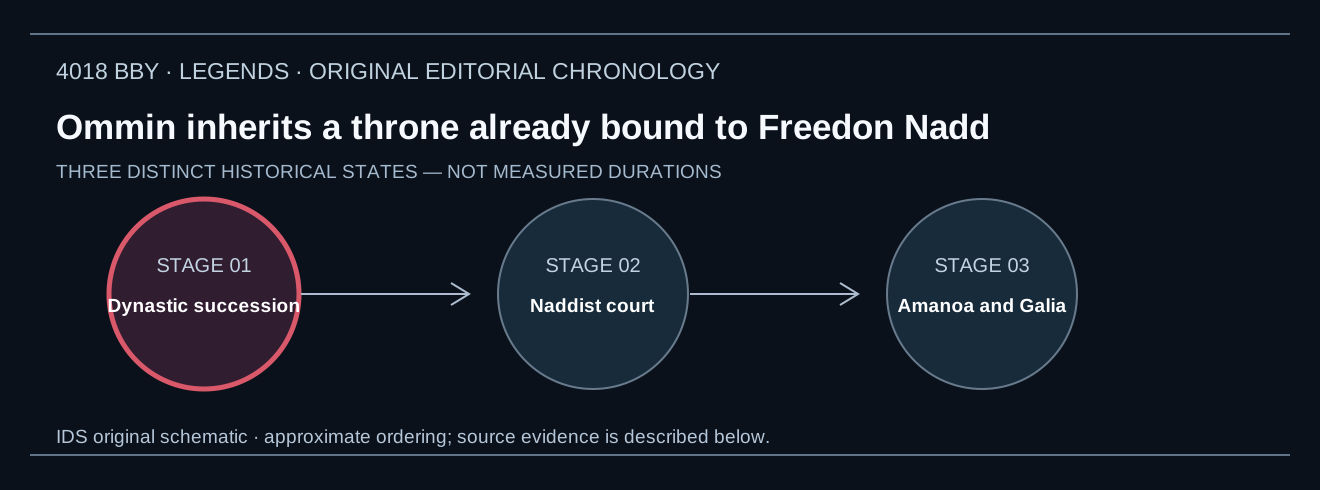
The royal office survives a change of ruler
Ommin's accession is placed at 4018 BBY in Legends reference chronology, following his father's death. The right to the throne came through an inherited royal institution rather than a new founding election. The court at Iziz was already deeply associated with Freedon Nadd's dark-side teachings. Naming Ommin as king at this point should not imply that he personally created the Beast Wars or introduced Naddism for the first time. Both the city's exclusionary politics and the legacy of Nadd predated his rule.
What a source can and cannot date
The published Freedon Nadd Uprising comics dramatize the later exposure of the Onderonian royal family's Sith allegiances, while the earlier accession year comes from background reference material. Marvel's catalog record identifies the comic and its creative team but does not independently establish the exact regnal date. Keeping those source categories distinct protects an otherwise thin biographical entry from looking like an invented scene at a coronation that was never shown on-page.
Dynasty, belief and kinship networks
Ommin and Queen Amanoa became the parents of Galia, whose later actions helped unsettle the assumptions of the court. Dynastic membership did not require each family member to hold identical beliefs. A household can provide a route to authority while also producing alliances across political boundaries. This perspective is especially useful in the Onderon story, where royal power claimed continuity through a dead Sith ruler's cult but was eventually challenged from within the ruling family.
Source judgment: Does a new king necessarily create a new political-religious ideology?
Explanation: No. The Legends backstory describes Ommin inheriting an existing hereditary order shaped by Freedon Nadd's influence. His accession continued, rather than originated, that tradition.
Original publication context: Marvel publisher record for the later Naddist uprising. Public publisher summaries identify the story and creative edition, but precise birth years and off-panel histories often come from Legends reference chronology and require full print verification. Related timeline event →
4018 BBY · Legends · assessed sources
Ommin's accession: authority and Naddist ritual
Evidence
Ommin inherited the crown of Onderon when his father died in 4018 BBY. Later sources describe how Sith tradition and the spirit of Freedon Nadd influenced his court.
Anthropological interpretation
Royal succession, inherited religious legitimacy and political coercion are connected but not identical. His later conduct and deterioration should not be presented as if they occurred during one coronation.
What remains uncertain
An exact coronation day and full ceremonial record are not independently described.
Historical judgment: Does the accession year establish every ceremonial detail?
Explanation: No. It records the inherited office, not a complete coronation narrative.
Source: The Dark Side Sourcebook; Tales of the Jedi. Consult source record →.
Sources and further reading
- The Dark Side Sourcebook.
- Ommin/Legends, Wookieepedia