
- Founder
- Krynda Draay
- Purpose
- Prevent Sith resurgence
- Method
- Prophecy + WatchCircles
- Status
- Secret Jedi network
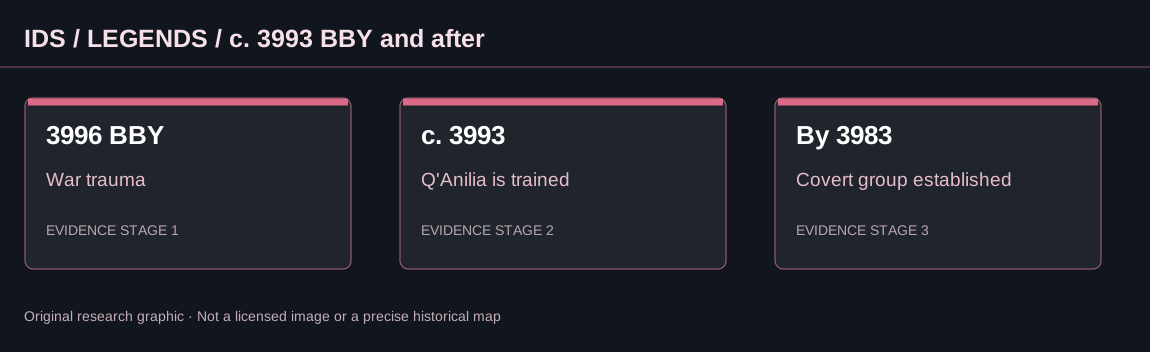
Around 3993 BBY, Krynda Draay resumed training young seers after meeting the Miraluka Q'Anilia. This was an early stage in the formation of the secret Jedi Covenant. More detailed histories describe an established covert organization by 3983 BBY, rather than a single documented founding ceremony in 3993.
3993 BBY · Legends · Postwar evidence
Krynda Draay begins the Jedi Covenant
Source-supported history
Krynda Draay, widowed by the Great Sith War and shaken that Jedi seers had not predicted the rise of Exar Kun, withdrew from wider Jedi life. Around 3993 BBY she began training the Miraluka child Q'Anilia and organizing the secret Jedi Covenant. Its members dedicated themselves to identifying the next Sith threat before it could mature into another war.
Institutions, identity and consequences
The Covenant turned a loss of institutional confidence into covert surveillance. Members of the ordinary Jedi hierarchy did not necessarily know its existence. Divination could become an administrative rationale for surveillance and intervention long before an individual committed a crime. The Covenant's later practices, and particularly their treatment of Padawans during the Mandalorian Wars, must be read as consequences of this preventive logic rather than as inevitable acts on its founding day.
Was the Jedi Covenant a public governing body approved by the entire Jedi Order?
No. It was a secret organization within the broader Jedi world, formed to find and preempt future Sith threats.
Source basis: Knights of the Old Republic comic series and Knights of the Old Republic Campaign Guide. Review the publication reference and source trail →. The hero image is original IDS symbolic artwork, not a frame or cover from that source. Specific panels or page references should be checked against the original edition.
Trauma becomes institution
Krynda lost her husband Barrison and many companions during the Sith War.
The Covenant transformed fear of recurrence into a permanent organizational mission.
Foresight becomes governance
The Covenant used prophetic visions to guide security decisions and even financial activity.
Uncertain future knowledge became a basis for real power in the present.
The Covenant institutionalizes fear of recurrence
Krynda Draay's generation had watched Jedi fall, Ossus burn, and the Sith return through figures who had once been trusted members of the Order. The Covenant converted that trauma into a permanent preventive mission.
Its members believed ordinary Jedi procedures were too slow to detect the next Sith threat. That conviction justified secrecy, independent surveillance, and reliance on seers whose visions were treated as evidence before events occurred.

Explore this entry
Was the Covenant part of the official Jedi hierarchy?
Its members were Jedi, but the Covenant operated as a secret organization with its own WatchCircles, finances, intelligence, and hidden priorities.
Why did it become dangerous?
The more seriously it treated prophecy as actionable evidence, the easier it became to justify coercion against people who had not yet done anything.
Anthropological assessment
The Covenant shows how collective trauma can create preventive institutions whose extraordinary powers seem justified by fear of repetition.
It also foreshadows the danger of treating uncertain predictions as sufficient evidence for coercive action.
After the Great Sith War / source-critical history
When fear of the Sith becomes a secret institution
Krynda Draay's response to the Great Sith War was shaped by personal and institutional losses. She believed that ordinary Jedi procedures had failed to recognize the danger of trusted members turning toward Sith power. The Miraluka Q'Anilia's prophetic abilities offered the prospect of detecting a future return before it occurred. The Jedi Covenant grew from this combination of trauma and prevention, organized through hidden WatchCircles rather than transparent Council proceedings.
Its later history reveals the risk of using visions as grounds for coercive decisions against people who had not committed crimes. The Covenant also accumulated resources and developed relationships to finance and political influence. Those features show that it became an institution capable of acting independently, not just a group of concerned teachers. The founding entry must distinguish Krynda's protective intention from the much later Padawan Massacre, which exposed where unaccountable preventive logic could lead.
Did the Covenant start as an official Jedi Council with public membership and oversight?
No. Its members were Jedi, but the Covenant was a secret network that developed separate priorities and forms of power.
Primary and reference record: Knights of the Old Republic comics; Knights of the Old Republic Campaign Guide. This is Legends history. Claims about private thoughts, precise unnamed casualties and unsupported sequences are not invented.
c. 3993 BBY and after · Legends source-critical expansion
The Covenant's founding was a process, not one documented signing
What the original chronology can establish
Krynda Draay survived the Great Sith War but lost her husband Barrison and her confidence in Jedi foresight after the rise of Exar Kun went undetected. Around 3993 BBY, Haazen introduced her to the young Miraluka Q'Anilia, whose promise encouraged Krynda to resume teaching. A secret network of seers began to form around the Draay Estate. Later accounts explain that Krynda had developed the Jedi Covenant as an organization by 3983 BBY. These dates refer to different stages: first recruitment and early organization on the one hand, and an established, coordinated covert faction on the other.
Institutional, cultural and material consequences
The Covenant's central belief was that another Sith catastrophe could be prevented through preemptive discovery of threatening futures. Its members were Jedi, but their surveillance structures and private networks were not equivalent to an ordinary public Jedi Council department. Wealth and the influence of the Draay household helped support the group, while skilled seers provided its distinctive form of expertise. The problem was not that Force visions were irrelevant within Jedi spirituality. It was the conversion of uncertain interpretations into decisions that bypassed normal accountability. The later WatchCircle killings on Taris illustrate the possible institutional cost of treating predicted harm as proof of an identifiable offender.
Uncertainty and continuity check
Some chronologies label 3993 BBY as the Covenant's foundation; more detailed biographies describe Q'Anilia's arrival then and say the functioning society was established by 3983 BBY. This page now identifies the ambiguity and must not pretend a signed charter survives from 3993.
Test your historical judgment: Did Krynda receive the Prophecy of the Five and immediately establish the Covenant in 3993 BBY?
Correction and educational insight: No. The Prophecy of the Five is dated 3988 BBY. The 3993 record marks early recruitment, and formal organization developed over subsequent years.
Sources: Knights of the Old Republic 24; Krynda Draay and Jedi Covenant chronologies; Knights of the Old Republic Handbook. Consult bibliography and event reference ↗. Original-edition page references require continued verification.
Sources and further reading
- Knights of the Old Republic comics.
- Knights of the Old Republic Campaign Guide.