
Continuity note: This story is Legends, not Canon. Its Fel Empire, Krayt's One Sith and the Skywalker descendants belong to the published Dark Horse Legacy timeline, distinct from events after the Battle of Exegol.
A world pays for resistance
Krayt's regime targeted Dac after Mon Calamari assistance to the Galactic Alliance Remnant. Imperial leaders presented entire populations as enemies because political actors among them had challenged Sith control.
Murder becomes policy
Sith forces conducted systematic killings and deployed terror against aquatic populations and settlements. The operation went beyond defeating armed opponents: it sought to destroy a people as a category, using collective classification to legitimize mass violence.

Evacuation and external rescue
Admiral Gar Stazi's forces and other anti-Sith allies helped evacuate some inhabitants. The work depended on transport routes, rescue fleets and individuals willing to take people to safety. Even successful evacuations could not eliminate the scale of devastation and loss.
A galaxy sees the regime's priorities
Krayt's government demonstrated that its claims of stability were compatible with killing populations it regarded as obstacles. The atrocities contributed to resistance and complicated the calculations of Imperial factions trying to distinguish their rule from Sith terror.
Anthropological assessment
The campaign illustrates the danger of defining political dissent through collective ancestry or species identity. Resistance by some individuals cannot justify punishment of an entire population. Recording evacuation alongside atrocities keeps the agency of threatened communities visible.
Interactive evidence lab
Did the anti-Sith forces safely evacuate every inhabitant of Dac?
No. Rescue saved some, but the campaign caused enormous destruction and loss of life.
Explore the published event from different perspectives.
Ethics and institutions scenario
Choose a research approach to see its implications.
Select one option above.
These are interpretations, not rewritten outcomes for the Star Wars story.Published issue evidence: how the story develops
01 · Earlier evidence
Star Wars: Legacy (2006) #22 →
Issue #22 describes a collective punishment by Darth Krayt that targets an entire people and makes suffering a message to other systems. Its marketing summary does not enumerate every victim, but it documents an explicitly population-targeted policy beyond battlefield retaliation.
02 · Compare the outcome
Star Wars Legends Epic Collection: Legacy Vol. 2 →
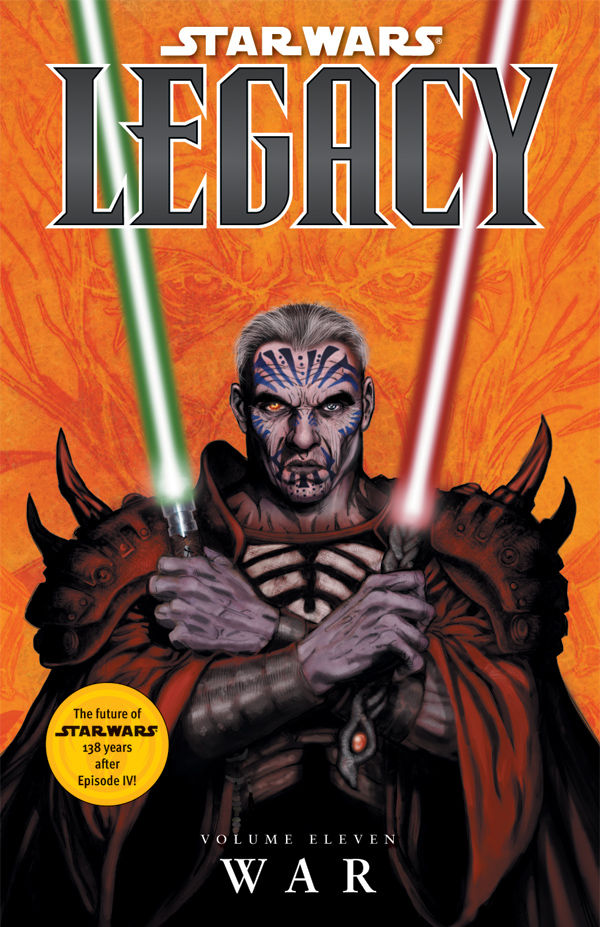
The official Marvel collection of Legacy #20–36 explicitly states that the Mon Calamari face extinction. It supplies direct publication context for the Dac campaign and the related Alliance resistance. The site's generic Krayt-cover artwork should not be mistaken for a scene of the Mon Calamari evacuation or mass killing.
Source judgment: Is an entire community's punishment for acts attributed to some of its members equivalent to a battle between fleets?
Historical correction: No. The publisher's framing singles out an entire people as a target of coercion. The distinction is central to evaluating mass violence and responsibility.
Publisher issue synopses identify books and story contexts. They do not substitute for page-level review of the original published comics. From persecution to coalition warfare →
Legends · Original comic research · 127–139 ABY
Collective punishment is not an ordinary fleet engagement
The Sith Empire's assault on the Mon Calamari of Dac targeted communities as well as military opponents. Marvel's second Legacy collection explicitly describes the Mon Calamari as facing extinction in the relevant comic stories. That summary establishes the scale of the threat described by the publisher, but it does not supply a reliable death toll or a complete record of attempted evacuations. A historian should not substitute an invented casualty estimate for missing evidence.
An individual's homeworld does not establish that person's combat status. The populations of Dac included people who did not personally command resistance forces, while the regime's violence reached beyond those it identified as armed opponents. The series' depiction of rescue and survival also means the campaign cannot be described as having killed every member of the population. It is essential to distinguish what the Sith ordered, what characters attempted and what the story actually shows as completed.
The anthropological concern is the use of collective identity to justify violence and the subsequent work of preserving community life. The crisis around Krayt's authority belongs to the same regime; the Coruscant campaign describes the coalition that later ended its open control.
Publisher record: Marvel Comics issue or collection. Original panels are required for precise scene dialogue and claims not supported by the catalog. The fictional year is not the publication year. Analysis of institutions and cultural practice is IDS interpretation.
Primary comics and research background
Star Wars: Legacy (2006) #22–27 and later Dac story arcs; Mon Calamari Genocide, 137 ABY. See Marvel’s original-issue collection →.