
Darth Krayt begins life as A’Sharad Hett, a Human raised among Tuskens on Tatooine who becomes a Jedi and later builds a new Sith order. His story connects the Clone Wars to the distant conflict of Star Wars: Legacy. By the time he occupies the Coruscant throne, his authority rests on decades of training, concealment, conquest, and dependence on followers who can also threaten him. [1]
Explore the biography
Six stages of a changing life
Select a stage, then open its consequence. Dates use BBY and ABY, before and after the Battle of Yavin.
A’Sharad Hett
A Human raised in Tusken society becomes a Jedi. His inherited identity and his father’s example accompany him into an institution with different expectations of duty.
Read the supporting sourceWhat changed?
His early life establishes that species, culture, and institutional membership are separate parts of his identity.
Biography: from Hett to Krayt
Tatooine: a Human child in Tusken society
A’Sharad is the son of Sharad Hett and K’Sheek, Humans who live among Tuskens. His upbringing makes Tusken belonging a central part of his early life. Calling him a Tusken Jedi describes cultural formation as well as institutional membership. It does not establish that he belongs biologically to the Tusken species. This distinction matters when reading the changes in his appearance and affiliations over time. [2]
His father is an exiled Jedi whose weapon and reputation preserve a connection to the wider Jedi tradition. Sharad’s death at Aurra Sing’s hands leaves A’Sharad with an inherited lightsaber and an interrupted family relationship. The son’s later movement into formal Jedi training continues that connection while changing the community in which it operates. [3]
Jedi training and the Clone Wars
A’Sharad’s training brings him under Ki-Adi-Mundi and later An’ya Kuro, the Jedi known as the Dark Woman. Kuro’s demanding instruction concerns the control of anger and the recognition of darkness within oneself. His later fall should not erase this earlier participation in Jedi teaching or imply that every part of his early life already expresses Sith doctrine. [4]
In Republic #59, Hett and Anakin Skywalker are stranded together after a battle on Aargonar. Anakin’s hatred of Tuskens and the secret of his massacre make their shared danger morally charged. Hett’s cultural identity confronts another Jedi with people he has reduced to targets of vengeance. The story places Hett within the Republic-era relationships that his later identity as Krayt can obscure. [6]
IDS interpretation: This history gives Krayt’s eventual hostility toward the Jedi a personal dimension. He once belonged to the tradition he later persecutes. He can speak its language, recognize its commitments, and use its history when attempting to manipulate people such as Cade. Familiarity with an ethical system does not guarantee continued adherence to it.
Order 66 and the duel with Obi-Wan
After surviving Order 66, Hett returns to Tatooine and leads Tuskens against settlers. In 17 BBY, Obi-Wan Kenobi confronts him near the Lars homestead. Hett’s campaign of revenge threatens the community Kenobi protects. Kenobi defeats him, cuts off his right arm, and removes his mask. The defeat destroys Hett’s standing with his followers and contributes to his exile from the planet. [5]
This is a crucial change in the biography, but it should not be mistaken for an excuse for everything that follows. Hett loses a claim to leadership at the same time that he has lost the Jedi institution. Those losses help explain his circumstances. His later choices still include deliberate instruction in the dark side, the creation of a coercive order, and campaigns against populations far removed from the original conflict.
XoXaan, captivity, and the Sith identity
After leaving Tatooine, Hett eventually reaches Korriban and encounters XoXaan’s holocron. Her ancient Sith teachings give him a new path to power. When he emerges from his period of instruction, the opportunity to take his original revenge against Vader and Sidious has passed. He travels into the Unknown Regions and is captured by the Yuuzhan Vong. [7]
Captivity brings biological alteration and contact with Vergere. Her involvement is part of Krayt’s account of his development, but claims about her Sith identity deserve careful attribution. Reference accounts note that Lumiya and Krayt’s faction are interested narrators of that claim. Her role in his story can be discussed without presenting every assertion made by Sith characters as independently verified truth. [8]
Krayt escapes and establishes the One Sith on Korriban by 27 ABY. His order develops in concealment for roughly a century before its public emergence. The name Krayt recalls the krayt dragons of his homeworld. A new Sith name therefore accompanies a project that still draws from the place where his life began. [9]
A hidden Sith encounters Luke Skywalker
His long life includes an encounter well before the events of Legacy. In 44 ABY, the Sith identified as the Dark Man joins Luke Skywalker against Abeloth at the Lake of Apparitions, beyond shadows. Their cooperation addresses a shared danger. It does not make Krayt a Jedi again or establish a lasting alliance between their institutions. [19]
IDS interpretation: This episode complicates a simple division of every encounter into permanent allies and enemies. People can coordinate against a danger while retaining opposing ambitions. A relationship map must therefore identify the event and period of cooperation. An undated line labeled “ally” would misrepresent the larger history.
Conquest: the One Sith enters government
Sith interference with the Jedi and Yuuzhan Vong reconstruction effort on Ossus helps undermine confidence in the Galactic Alliance. During the war of 127–130 ABY, Imperial leaders accept Sith support. Krayt uses the victorious alliance to take the Coruscant throne from Roan Fel, who escapes. His rule depends on fleets, officials, and the infrastructure of a state much larger than his order. [10]
The massacre of Jedi at Ossus becomes central to the fractured galaxy of Legacy. Kol Skywalker dies there, and Cade survives. The attack targets the continuity of Jedi teaching as well as a military opponent. Krayt’s victory over the Alliance thus develops into an attempt to suppress a rival Force tradition. [11]
His reign also brings genocidal violence against the Mon Calamari of Dac. The regime treats support for the Alliance’s surviving forces as grounds for punishment of a people. This policy establishes the severity of Krayt’s government more clearly than the language of peace or unity he uses to justify domination. [12]
The ruler who needs Cade
Krayt’s deteriorating condition gives Cade’s exceptional healing ability strategic importance. The emperor seeks to control that ability while drawing a Skywalker into his order. Legacy #15 explicitly frames the captured Cade as an opportunity to restore Krayt’s power. Their confrontation combines bodily need, coercive instruction, and the symbolic value of securing a famous lineage. [13]
At Had Abbadon, a confrontation involving Cade, Imperial Knights, Celeste Morne, and Karness Muur leaves Krayt badly wounded. Wyyrlok finds him alive and kills him rather than helping him recover. The trusted adviser argues that the founder’s vision can continue without the founder. Krayt’s body is then used to preserve the appearance of a ruler resting in stasis. [14][15]
Rebirth and the final death
Krayt returns through the understanding of dark transfer gained from his experience of death. He restores his body and comes back to challenge Wyyrlok. His return to the Coruscant temple ends in the adviser’s death and the restoration of the founder’s command. [16][17]
He also deploys a secret force of Sith troopers, trained and altered to serve him with exceptional obedience. These combatants belong to a separate project from ordinary Imperial stormtroopers. Their appearance expands his final offensive and makes his renewed command visibly more extreme. [18]
In 138 ABY, Cade kills Krayt during the Battle of Coruscant. A previous death has already failed to end the threat, so Cade sends the body into the sun to prevent another return. The emperor’s fall breaks his open regime. Surviving members of the One Sith withdraw under Nihl rather than disappearing at the instant their leader dies. [20][21]
Relationships and belonging
Krayt’s relationships change with his position. Sharad Hett is a father and early teacher. Ki-Adi-Mundi and An’ya Kuro belong to his Jedi education. Obi-Wan becomes the opponent who ends his Tusken campaign. XoXaan supplies Sith instruction, while Vergere enters the account through captivity. These ties carry different forms of obligation and should not be reduced to an undifferentiated list of associates.
Within the One Sith, Wyyrlok III occupies the most politically consequential position. His service as adviser and custodian of authority allows him to maintain the order during Krayt’s absences. It also places him close enough to kill the founder and control the explanation of what has happened. The relationship moves from dependence to betrayal, then ends with Krayt’s vengeance. [15]
Talon and Nihl serve as prominent Hands. Stryfe performs military leadership, and Maladi directs intelligence and assassination while conducting biological research. Ruyn’s place is different: he trains Talon, then dies at Krayt’s command as her final test. The episode demonstrates the emperor’s authority over a teacher–student bond. [22][23]
Cade is an opponent whom Krayt also seeks to recruit and exploit. Roan Fel is an imperial rival who survives the seizure of his throne. These relationships illustrate why a person can matter in several ways at once. Krayt can need someone’s ability, threaten their life, and want their allegiance within the same encounter. The guide below keeps the court’s changing phases visible.
People and power
Who stands with Krayt?
Choose a phase to see how service, betrayal, and succession change the inner circle. This guide describes relationships rather than inventing an official rank ladder.
Service beneath the emperor
Interprets Krayt’s will and governs during his periods of stasis. Proximity gives him access to the ruler and the machinery of authority.
A direct agent of Krayt whose loyalty is demonstrated through service, violence, and obedience.
Another of Krayt’s principal agents. The office binds its holder to the Dark Lord rather than to an equal partnership.
Commands military force. His office turns Sith authority into organized coercion.
Oversees intelligence and scientific projects. Her specialist work supports control through information and experimentation.
The named functions belong to different kinds of authority. Proximity to Krayt does not make every role interchangeable.
Identity and social position
Krayt’s biography distinguishes biological identity from cultural and political identity. He is Human, formed in Tusken society, trained as a Jedi, and later recognized as a Sith leader. The category “Tusken Jedi” brings together two important relationships without making them the same thing. His movement between communities changes what others recognize in him and which obligations he accepts.
The name A’Sharad Hett places him inside a family history. Darth Krayt asserts a position within a Sith tradition. Emperor identifies a claim to political sovereignty. These names and titles do different work. A new title can demand obedience from subjects who have no personal connection to the man’s earlier life. It can also conceal parts of the biography that would complicate his preferred public identity.
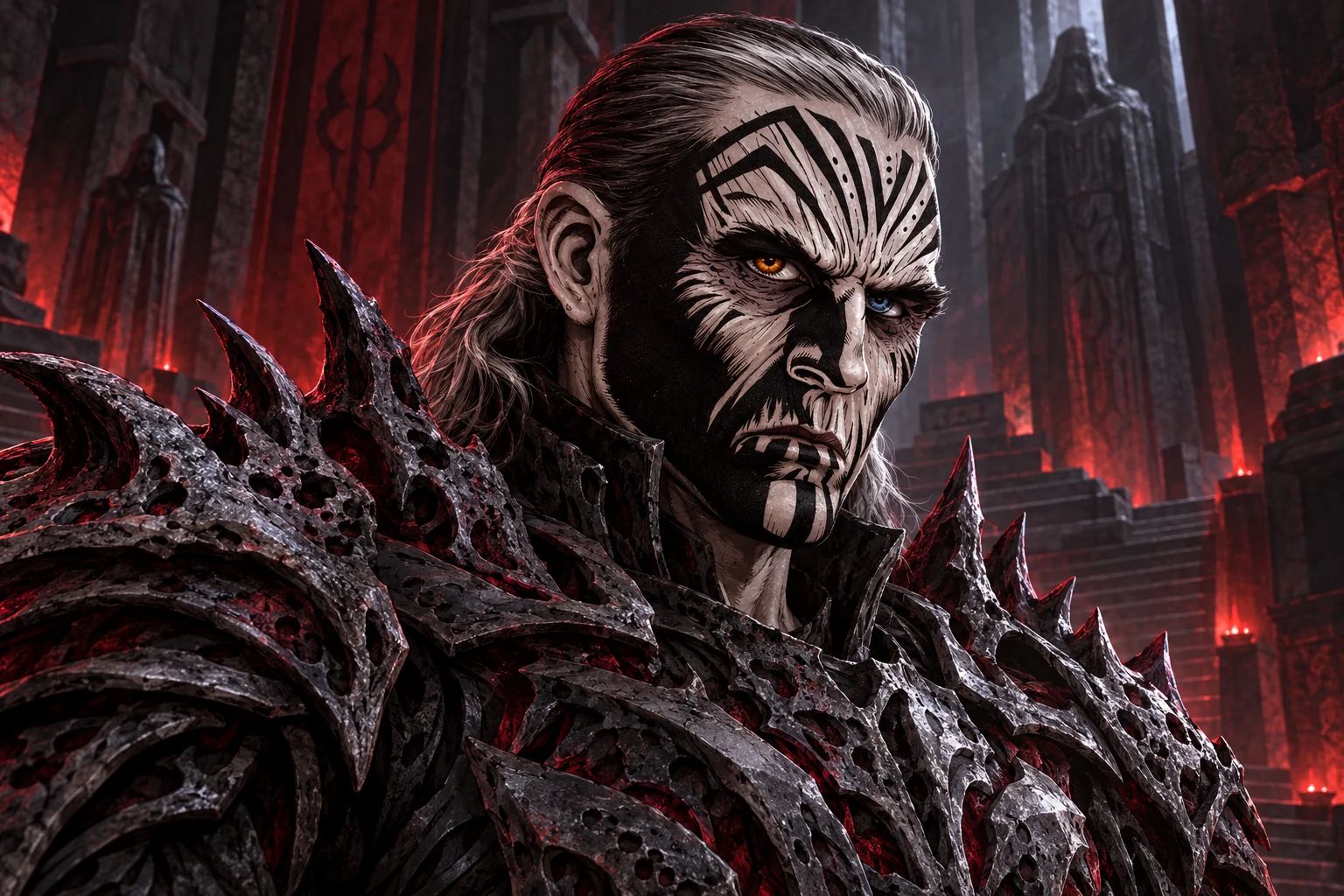
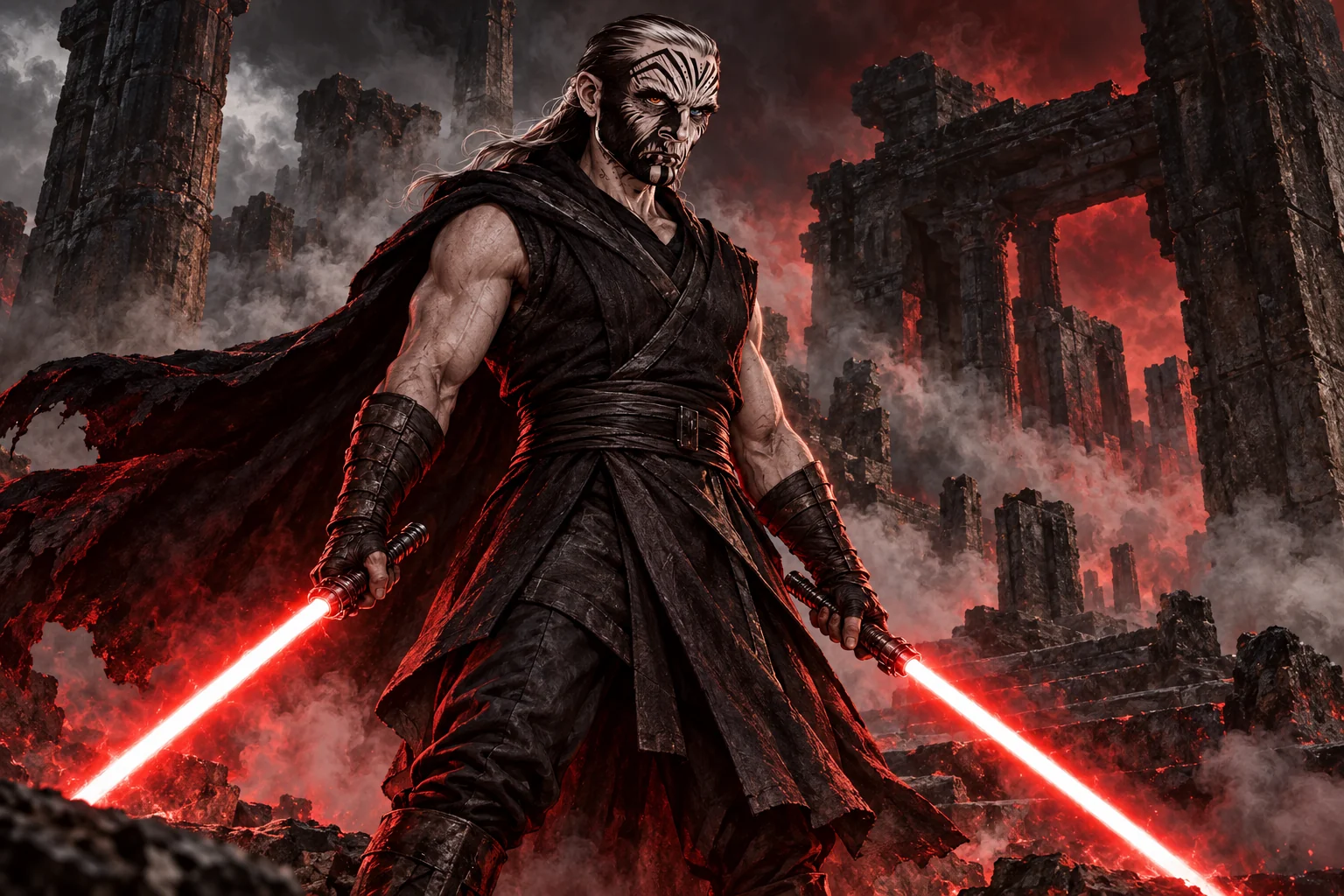
IDS interpretation: His bodily appearance intensifies the claim to transformed status. Tattoos, altered eyes, gray hair, armor, and the later renewed body make different phases recognizable. Appearance does not establish moral legitimacy, but it gives authority a visible form. The transition to a restored body makes renewed power easier to present as a decisive break with weakness. That public interpretation still depends on victories, witnesses, and followers prepared to accept it.
Institutions and power
The One Sith are an order, and Krayt’s Empire is a government. Their overlap allows trained Sith to direct an apparatus that includes many people without Sith training. Imperial officers, military units, officials, and shipyards give a relatively small leadership group the reach to act across worlds. Krayt’s position therefore depends on more than personal Force ability. [10]
The order’s hidden development gives it teachers and specialists before it gains the throne. Its public rule then exposes a new problem: those specialists must function within a larger system of command. Wyyrlok’s role becomes especially significant when Krayt withdraws into stasis. The adviser provides continuity between the absent ruler and the institution that keeps operating. [15]
IDS interpretation: Delegation is a source of both capacity and vulnerability. Krayt needs people who can interpret commands, maintain knowledge, and act without his constant presence. Those same capacities make independent political action possible. Wyyrlok’s deception succeeds for a time because his office already authorizes him to speak for the ruler. The coup exploits a routine part of government rather than arriving from entirely outside its structure.
Beliefs and worldview
Krayt’s Rule of One permits numerous Sith to serve a single supreme Dark Lord. The “one” refers to the order treated as a unified whole. It does not mean a limit of one Sith practitioner. His doctrine rejects Bane’s restriction to a master and an apprentice while preserving strongly unequal authority. [24]
That revision does not win unanimous recognition from the tradition he claims. When Krayt seeks help from the holocrons of Bane, Andeddu, and Nihilus, their gatekeepers rebuff him. These encounters place inherited Sith authority in conflict with his reform. They are holocron-mediated representations of earlier Sith, not proof that three living rulers have joined his court. [25]
IDS interpretation: The dispute concerns who can define authentic Sith practice. Krayt argues through his own order and its effectiveness. The older authorities deny the legitimacy of his departure from their expectations. Conquest can give him political power without resolving that religious disagreement.
His emphasis on unity also leaves a practical question unanswered: what happens when the founder becomes unable to lead? Loyalty to the leader and loyalty to his project can diverge. Wyyrlok uses that division to justify murder. The doctrine attempts to govern ambition through collective purpose, but ambitious followers can disagree over who best represents that purpose.
Material life: armor, weapons, and holocrons
Krayt’s distinctive organic armor is connected to Yuuzhan Vong alteration and the biological processes that threaten him. Its visual severity expresses power, but the same bodily history makes him seek healing. The armored emperor’s public image and his private vulnerability are closely connected. [26]
His earlier lightsabers also carry a history beyond combat utility. Sharad’s weapon passes from father to son. Its inheritance connects family memory to Jedi practice. Later weapons and Sith presentation accompany a changed set of affiliations. A weapon’s meaning depends on its owner, use, and history rather than its shape alone. [3]
Holocrons offer access to teachers and traditions separated from him by vast periods of time. They remain selective sources of knowledge. Their gatekeepers can refuse him, judge him, or withhold the expertise he wants. Possessing an archive does not guarantee control over everything it contains. [25]
IDS interpretation: The body, the weapon, and the archive make three forms of dependence visible. Krayt depends on biological processes he struggles to control, a history he cannot fully discard, and knowledge held by others. His title does not remove those dependencies. They help explain why the ruler’s quest for absolute command repeatedly returns to medicine, instruction, and the control of access.
Historical significance
Krayt connects stories usually separated by publication and historical era. The Hett of the Republic comics becomes the ruler confronting Cade in Legacy. The identity reveal asks readers to reinterpret a former Jedi’s story through later actions while keeping the earlier events intelligible on their own terms. His long life provides continuity across the Republic’s collapse, Imperial history, and the later Sith conquest.
His institutional significance lies in rebuilding a numerous Sith order after the prominence of the Banite lineage. That organizational change produces a court with different functions and a state able to carry out its leaders’ objectives. It also creates a dispute over Sith legitimacy and a larger set of possible internal rivals. [24]
The final death in 138 ABY ends his reign. It does not establish that every member of the order dies with him. Nihl’s withdrawal of surviving Sith shows that a ruler, a government, and a teaching tradition can have different endings. [21]
IDS interpretation: His defeat should therefore be assessed at several levels. The loss of the emperor removes a central source of command. The end of the regime changes the political system. The survival of trained followers leaves knowledge and affiliation available for future conflict. A precise historical account keeps those outcomes separate.
Lore challenge
How well do you know Krayt?
Five questions about the biography. Each answer includes an explanation and a source.
Question 1 of 5
What does the “one” in the Rule of One refer to?
Anthropological assessment
IDS interpretation: Krayt offers a specific case of a religious leader converting institutional authority into state rule. He creates membership through teaching, recognized rank, ritual testing, and obedience. He then uses a government to extend that authority over people whose participation does not require the same religious commitment. Sith devotion and ordinary compliance can support the same regime through different mechanisms.
The final test imposed on Talon illustrates the control of personal relationships. Krayt requires an apprentice to place his command above her bond with her teacher. Wyyrlok’s betrayal illustrates the opposite pressure. A senior follower can claim that loyalty to the order’s future justifies removing its founder. The two events expose a tension between allegiance to a person and allegiance to a collective project.
Krayt’s biological vulnerability adds another dimension. The ruler’s survival becomes an institutional concern, drawing specialists and unwilling outsiders into his search for healing. Claims of unity coexist with the needs of one body. When the emperor identifies his continued life with the order’s future, personal treatment becomes a matter of political authority.
These observations do not turn the biography into a universal explanation of religion or government. They identify mechanisms shown in this story: controlled recognition, coercive initiation, delegated authority, and disputed succession. Krayt’s history allows those mechanisms to be examined through concrete relationships and events.
Collecting this character
Hasbro released Darth Krayt with Sigel Dare in a 2009 Legacy Collection Comic Pack, packaged with Legacy #22. The pairing links an action figure to the comic period that made him recognizable as emperor. Loose examples should be identified by the exact release, facial paint, armor, and included accessories.
The comics provide a broader collection of his identities. Republic-era Hett stories and later Krayt appearances belong to the same Legends biography, but different collections assemble different portions of it. Check the issue contents of a collected edition before treating a cover featuring Krayt as a complete account of his life. Original issues, reprints, and omnibus editions offer different approaches to collecting the story.
Source trail
Sources and reading guide
Follow the story in publication order
- Star Wars: Outlander and the Republic-era Hett stories. Begin with his family and Jedi background. Republic #59 makes his relationship with Anakin especially important.
- Star Wars: Legacy (2006). “Broken” establishes the Sith regime. “Claws of the Dragon” develops the identity reveal and Krayt’s confrontation with Cade. The later Had Abbadon story changes the leadership struggle.
- Star Wars: Legacy—War #1–6. Read the final return and the end of Krayt’s reign here.
- Fate of the Jedi: Apocalypse. This novel places the encounter with Luke and Abeloth earlier in the in-universe chronology. It is a separate reading branch from the main Legacy comic narrative.
The comics and novel are the underlying story evidence. Publisher records identify works and selected plot contexts. Community references provide accessible biographies, chronology, and terminology. The collection reference supports the named Hasbro release. AI studies supply no factual evidence.
- Legends biographyDarth Krayt
- Legends kinship referenceHett family
- Legends object historySharad Hett’s lightsaber
- Legends teacher referenceThe Dark Woman
- Legends event referenceDuel on Tatooine (17 BBY)
- Official issue recordRepublic (2002) #59
- Legends captivity and escapeEscape of A’Sharad Hett
- Legends reference · attribution limitsVergere
- Legends founding contextKorriban / Legends
- Legends political historyDarth Krayt’s Galactic Empire
- Legends event referenceMassacre at Ossus
- Official issue record · collective punishmentLegacy (2006) #22
- Official issue record · Cade’s captivityLegacy (2006) #15
- Legends confrontationBattle on Had Abbadon
- Legends adviser and usurperDarth Wyyrlok (III)
- Legends Force techniqueDark transfer
- Legends return to powerAssault on the Temple of the Sith
- Legends military projectDarth Krayt’s Sith trooper
- Legends encounter in 44 ABYDuel at the Lake of Apparitions
- Legends final defeatBattle of Coruscant (Second Imperial Civil War)
- Legends order and aftermathOne Sith
- Legends court officeHand (One Sith)
- Legends teacher and initiationDarth Ruyn
- Legends doctrineRule of One
- Community issue summary · holocronsLegacy (2006) #5
- Legends biological alterationYorik-Kul
- Official series recordLegacy—War series
- Collectible release referenceDarth Krayt and Sigel Dare Comic Pack
- Original publisher record and previewOfficial Legacy—War #1 preview
- Legends intelligence and researchDarth Maladi
- Legends military officeFist
Evidence standard: Statements about Vergere’s Sith affiliation retain attribution. The restored body and final death belong to Legends. The court guide identifies phases, and the lore challenge uses documented events. Read the IDS standard.