
Darth Stryfe makes Sith authority effective through military command. As Krayt’s Fist and later a Hand, he hunts Jedi survivors, participates in the Dac extermination campaign, and accepts the returning emperor after Wyyrlok’s defeat. His career ends in the final battle with Wolf Sazen.
Life and history
Command across four contested worlds
Select a stage to explore the event and its significance. BBY and ABY mean before and after the Battle of Yavin.
A military office inside the Sith order
Stryfe serves the emperor as a commander and enforcer.
Read the supporting sourceWhy this matters
A personal religious hierarchy gains the reach of Imperial armed forces.
Biography
A commander inside the One Sith
Darth Stryfe is a Human Sith Lord who serves Krayt as a military enforcer. His public biography is defined principally through service and campaigns rather than a fully documented childhood. The absence of that earlier history should not be filled with an invented family, recruitment episode, or birthplace. The available stories establish what he does within the order and how his command changes when the leadership becomes disputed. [1]
The office of Fist identifies an important function: the direction of armed force. It is different from Maladi’s intelligence work and Wyyrlok’s role as adviser and regent. Stryfe can intimidate individuals personally, but his larger influence comes from commanding forces capable of acting across worlds. His story places Sith violence inside an existing Imperial military apparatus.
IDS interpretation: A commander’s authority is not reducible to physical size or combat skill. Those qualities help construct Stryfe’s presentation, but orders need recognition, personnel, transport, and an objective. His effectiveness depends on other people treating him as entitled to direct their actions. The title and the machinery of command matter alongside the blade.
The hunt on Ossus
In 137 ABY, Stryfe searches for surviving Jedi on Ossus. The task follows the earlier massacre without proving that the massacre achieved complete extermination. Survivors retain ties, knowledge, and routes that the occupying force does not fully control. Wolf Sazen and Shado Vao belong to that continuing Jedi world. [2]
A search operation differs from a set-piece battle. The commander wants to locate people who may conceal themselves, flee, or receive help. Control of a place does not automatically provide reliable knowledge of everyone within it. Stryfe’s power is therefore constrained by an information problem even when he can dominate a direct confrontation.
The Jedi ultimately reach the Hidden Temple. Their escape preserves institutional continuity beyond the place the Sith have conquered. The order is not identical to its visible buildings. Students, teachers, and remembered practices can survive when an academy is destroyed or occupied. The episode makes that distinction a practical issue for a commander tasked with eliminating the remaining Jedi. [3]
A new position after Cade’s escape
Cade’s escape from the Sith temple damages the standing of Krayt’s Hands, Talon and Nihl. Krayt recalls Stryfe to serve as a Hand. The appointment does not mean Fist and Hand have always described exactly the same office. His changing functions belong to particular phases of the story. [4]
The recall places him closer to the emperor’s immediate objectives. Krayt wants Cade brought back because healing remains a central concern. Stryfe’s work now connects battlefield authority to the pursuit of a specific person. The target is valuable alive, which complicates a style of coercion built around straightforward destruction.
IDS interpretation: The change also shows how an autocratic court responds to failure. Recognition can shift quickly when an agent disappoints the ruler. Competence is judged in relation to the leader’s immediate need, and another specialist can be reassigned to fill the gap. Offices provide structure, but the ruler’s preferences can rearrange who performs them.
Had Abbadon
Stryfe accompanies the Sith confrontation on Had Abbadon, where Krayt has been drawn by the prospect of Cade and Karness Muur’s powers. The situation does not behave like an ordinary assault against a stable enemy position. The apparent offer conceals a trap, and the talisman introduces an ancient power with interests different from those of the visible combatants. [5]
Stryfe fights amid a conflict that leaves the emperor severely injured. That result creates a political crisis beyond the battlefield. The commander does not control the private encounter in which Wyyrlok subsequently kills Krayt. He returns to an institution whose leadership has changed without a public announcement of the change.
This distinction matters because later obedience cannot be evaluated as if Stryfe initially possesses the reader’s complete information. Wyyrlok presents commands through the familiar claim that he is carrying out Krayt’s will. The commander must decide whether to accept an account supplied by an official whose recognized responsibilities already include representing the emperor.
Dac and the Final Protocol
Under Wyyrlok’s regency, Stryfe oversees forces involved in the Final Protocol on Dac. The campaign poisons the planetary environment and seeks to eliminate its inhabitants. His role connects the policy issued from the center to the armed force needed to prevent escape and defeat rescue. [6]
Admiral Gar Stazi’s forces and Fel’s allies intervene. Resistance and evacuation disrupt the extermination effort, and Stryfe must respond to an operation whose intended victims and opponents continue acting. The narrative does not treat the population as a passive number. Rescue depends on ships, crews, timing, and the ability to contest Imperial control.
IDS interpretation: Identifying Wyyrlok as the authorizing ruler does not make Stryfe’s participation morally empty. A chain of command distributes work and responsibility. The commander’s actions help make the order effective. The victims encounter policy through the ships and personnel preventing survival, not through a private debate about who properly speaks for Krayt.
The returning emperor
When Krayt returns, Stryfe is confronted with the collapse of the regent’s explanation. The ruler is no longer an inaccessible body supposedly in stasis. He is a present claimant able to fight for the throne. Stryfe witnesses the outcome of the confrontation with Wyyrlok and accepts Krayt as the winner. [7]
That choice restores the commander to the founder’s side. It does not demonstrate a principled procedure for deciding legitimate succession. The contest is resolved through demonstrated power. Stryfe’s response matters because armed authority can consolidate the victor’s claim after the decisive personal encounter has ended.
Taivas and Coruscant
The restored Krayt launches a renewed campaign, including the attack on the Hidden Temple. Stryfe again appears within the force directed against the surviving Jedi. The war now includes Sith troopers whose relationship to Krayt differs from that of ordinary Imperial personnel and established Sith officers. Their power creates danger even for the regime’s existing forces. [8]
In the final assault on Coruscant, Stryfe confronts Wolf Sazen. The two strike one another down in Legacy: War #5. The commander’s death ends a biography organized around the enforcement of Sith rule. Sazen’s death also makes the encounter consequential for Cade’s former teacher and the Jedi community that has survived the earlier campaign. [9]
Their final exchange should be read through that history rather than as an isolated contest between two powerful combatants. Ossus, the Hidden Temple, and the final coalition connect the opponents across a prolonged effort to destroy or preserve an institution. Stryfe’s force has never existed outside that political purpose.
Relationships and belonging
Krayt recognizes Stryfe as an enforcer and assigns him different responsibilities as the war develops. Their relationship is strongly hierarchical. The commander’s position depends on the ruler’s recognition, while the ruler needs someone who can turn objectives into organized violence. Neither dependence makes the relationship equal.
Wyyrlok creates a more complicated arrangement. During the concealed regency, Stryfe follows commands represented as Krayt’s will. The adviser’s authority over information supports the commander’s authority over force. When the actual Krayt returns, the same relationship becomes unstable. Stryfe’s acceptance of the victor marks the end of the regent’s practical claim. [7]
Talon and Nihl are colleagues whose failures help explain Stryfe’s recall as a Hand. Maladi directs a different specialization within the same order. Their shared membership does not erase competition or make their offices identical. The court’s division of work lets the ruler use several forms of coercion without personally managing every operation.
Wolf Sazen is a recurring opponent whose survival frustrates the effort to finish the destruction begun on Ossus. Their final deaths connect Stryfe’s military career to the people preserving Cade’s Jedi inheritance. Stazi and Fel’s forces oppose him at a different scale, through fleet action and rescue.
IDS interpretation: Dac’s inhabitants belong in the relationship account as governed and targeted people. A commander's biography becomes misleading if it includes only the superiors who promote him and the named warriors who challenge him. His office is meaningful because it can direct force against populations with no place in the Sith court.
Explore the character
From a Sith order to a military operation
Explore how information, command, and resistance affect different campaigns.
Locating surviving people
Force and intimidation support a hunt for Jedi.
Their knowledge and relationships permit continued movement and instruction.
A concealed institution preserves what an occupied academy cannot.
Destroying a visible site does not guarantee the destruction of its community.
Identity and social position
Stryfe’s identity is presented through Sith membership, rank, and an imposing bodily design. The title Darth places him within a religious tradition. Fist and Hand identify responsibilities inside Krayt’s order. Military command identifies a practical relation to ships, troops, and operations. These categories overlap, but they do not answer exactly the same question.
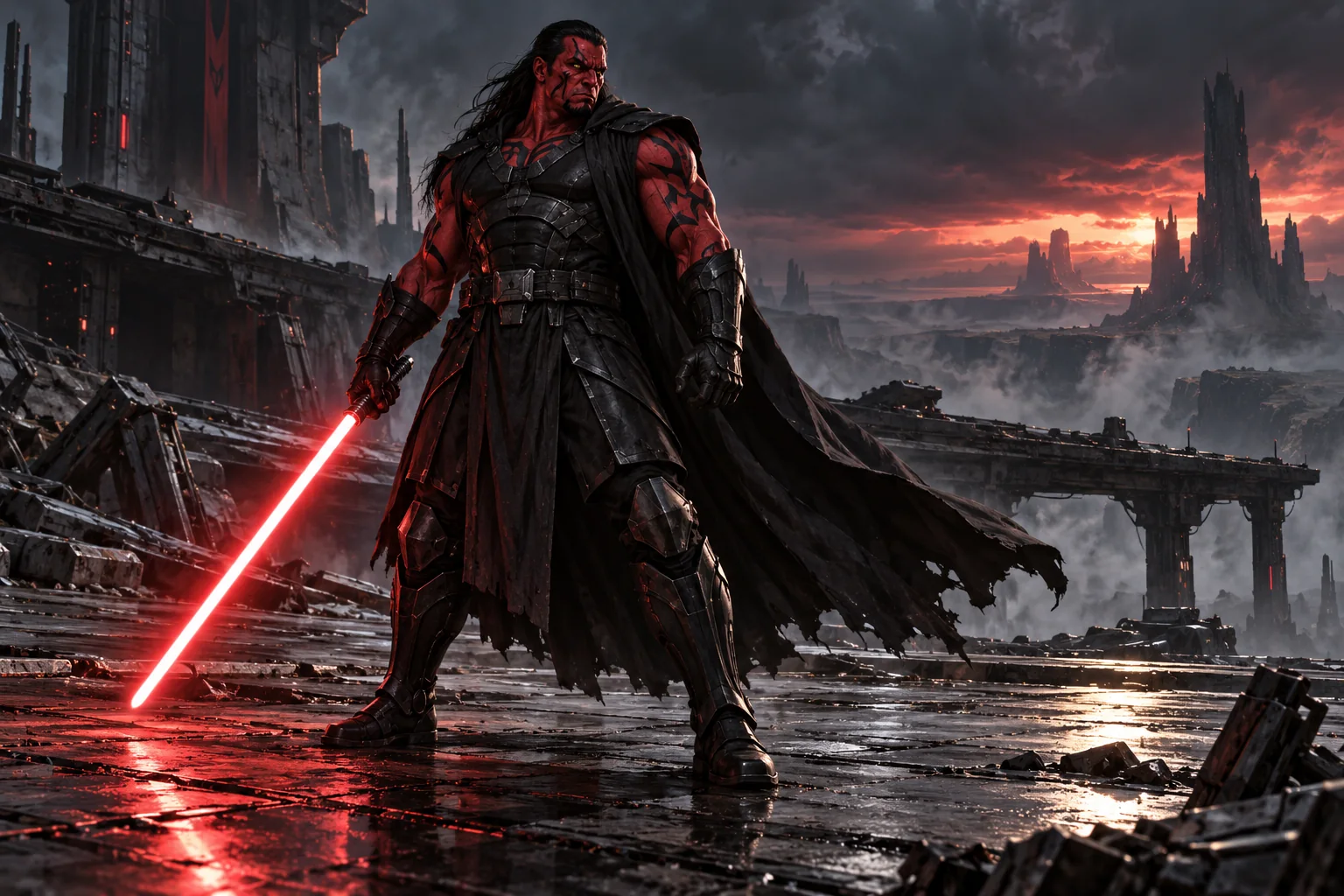
The published character’s muscular build, tattoos, and long dark hair make him visually recognizable. Appearance supports a presentation of intimidation. It should not be treated as independent evidence of undocumented feats, invulnerability, or a special biological origin. The stories establish abilities through actions, not through the degree to which a portrait looks threatening.
IDS interpretation: A commander’s visible identity can help produce compliance before violence occurs. People recognize the representative of a regime and anticipate consequences for refusal. That recognition depends on the institution behind him as well as his physical presence. A threatening individual without authority over a fleet is different from a threatening individual able to issue enforceable orders.
His career also shows that an official identity can change without changing the person. The recall as a Hand rearranges his position in relation to Krayt’s needs. Readers should therefore attach titles to their story phases. A fixed label can obscure changes in which tasks he performs and how close he stands to the ruler.
The absence of a developed family history is a limit on the biography, not a reason to write that he has no family. These are different claims. The dossier preserves the limit while concentrating on the documented institutional life.
Institutions and power
Stryfe operates where the One Sith overlaps with Imperial military power. The order provides recognized authority and a doctrine of service to one Dark Lord. The military supplies transport, weapons, personnel, and command relationships. Combining them allows a Sith officer to extend the ruler’s objectives over distances no individual could personally cover.
The Ossus search demonstrates a limit to territorial control. The commander can search a known place and still fail to locate or contain the people he wants. Jedi continuity moves through surviving relationships and hidden infrastructure. The failure is therefore institutional as well as tactical: destroying a public academy does not eliminate the community’s ability to teach and regroup.
The Dac campaign demonstrates the opposite kind of reach. A central order becomes a coordinated operation affecting a planetary environment. Scientific agents and naval forces perform different tasks toward the same destructive objective. Stryfe’s command helps enforce the conditions under which biological violence can become mass death. [6]
IDS interpretation: His allegiance during the succession crisis shows the role of armed institutions in stabilizing political claims. Wyyrlok needs obedience to keep the concealed government working. Krayt needs the acceptance of established commanders after his return. Personal victory is decisive, but its consequences spread through recognition by people who control force.
This is why an account of Stryfe should include fleets and offices rather than treating every episode as a duel. The scale of his authority comes from a system capable of organizing many acts of coercion around one command.
Beliefs and worldview
Stryfe’s conduct expresses commitment to Krayt’s order and a readiness to use destruction as a means of enforcement. The record supports that institutional allegiance more clearly than it supports a long personal philosophical system. His threats and actions belong to particular conflicts. They should not be expanded into invented writings, private rituals, or a unique doctrine absent from the stories.
The Rule of One gives his service a collective frame. Many Sith may exist within a hierarchy directed by the supreme Dark Lord. Military specialization becomes compatible with that unity: Stryfe can direct force while Maladi directs intelligence and Wyyrlok manages interpretation. The order’s claim to one purpose relies on differentiated labor.
IDS interpretation: His acceptance of the returning Krayt places demonstrated strength beside declared loyalty. When Wyyrlok loses the confrontation, the commander recognizes the winner rather than defending an independent procedure of succession. This conduct helps reveal what obedience means under a system where supremacy can be settled through personal combat.
Dac also prevents loyalty from being described as an abstract virtue. Service to a ruler can involve active participation in extermination. A commander’s willingness to carry out the order is part of the outcome, even when he did not invent the policy. Faithfulness to an institution does not establish that the institution’s objective is justified.
The dossier therefore assesses his beliefs through documented choices and their effects. It does not treat combat enthusiasm as evidence about every aspect of his inner life.
Material life and appearance
Stryfe’s lightsaber is the most immediate instrument of personal violence, but his military environment contains more consequential systems. Fleet command allows him to direct operations across a planetary space. Ships, communications, weapons, and trained crews make that command effective. These materials distinguish a state officer’s violence from an isolated attack.
His appearance places tattoos and clothing beside the body itself. They identify him with the One Sith while making intimidation visible. Their meaning is relational: the viewer recognizes a member of a regime with a history of coercion. The same marks would not carry identical political force outside that recognized setting.
The Final Protocol adds biological and environmental materials. Poisoning oceans makes a world’s ordinary conditions of life into the medium of destruction. A fleet can then block rescue or enforce the campaign. The operation depends on several kinds of technology and labor, not only the commander’s own Force powers.
IDS interpretation: The Hidden Temple makes a useful comparison. Concealment and repurposed infrastructure support survival against a superior military force. The difference is not simply that one side has objects and the other has conviction. Both depend on material arrangements. Stryfe’s campaigns try to locate and destroy the arrangements through which Jedi life continues.
The AI study supplies a visual interpretation of the commander in such a setting. It does not reproduce a specific fleet interior or establish a documented weapon configuration beyond the published character design.
Historical significance
Stryfe helps explain how the One Sith changes from a hidden religious order into a government able to direct war and extermination. His office embodies the connection between the Dark Lord’s objectives and the military apparatus carrying them out. The narrative places that connection on Ossus, Dac, Taivas, and Coruscant rather than leaving it as a title without consequences.
His changing appointment also reveals the flexibility of Krayt’s court. An established military specialist can become a more immediate agent when others fail. The regime’s command structure is hierarchical, but it is not completely static. The sovereign’s needs can redraw the relationship between a person and an office.
The regency episode makes Stryfe significant to succession. A ruler’s authority persists through the people willing to accept commands in his name. When that claim is exposed, military recognition helps determine which new account will become effective. The adviser controls information for a time; the commander helps convert the accepted explanation into action.
IDS interpretation: His final confrontation with Sazen connects the military narrative to the survival of teaching relationships. The Jedi whom the Sith repeatedly attempt to eliminate do not disappear as a consequence of one occupied site. They regroup, continue instruction, and contribute to the final coalition. Stryfe’s death closes the career of an enforcer whose repeated campaigns never achieve the complete institutional destruction they seek.
That significance differs from a ranking of fictional strength. The useful question is what his work makes possible and what limits its success.
Following the chain of command
A title, an order, and an outcome
Stryfe’s service allows the reader to separate three parts of military authority. The title establishes an acknowledged function. The order defines an objective. The outcome depends on people, information, materials, and resistance. None of these parts guarantees the others. A recognized commander can fail, and a coherent order can produce an unjustified outcome.
IDS interpretation: On Ossus, the objective is to find surviving Jedi. The institution has already demonstrated destructive power there, but it lacks complete knowledge of the survivors’ movements. The commander’s authority does not solve that information problem. Flight and concealment change what force can accomplish.
Command under a concealed ruler
Wyyrlok’s regency makes the source of orders uncertain. Stryfe accepts a representation of Krayt’s will because the regent is positioned to supply it. The account becomes politically useful through the commander’s obedience. A claim inside the temple can then direct events far beyond it.
IDS interpretation: The question is not simply whether a follower should trust anyone. It is how an institution checks a specific claim when the claimant controls access to the supposed source. Stryfe’s position makes that difficulty concrete. Doubting the regent may look like doubting the emperor, even when the regent’s explanation is false.
Dac and distributed responsibility
The Final Protocol demonstrates a destructive chain of work. Political authorization, biological attack, military enforcement, and attempted rescue belong to the same event but are performed by different actors. The distinction identifies responsibility rather than dissolving it. An operation can have many contributors without becoming nobody’s action.
IDS interpretation: The commander’s role includes preserving the conditions under which the attack can proceed. Blocking intervention can be as consequential as producing the weapon. The presence of another person higher in the hierarchy does not eliminate the effects of Stryfe’s decisions or the labor performed under his orders.
The returning founder and the armed elite
When Krayt wins, Stryfe’s acceptance gives the victory a practical consequence beyond the defeated regent. The ruler regains an officer able to command. A successful confrontation at the center can become renewed operations elsewhere because the institutional personnel recognize its result.
IDS interpretation: This is a specific feature of the story’s government. It should not be mistaken for proof that every political institution selects rulers in the same way. The One Sith’s emphasis on personal supremacy makes combat unusually consequential. Its military remains an organized body whose participation helps translate the victorious claim into a restored regime.
The case therefore follows authority from recognition to action. It asks who supplies the account, who accepts it, what resources make it effective, and whom its consequences reach. Those questions reveal more about Stryfe’s importance than the size of his body or an unsupported list of victories.
Lore challenge
How well do you know Darth Stryfe?
Five questions, with an explanation and a source after every answer.
Question 1 of 5
What is Stryfe’s principal specialization?
Anthropological assessment
IDS interpretation: Stryfe provides a case in the institutional organization of force. His personal abilities matter, but the scale of his violence comes from an office embedded in a state. Military command joins the Sith ruler’s objectives to ships, crews, communications, and coordinated operations. The result is authority able to affect people the commander never personally meets.
His career also demonstrates that control has different requirements. Conquering a place does not reveal every hidden survivor. Issuing an order does not prevent rescue or resistance. Winning a succession duel does not restore government unless people controlling institutions accept the winner’s claim. Stryfe occupies these different problems at different points in the story.
The Final Protocol is the strongest example of his responsibility. The central decision belongs to Wyyrlok, but enforcement belongs to commanders and other specialists. Examining that distribution makes the relationship between policy and killing visible. It does not reduce the event to impersonal machinery or erase the people making choices inside it.
His final clash with Sazen also highlights the object of the campaigns: a community whose continuity rests on teachers, students, and refuge. The Sith attempt to destroy those relations along with physical sites. The Jedi’s continuing participation in the final coalition demonstrates that institutional survival can persist after military defeat.
Stryfe’s importance therefore lies in what his recognized command can organize, not merely in what he can do alone. The dossier keeps that distinction central while preserving the limits of the documented personal biography.
Collecting this character
Legacy #13–14 helps place Stryfe within the search for surviving Jedi. The later Claws of the Dragon issues explain his recall after Cade’s escape. The Vector conclusion covers Had Abbadon, while Legacy: War follows the restored Krayt’s campaign and Stryfe’s final confrontation with Wolf Sazen. Look for the actual issue contents when comparing collected volumes.
The character’s long dark hair, large build, and tattoo pattern are useful identification features for comic art and licensed portrayals. Do not substitute an unrelated red-skinned or heavily built Sith simply because a listing uses Stryfe’s name. Issue covers may feature another character even when Stryfe appears inside, so a cover image alone does not establish his role in the story. The AI artwork here is an editorial interpretation rather than evidence of an official figure, card, bust, or costume product.
Sources and reading guide
Primary stories establish events. Community references help locate those stories and identify their chronology. AI artwork and IDS analysis are not additional story evidence.
Follow the story
- Legacy #13–14 develops the Jedi-survivor story on Ossus.
- The end of Claws of the Dragon explains Stryfe’s changed appointment.
- Vector’s Legacy chapters place him at Had Abbadon.
- Legacy: War follows the restored regime, the Hidden Temple attack, and his final clash with Sazen.
- Legends reference and story locatorDarth Stryfe
- Legends reference and story locatorLegacy #13
- Legends reference and story locatorLegacy #14
- Legends reference and story locatorLegacy #19
- Legends reference and story locatorBattle on Had Abbadon
- Legends reference and story locatorFinal Protocol
- Legends reference and story locatorLegacy: War #1
- Legends reference and story locatorAttack on the Hidden Temple
- Legends reference and story locatorLegacy: War #5
Event statements follow the Legends stories listed here. Interpretive arguments and invented illustration settings are labeled separately.