
The One Sith are Darth Krayt’s answer to a recurring Sith problem: how can an order built around personal power become a lasting collective? His solution replaces the isolated master and apprentice with a large, organized body of Sith serving one supreme Dark Lord. It gives the dark side teachers, enforcers, scholars, spies, and soldiers. It also gives them a command structure that makes obedience to Krayt the measure of their belonging. [1]
What “One Sith” means
The name does not mean that only one Sith exists. The “one” is the Sith Order understood as a single body, directed by the Dark Lord. Many Sith can be trained and hold authority within it. Their competing talents are supposed to serve a shared project rather than independent claims to ultimate rule. Krayt therefore rejects Darth Bane’s numerical restriction while retaining a sharply unequal hierarchy. [2]
It is useful to separate three things: the One Sith are the religious and political order; the Rule of One is its organizing doctrine; and Darth Krayt’s Galactic Empire is the state it captures and rules. A Sith instructor belongs to the order. A stormtrooper serving Krayt’s government does not automatically become a trained Sith. The Empire’s officers, fleets, and administrators remain a much larger apparatus through which the Sith exercise power. [3]
IDS interpretation: The doctrine turns the familiar Sith promise of personal greatness into a conditional promise. An ambitious initiate may rise, but only inside the structure the Dark Lord controls. Krayt offers advancement without equality. He claims the right to decide which ambitions strengthen the order and which constitute betrayal. This distinction becomes unstable whenever a powerful subordinate decides that the leader himself obstructs the collective mission.
A fallen Jedi and an ancient grave world
Before he became Darth Krayt, the founder was A’Sharad Hett, a Human Jedi associated with the Clone Wars and a survivor of Order 66. His history connects the far-future conflict of Legacy to the Republic’s fall. The Sith emperor is not simply an unknown conqueror appearing after Luke Skywalker’s lifetime. He carries the memory of an earlier Jedi identity into his new order. [4]
On Korriban, Hett encountered the teachings of XoXaan, an ancient Sith whose holocron helped draw him into the dark side. Korriban matters as more than a convenient hiding place. Its tombs and inherited teachings offer a setting in which a new claimant can present himself as the continuation of an old tradition. [5]
His later experiences with the Yuuzhan Vong left a dangerous biological legacy. The growths afflicting his body and his efforts to overcome them became a central weakness of his rule. Krayt’s leadership therefore developed alongside a struggle to survive. His authority could reach across the galaxy while his own body remained a source of uncertainty. [4]
IDS interpretation: Hett’s biography helps explain the scale of Krayt’s claim without excusing it. He has lived through institutional collapse and treats domination as the answer to instability. The resulting order makes his personal survival a matter of collective destiny. Once the ruler identifies his own life with the future of the Sith, medicine, succession, and obedience become parts of the same political problem.
The hidden order: building before conquering
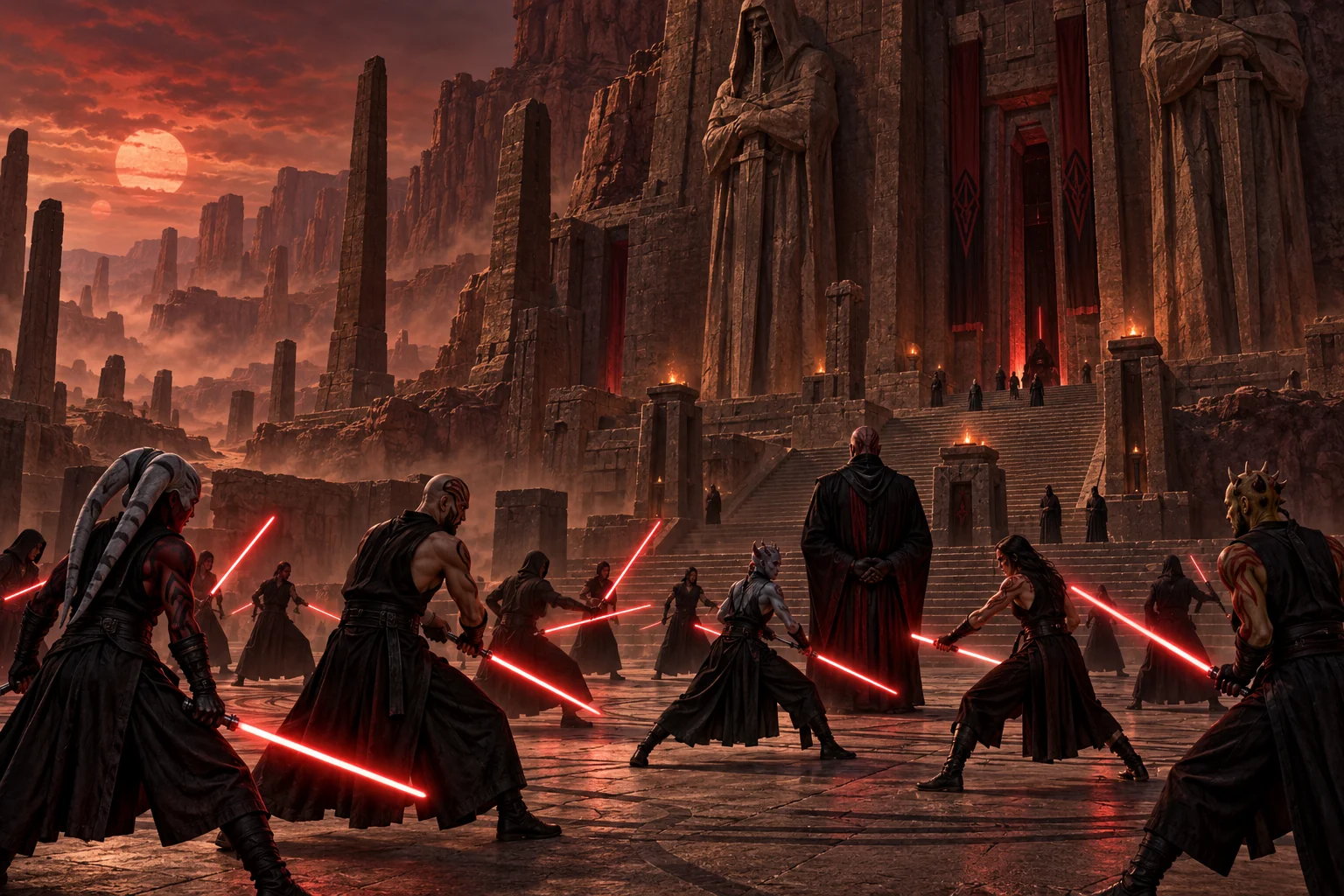
The One Sith were established on Korriban by 27 ABY and remained concealed for roughly a century before their emergence in the Sith–Imperial War. Their hidden existence overlapped an era in which other Sith struggles occupied galactic attention. The chronology should not be read as a simple sequence in which every later dark-side movement replaces all earlier ones. [33]
Secrecy gives Krayt time to build something that the Rule of Two cannot easily provide: an institution with multiple teachers, apprentices, and specialists. The continuing master–apprentice relationship exists within a larger order rather than defining its entire membership. A student’s immediate teacher is therefore a local authority beneath the supreme Dark Lord. [6]
IDS interpretation: A hidden institution needs continuity as much as concealment. Knowledge must move between generations. Training must continue when the founder is absent. Someone has to maintain collective expectations and distinguish authorized teaching from private experimentation. The One Sith’s later offices make visible the organizational labor behind its apparent unity. A century of preparation does not happen through the founder’s will alone.
This distinction changes how to read a figure such as Darth Ruyn. A teacher is not peripheral merely because he spends little time in the published story. Repeated instruction is how an order turns a doctrine into reflex, skill, and habit. Krayt can issue a command at the top of the hierarchy because others have spent years producing the people who will obey it.
Rule of One and Rule of Two
Bane’s system restricts the Sith lineage to a master and an apprentice. Its central relationship concentrates knowledge and power while making succession a confrontation between two people. Krayt’s system permits many Sith, with their authority subordinated to the order’s single leader. The difference concerns the distribution of training and command as well as the number of red lightsabers in a room. [7]
| Question | Rule of Two | Rule of One |
|---|---|---|
| Who receives Sith training? | A restricted master–apprentice lineage. | Multiple masters, apprentices, and specialists under one Dark Lord. |
| Where does authority concentrate? | In the master, with the apprentice as challenger and successor. | In the supreme leader, exercised through a larger hierarchy. |
| How does the system imagine strength? | A narrow lineage that concentrates power and tests succession. | A unified order whose members contribute different capacities. |
| What threatens continuity? | The fragility of a lineage concentrated in very few people. | Factional rivalry and uncertainty over who embodies the order’s will. |
The final row is IDS comparison, not an official checklist of guaranteed outcomes. Neither system abolishes ambition. They organize it differently. Krayt’s hierarchy can employ more talent at once, but it also needs more mechanisms of discipline. Its promise of collective purpose depends on keeping numerous powerful people aligned with a single interpretation of that purpose.
The One Sith should also not be treated as a community of equal dark-side users. Unity describes the demanded result, not an equal share in decision-making. A teacher can command an apprentice, a Hand can enforce the emperor’s wishes, and a Voice can speak in his name, while the supreme authority remains above all of them. The order multiplies offices without distributing sovereignty.
From ecological sabotage to imperial conquest
The path to power begins with the Ossus Project, a joint Jedi and Yuuzhan Vong effort to restore damaged worlds. Sith sabotage corrupted that work and made a project of reconstruction appear to demonstrate the danger of renewed cooperation with the Yuuzhan Vong. This provided a political crisis through which the Sith could damage trust in the Jedi and the Galactic Alliance. [8]
The Sith–Imperial War lasted from 127 to 130 ABY. The Moff Council supported an alliance with the Sith despite Roan Fel’s objections. The Galactic Alliance’s defeat at Caamas helped bring the war to its conclusion. Imperial ambition and Sith strategy converged, but the parties did not share the same ultimate intentions. [9]
Krayt then moved against the emperor whose state had helped carry the Sith to victory. Roan Fel escaped the attempt to remove him, and Krayt took the Coruscant throne. The Empire consequently split between the Sith regime and Fel’s surviving claim to Imperial authority. Krayt’s accession in 130 ABY begins the imperial reign that ends in 138 ABY. [10]
IDS interpretation: This is a conquest built through the manipulation of existing political relationships. The Sith do not need to convince every citizen to embrace their religion before taking power. They exploit fear, sponsor a useful alliance, and capture institutions already able to command fleets and populations. The sabotage is especially revealing because it attacks the credibility of repair itself. A cooperative future is made to look dangerous, while war is offered as the route to security.
Ossus: victory becomes a purge
The Massacre at Ossus in 130 ABY brought Sith and Imperial forces against the Jedi gathered there. Many Jedi were killed, along with Yuuzhan Vong warriors and shapers. Kol Skywalker died during the attack, while his son Cade survived. The massacre marks a decisive transition from defeating an opposing government to hunting an alternative source of moral and Force authority. [11]
Darth Nihl’s role at Ossus makes him one of the order’s clearest embodiments of coercive power. The Nagai warrior killed Kol Skywalker and gravely wounded Wolf Sazen. His later prominence in Krayt’s inner circle rests within this history of direct violence against the Jedi. [12]
IDS interpretation: A conquered fleet can be absorbed into an empire. A surviving Jedi teacher presents a different problem because their legitimacy does not originate with the emperor. They can preserve another account of duty, train another generation, and refuse the claim that imperial victory determines what is right. The purge seeks to close off that future. It attacks the transmission of a rival tradition as well as the bodies of its current members.
The people and offices behind the order
Krayt’s court contains more than interchangeable assassins. Its named offices divide enforcement, military command, counsel, scholarship, and intelligence. Appointments change over time, and the same Sith may hold different functions during different phases. Treating every title as a permanent rank would flatten a court whose loyalties and responsibilities are continually being rearranged.
| Figure or office | Role in the One Sith | Why it matters |
|---|---|---|
| Darth Krayt | Founder, supreme Dark Lord, and emperor. | Claims to embody the order’s unity and direction. |
| Voice and Regent | The Wyyrlok line serves as interpreters and custodians of Krayt’s authority. | Allows the order to function during the ruler’s absences. |
| Hands | Elite personal agents, prominently Darth Talon and Darth Nihl. | Bring the ruler’s orders into direct action. |
| Fist | Military leadership associated with Nihl and later Darth Stryfe. | Connects Sith authority to organized armed force. |
| Darth Maladi | Head of Sith Intelligence and Assassination; skilled in alchemy and biological research. | Turns secrets and specialized knowledge into strategic power. |
| Darth Ruyn | An elder Sith teacher and Talon’s master. | Shows how instruction prepares members for the supreme leader’s demands. |
The Voice is particularly important during Krayt’s periods of stasis. Successive Chagrian Wyyrloks maintain the link between the ruler and the institution. Their office gives continuity to a regime whose founder cannot always remain active. [13]
The Hands represent immediate personal service to Krayt. Talon and Nihl are prominent examples, but their assignments and status develop through the story. The office is a form of proximity to the sovereign, rather than a description of every Sith combatant. [14]
The Fist expresses the military side of that relationship. Nihl held the title before his elevation as a Hand; Stryfe later becomes a major military enforcer. A Sith court needs commanders who can turn a command into coordinated violence beyond a single duel. [15]
Maladi demonstrates another route to importance. Sith Intelligence and Assassination has its own function, and her scientific knowledge gives her influence beyond conventional combat. Her work on Krayt’s affliction also makes technical expertise politically intimate: the ruler depends on specialists whose knowledge he cannot replace simply by issuing an order. [16]
Institutional lens · IDS interpretation
How the One Sith reproduces power
Choose a lens to connect the order’s doctrine to its everyday mechanisms.
One will at the center
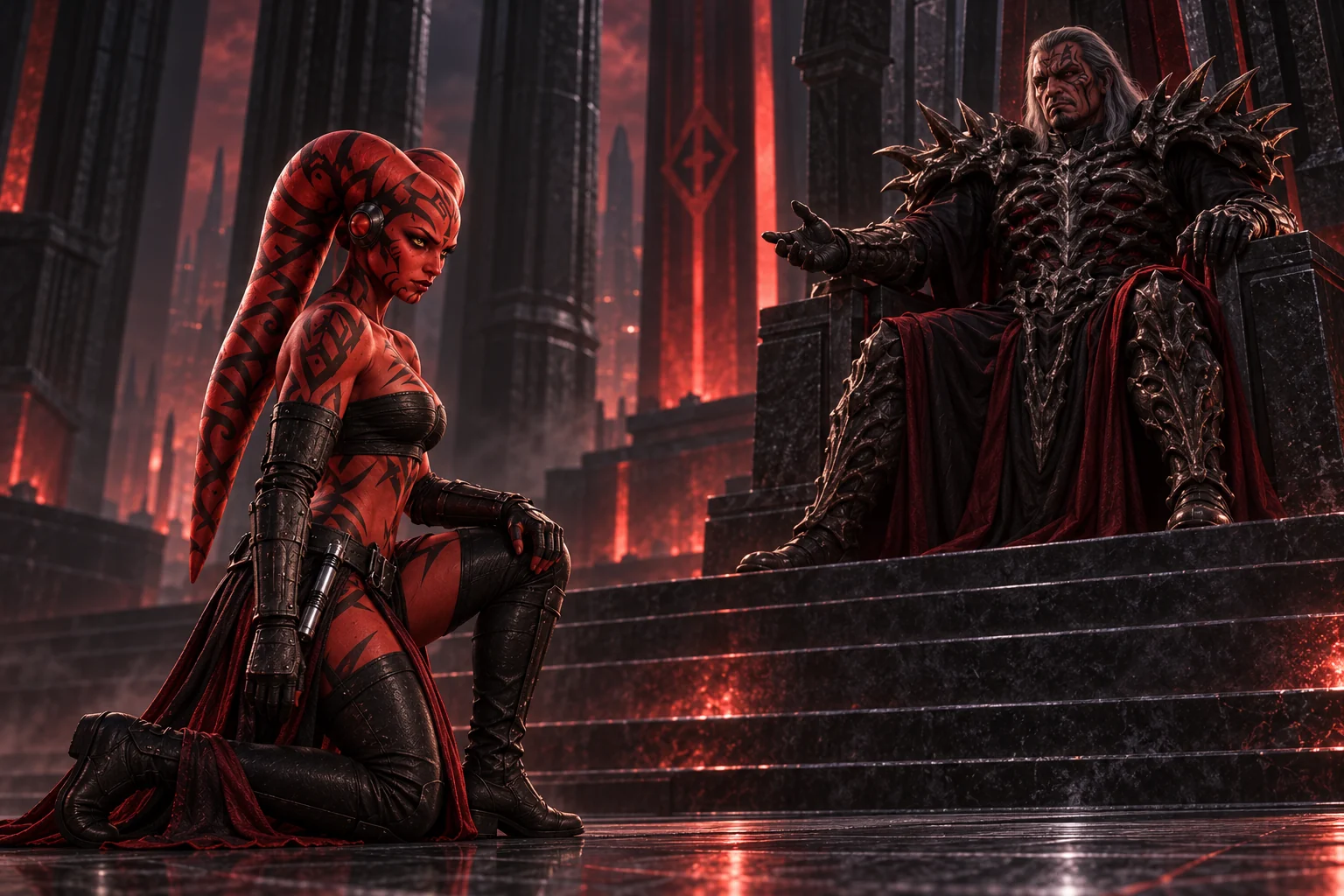
Krayt makes access to rank and recognition depend on his judgment. The court’s rituals locate the source of legitimate advancement in the Dark Lord, even when a student’s skills were formed by someone else.
The institution celebrates belonging while keeping the power to define it unequal.AI artwork in every tab. Images are interpretive; the teacher portrait follows published Ruyn references.
Ruyn and Talon: the final lesson is obedience
Darth Ruyn is an elderly Twi’lek Sith who trains Darth Talon. In 137 ABY he presents her to Krayt at the completion of her training. Krayt orders Talon to kill her master, and she does so without hesitation. Ruyn does not resist. The scene in Legacy #2 turns a teacher’s successful instruction into the condition of his own death. [17]
Ruyn’s teaching also includes quieter practices. He takes Talon to the Sith Art Chamber in the Coruscant temple, finding it conducive to meditation. The chamber gives a brief glimpse of the order as a place where images, instruction, and contemplation accompany martial training. [18]
IDS interpretation: The killing severs an immediate relationship of dependence and replaces it with service to a higher authority. Talon’s skill alone is insufficient as a final credential. Krayt demands a visible demonstration that gratitude, familiarity, or attachment to her teacher will not override his command. Ruyn’s stillness makes the scene especially severe: the master becomes part of the examination rather than an opponent trying to survive.
This single episode should not be expanded into an invented regulation that every One Sith apprentice must kill their teacher in an identical ceremony. The scene establishes what Krayt demands from Talon. Its broader significance lies in the relationship it exposes: the Dark Lord can claim authority over the most formative bond in an apprentice’s life. The order’s collective ideal is enforced through a deliberately personal sacrifice.
Tattoos, names, and the visible Sith body
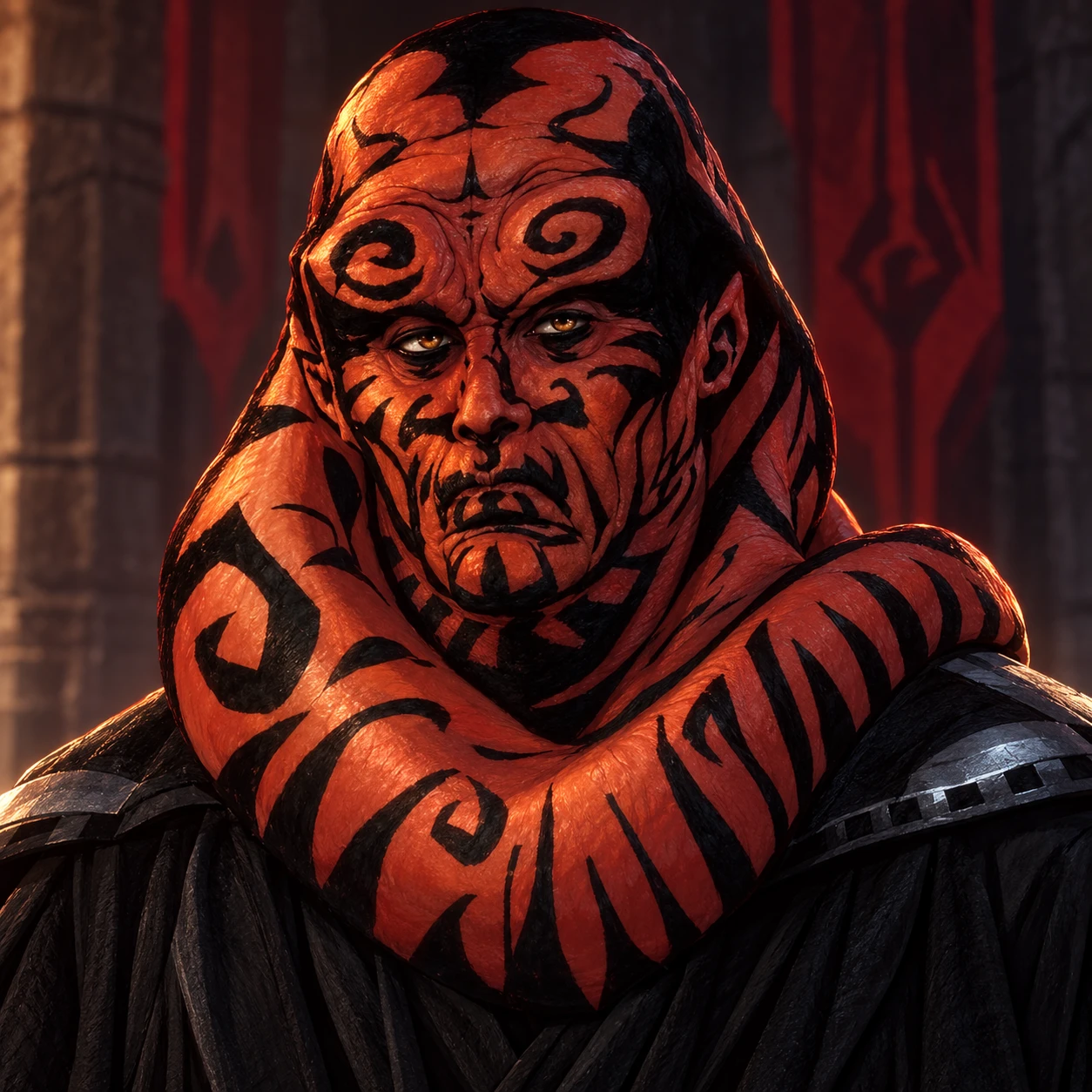
The One Sith are prominent practitioners of Sith tattooing. Talon’s red skin and black markings make her especially recognizable, but the order includes different species and different appearances. The red-and-black visual language should not be mistaken for a single biological identity, nor should every member be assumed to look identical. [19]
IDS interpretation: A marked body carries institutional identity outside the temple. Where clothing can be removed, extensive tattoos make affiliation appear enduring. They allow the individual to be recognized as a member of a dangerous collective before speaking. In this reading, the body becomes an archive of belonging: a visible surface on which rank, ordeal, and allegiance can be made socially meaningful.
The title Darth similarly places an individual within a tradition larger than their previous biography. Yet neither a title nor a tattoo erases personality. Nihl, Talon, Maladi, and Wyyrlok differ in temperament, expertise, and political choices. The compelling tension is between the order’s common identity and the particular people who wear it. Unity has to be continually performed because difference remains.

Coruscant: a Sith court inside an Imperial state
Krayt’s government uses the existing scale of Imperial rule. The Moff Council, military formations, and administrative institutions matter because the Sith cannot personally carry out every act of governance. The state extends their commands across territories and populations far beyond the immediate circle of Force-users. [3]
IDS interpretation: A government’s continuity can disguise a change in its ultimate purpose. An officer may continue to issue orders, a shipyard to produce warships, and a bureaucracy to classify subjects, while final authority now belongs to a Sith emperor. Familiar institutions help make conquest durable. The ruler does not have to invent an administrative world from nothing; he can redirect one that already exists.
This also means service and devotion are different relationships. Some people obey because of ambition, some through institutional loyalty, and others under coercion. A functioning regime does not require every participant to hold the same religious belief. It requires enough cooperation to move information, labor, and force through the chain of command. The One Sith sit at the apex of that system while depending on many people outside their order.
Coruscant makes the claim visible. The hidden tradition of Korriban enters the political center of the galaxy. A temple that once sheltered conspiratorial instruction can now stand beside the machinery of open imperial authority. The movement from concealment to spectacle is part of the conquest: power announces itself as the new normal.

The cost of “unity”: Dac and collective punishment
Krayt’s regime directs genocidal violence against the Mon Calamari of Dac in response to their support for the Galactic Alliance Remnant. The campaign seeks both punishment and deterrence. Its targets are a people, not merely a set of individual combatants. [20]
The devastation of Da Soocha, where Mon Calamari survivors had sought refuge, extends the violence beyond their homeworld. These atrocities also help drive additional opponents, including Hutts, toward cooperation against the Sith Empire. Terror can therefore enlarge the coalition resisting the ruler who employs it. [21]
IDS interpretation: The rhetoric of order should be judged against the practices used to produce it. Collective punishment makes a population responsible for the perceived disloyalty of some of its members. It eliminates the distinction between an adversary’s armed forces and the broader social world sustaining them. The resulting fear is meant to teach other populations that aiding resistance threatens their collective survival.
The same policy exposes the limits of coercive legitimacy. People can comply because they fear a ruler while refusing to recognize his right to rule. When violence reaches a scale that threatens whole communities, even actors with different interests may see coordination as necessary. Krayt’s drive to make opposition impossible helps create a shared reason to oppose him.
Cade Skywalker and the politics of healing
Cade’s extraordinary ability to intervene at the boundary of life and death makes him a target for Krayt. The emperor wants access to a power that could remedy his own deteriorating condition, while also seeking to draw a Skywalker into Sith service. Cade’s refusal disrupts both the medical objective and the symbolic victory Krayt desires. [22]
IDS interpretation: A rare ability becomes a contested resource when the sovereign believes his survival depends on it. Krayt’s interest is not a neutral request for help. It exists within captivity, manipulation, and an attempt to control the person who possesses that power. The body of a reluctant outsider is drawn into the maintenance of imperial authority.
Cade also makes the succession problem visible from outside the order. Krayt can train many followers, but he cannot command every form of Force knowledge into existence. His hierarchy depends on powers, histories, and relationships it does not fully control. The persistence of those outside sources is why victory over institutions does not amount to complete mastery of the galaxy.
Wyyrlok: when the Voice claims the dream
Following the battle on Had Abbadon, Wyyrlok turns against a grievously injured Krayt and kills him. He then preserves the appearance of the Dark Lord’s continuing authority through a stasis deception, ruling while other Sith are led to believe their master remains in recovery. His justification separates the survival of the vision from the survival of its founder. [23]
The concealment centers on Krayt’s body in the Korriban temple. What appears to be a period of regenerative withdrawal becomes a way to hide the ruler’s death. The distinction between a resting sovereign and an absent one is controlled by those with access to the chamber and the authority to explain it. [24]
IDS interpretation: The office built to preserve continuity gives its holder the means to counterfeit it. A Voice speaks because others accept that he transmits the ruler’s will. If they cannot independently verify that relationship, the interpreter can become the practical source of command. The deception exploits routines already established by Krayt’s earlier absences.
Wyyrlok’s betrayal is therefore more revealing than a generic struggle for a throne. It exposes a disagreement over what the “one” actually means. Is the order united by a living founder, by his doctrine, or by whoever can maintain its machinery? Once those things diverge, loyalty to the institution can be presented as a reason to kill the person who created it. Krayt’s system has not removed the Sith succession struggle; it has supplied a new language for it.
Krayt returns: absolute obedience and the Sith troopers
Krayt returns from death and reveals the new phase of his power. In 138 ABY he attacks the Coruscant temple, defeats Wyyrlok, and reclaims the center of the order. Talon and Nihl accompany him during the return. The confrontation resolves the immediate challenge through force rather than an agreed procedure for deciding legitimacy. [25]
His Sith troopers are a distinct force associated with this renewed campaign. Their obedience is extreme: one kills himself on Krayt’s command as a demonstration. The troopers and their Annihilator craft expand the violence of his final offensive. They should not be confused with ordinary Imperial stormtroopers merely because both serve a Sith emperor. [26]
IDS interpretation: These soldiers sharpen the order’s existing demand for submission. Where the earlier court still contains competing judgments, the troopers display a model in which the individual offers no independent limit to the ruler’s command. Obedience becomes a spectacle, staged to reassure the sovereign and instruct everyone watching.
Yet the demonstration also reveals anxiety. A leader entirely secure in the loyalty of his followers would not need to make its extremity so visible. The story’s return to personal enforcement, exemplary punishment, and spectacular devotion suggests that the collective still has to be held together. Krayt’s rebirth intensifies his control without solving the institutional contradiction beneath it.
138 ABY: the emperor falls, the order retreats
The final struggle culminates in the Battle of Coruscant. Cade confronts Krayt, resists the attempt to turn him, and kills the Dark Lord. Because a previous death had not ended Krayt’s threat, Cade sends the body into Coruscant’s sun. He escapes the doomed ship rather than surrendering his own future to the fear of Krayt’s return. [27]
The fall of the Sith regime does not immediately erase its members. Nihl orders surviving Sith to withdraw from places including Coruscant and Korriban. The order returns to concealment under a new political reality, while the Galactic Federation Triumvirate brings together the victorious powers. [1]
IDS interpretation: A state and an order can have different endings. Losing the throne removes open control over the government. Surviving personnel can still preserve knowledge, contacts, and plans. This distinction is essential when assessing what a military victory has achieved. The institutions supporting a regime may be broken while the tradition that legitimized it remains available to future actors.
After Krayt: infiltration and Darth Wredd
In the later Legacy story following Ania Solo, Darth Wredd attacks members of the concealed One Sith. His campaign disrupts their infiltration and culminates in the Battle of the Floating World, where a gathered Sith force faces the Imperial Knights and their allies. The battle is the climax of the second Legacy series rather than part of Krayt’s initial conquest. [28]
Wredd’s insurgency demonstrates that Krayt’s death did not end conflict over Sith identity. A renegade’s effort to destroy the One Sith and return to a narrower Sith model makes internal hostility a threat alongside the victorious government’s pursuit. Although contemporaries believe the Sith have been exterminated after the battle, the wider account of the insurgency includes surviving Sith. Claims of permanent extinction should therefore be treated carefully. [29]
IDS interpretation: Concealment changes what defeat looks like. An open army can be counted more readily than a network of infiltrators. A declaration that the enemy has disappeared may describe the end of a visible campaign without settling the fate of every bearer of its teachings. The One Sith’s later history returns the reader to the original problem of secrecy: institutions may survive through people who no longer appear to belong to them.
Chronology at a glance
- The order takes shape
Krayt establishes the One Sith on Korriban. The group develops in concealment.
- Sith–Imperial War
Sabotage of the Ossus Project helps precipitate a war that weakens the Alliance and brings the Sith into an Imperial alliance.
- Ossus and the Coruscant throne
The Jedi suffer the Ossus massacre. Krayt removes Roan Fel from the seat of power, while Fel survives to lead opposition.
- Talon’s final test
Ruyn presents his apprentice; Krayt orders her to kill him. The main Legacy story develops amid continuing war.
- Betrayal and return
Wyyrlok conceals Krayt’s death; Krayt returns and defeats him.
- The Sith Empire falls
Cade kills Krayt at Coruscant. Nihl directs the remaining order into hiding.
- The struggle continues
Wredd’s campaign and the Battle of the Floating World challenge the concealed One Sith in Legacy Volume 2.
This is a selected chronology of the events discussed above, not a claim that every important battle or appointment is listed. Founding is presented as a date boundary rather than an invented exact year; the later insurgency is identified by sequence to avoid collapsing differing date references into a false precision.
Reading the One Sith as an institution
IDS interpretation: The order works on three connected levels. It teaches a doctrine of unity, creates relationships that transmit skills and obligations, and uses those relationships to capture and govern a state. The academy, the court, and the Empire are different settings, but each asks who may command, who must obey, and who decides whether obedience is sufficient.
Its strongest institutional achievement is scale. It can sustain teachers, scholars, intelligence specialists, and combatants at the same time. It does not have to place every function inside a single master–apprentice pair. This gives Krayt resources for a long project and a broad campaign. Its deepest weakness is the difficulty of separating the collective from the ruler who claims to define it.
Ruyn’s death reveals that problem at the intimate level: a formative relationship can be destroyed to prove allegiance. Wyyrlok’s coup reveals it at the administrative level: the official interpreter can claim to preserve the vision by removing its author. Krayt’s return reveals it at the sovereign level: the dispute is settled by the founder’s superior violence. These are three different pressures on the same promise of unity.
The One Sith make a useful case study because they remain recognizably Sith while trying to overcome an old Sith limitation. They build collective capacity without giving up the hunger for domination. The result can conquer a galaxy’s political center, but it cannot make personal ambition, bodily vulnerability, or conflicting interpretations disappear. Its history shows how an institution can become powerful without becoming secure.
Where to read the story
- Star Wars: Legacy (2006), beginning with “Broken.” The opening arc establishes the fractured galaxy, the Ossus aftermath, and Talon’s induction. Issue #2 contains Ruyn’s brief but decisive scene. Issue #2 at Marvel.
- The continuing original Legacy series. Read the court, Cade’s captivity, the imperial war, and the Had Abbadon confrontation in their wider context rather than treating individual Sith appearances as isolated duels. Legacy Book 1 collection record.
- Star Wars: Legacy—War (2010–2011), #1–6. The six-issue conclusion covers the final phase of Krayt’s rule. Marvel’s Legacy Book 3 record collects the closing original-series material and all six War issues. War series record.
- Star Wars: Legacy Volume 2, by Corinna Bechko and Gabriel Hardman. The Ania Solo story explores the aftermath, Wredd, and the concealed Sith. Read it after the original series and War to preserve the sequence of revelations.
Keep the continuities visible. The One Sith, the Banite lineage, and the Sith Eternal answer different questions in different story settings. Similar imagery or shared Sith vocabulary does not make them the same organization.
Source trail
Sources & evidence
The published Legacy comics are the underlying story evidence. Marvel links identify editions and issues; the clearly labeled community references provide accessible summaries and chronology. IDS interpretation extends the discussion without claiming to establish additional story events. AI artwork supplies no factual evidence.
- Legends reference · overview and survivalOne Sith
- Legends reference · doctrineRule of One
- Legends reference · state institutionsDarth Krayt’s Galactic Empire
- Legends reference · biographyDarth Krayt
- Legends reference · Sith instructionXoXaan
- Legends reference · trainingSith Master / Legends
- Legends reference · Banite lineageOrder of the Sith Lords
- Legends reference · reconstruction and sabotageOssus Project
- Legends reference · 127–130 ABYSith–Imperial War
- Legends reference · accessionAttack on Emperor Fel
- Legends reference · purgeMassacre at Ossus
- Legacy reference · warrior and enforcerDarth Nihl
- Legends reference · Wyyrlok lineVoice
- Legends reference · personal agentsHand (One Sith)
- Legends reference · military officeFist
- Legends reference · intelligence and researchDarth Maladi
- Legends reference · Talon’s teacherDarth Ruyn
- Legends reference · meditation and instructionSith Art Chamber
- Legends reference · body markingsSith tattoo
- Legends reference · collective punishmentGenocide on Dac
- Legends reference · persecution and resistanceDevastation of Da Soocha
- Legends reference · healing and refusalCade Skywalker
- Legends reference · betrayalDarth Wyyrlok (III)
- Legends reference · stasis deceptionDarth Krayt’s tomb
- Legends reference · Krayt’s returnAssault on the Temple of the Sith
- Legends reference · final offensiveDarth Krayt’s Sith trooper
- Legends reference · final defeatBattle of Coruscant (Second Imperial Civil War)
- Legends reference · later conflictBattle of the Floating World
- Legends reference · aftermath and surviving SithDarth Wredd’s insurgency
- Official publication record · Ruyn sceneLegacy (2006) #2
- Official publication record · conclusionLegacy—War series
- Official collection record · contentsLegacy Book 3
- Legends reference · founding geographyKorriban / Legends
Editorial method: Founding dates are kept approximate where appropriate; the order is distinguished from the state it controls; Talon’s initiation is not generalized into a universal rule; and the later Sith defeat is not treated as proof that every survivor disappeared. Read the IDS evidence standard.