
Biography
Darth Ruyn was an elderly Twi'lek Sith Lord in Darth Krayt's One Sith. His best-known student was the apprentice who became Darth Talon. In 137 ABY, he presented her to Krayt as ready to complete her training. Krayt then ordered her to kill her teacher. She obeyed immediately, decapitating Ruyn with her lightsaber. He did not block the strike. The scene belongs to the Legends comic Star Wars: Legacy, rather than the film-era history of the Sith. [1, 2]
The important sequence is training, presentation, command, death, and recognition. Ruyn helps prepare a student, but the ruler decides how that student's readiness will be demonstrated. His death closes his own story while opening Talon's career as a fully recognized Sith. It also establishes a central problem for the reader: the institution depends on teachers to build lasting personal relationships, then demands that those relationships remain subordinate to its leader. Ruyn's biography therefore has a clear endpoint and a large interpretive significance despite his brief appearance.
Relationships and belonging
Ruyn's relationship with Talon is the central social bond in his story. She respects him as her teacher, and the final test has force because he matters to her. Krayt does not ask her to kill an unrelated opponent. He chooses the person whose instruction helped bring her to this moment. Teacher and student belong to the same order, but their shared membership offers no protection against a command from above. [2]
For IDS, this relationship illustrates the difference between personal obligation and institutional obedience. A teacher can provide knowledge, discipline, and recognition. Those contributions create a claim on a student's loyalty. Krayt's test establishes that his own claim has priority. Talon's compliance turns the intimate relationship into a demonstration of allegiance to a third person. Ruyn consequently occupies two positions at once: he is the respected senior figure in the apprenticeship and the expendable subordinate in the larger hierarchy. His death exposes how quickly those positions can come into conflict.
Identity and social position
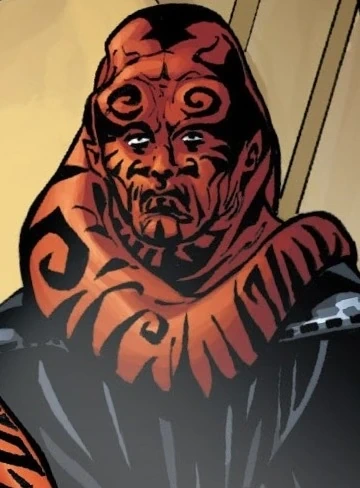
Ruyn's visual identity combines age, Twi'lek anatomy, and Sith affiliation. The supplied comic references show a broad, lined face, prominent lekku gathered around his shoulders, and extensive dark markings across reddish skin. His older appearance distinguishes him from the younger apprentice beside whom his story is usually discussed. The name Darth identifies his Sith position. His character should be understood through that specific institutional placement, rather than through assumptions about how all Twi'leks behave. [3]
The portrait makes seniority visible, but the narrative limits the protection seniority provides. An experienced teacher can hold authority over a pupil while remaining vulnerable to a higher ruler. That tension is more useful than a simple ranking of strength. Ruyn's status rests on instruction and membership, not on a documented military command. His relationship with Talon also shows that two people of the same species can occupy sharply different generational and institutional positions. Shared anatomy does not explain the hierarchy between them. Apprenticeship and the Dark Lord's authority do.
Institutions and power
Ruyn serves within the One Sith under Darth Krayt. His final encounter with Talon makes the order's hierarchy concrete: the instructor presents the apprentice, the ruler imposes the test, and the apprentice acts on the ruler's command. Authority over the educational relationship ultimately belongs to Krayt. Ruyn's teaching is valuable to the order, but that value does not give him an independent right to decide the conditions of graduation. [1, 2]
This is an institutional reading of the scene, rather than a claim that every One Sith apprenticeship ended in the same way. The available event demonstrates a particular use of authority. Krayt can make the death of one subordinate the condition for recognizing another. He thereby decides both who may advance and what advancement must cost. The result is a hierarchy in which useful service does not secure personal safety. The teacher produces a capable successor, yet remains subject to an order that treats his own life as available for its leader's purposes.
Sith teaching and worldview
Ruyn's documented affiliation places him within a dark-side teaching tradition. His role is to instruct a Sith apprentice, not merely to work for a political administration. The final test connects that instruction to obedience and the suppression of competing attachments. Ruyn's failure to resist is part of the recorded event. It does not, by itself, reveal every thought or motive he held at the moment of death. [1, 2]
The distinction matters when interpreting his worldview. Readers can describe what the scene requires from Talon without inventing a private monologue for Ruyn. The test treats attachment to a teacher as something that must yield to the Dark Lord's command. In that sense, Sith education includes learning which relationships count as obstacles when power demands their removal. IDS reads this as a moral structure within the institution: loyalty is judged through an act that violates a personal bond. That interpretation concerns the rule expressed by the test. It does not turn Ruyn's silence into a complete statement of personal belief.
Material life and visual design
The comic references make Ruyn recognizable through his face, lekku, markings, and dark clothing. These features provide a compact visual account of age and affiliation. They also explain the choices in the commissioned AI portrait: the face remains unobstructed, the heavy lekku retain their position around his shoulders, and the markings remain central to the design. The portrait is an interpretation of those references, not a newly discovered official illustration. [3]
Material objects also structure his final scene. Talon's lightsaber makes the command immediately executable. A training relationship becomes a lethal action through a weapon the apprentice already knows how to use. The object connects acquired skill to institutional judgment. The comic itself then carries that scene into later editions, archives, and collections. These are different kinds of material evidence. Clothing and weapons belong to the fictional setting. Printed issues and reproduced artwork belong to the history of publication and fandom. Keeping those categories distinct helps readers understand what an image can show and what a collectible can document.
Historical significance and appearances
Ruyn appears in Star Wars: Legacy (2006) #2, Broken, Part 2. Marvel's issue record credits John Ostrander and Jan Duursema. The story is part of the original Legacy series and belongs to Legends continuity. Its setting in 137 ABY places Ruyn far beyond the period of the original films. Readers looking for his central scene should begin with that issue, rather than the later Legacy series featuring Ania Solo. [1, 2]
His importance is concentrated in the introduction of Talon's relationship to Krayt. The scene establishes the cost of her recognition and gives her obedience a specific personal consequence. Ruyn is therefore more than an unnamed victim in a battle. He is the teacher whose death defines the terms of a student's advancement. As a narrative device, the sequence tells readers what kind of ruler Krayt is and what kind of loyalty he expects. Those observations concern the construction of the story. They should not be expanded into undocumented campaigns, earlier duels, or a detailed life history that the available references do not supply.
Anthropological assessment
IDS interpretation: Ruyn's death can be read as a violent rite of passage. A rite of passage is a process through which a person moves between socially recognized positions. Here the apprentice's prior relationship with her teacher is disrupted, a decisive test intervenes, and recognition follows. The violence is not incidental to that reading. It gives Krayt a visible demonstration that personal attachment will not prevent compliance.
The scene also shows how education can serve authoritarian power. Training requires sustained contact, trust, and unequal access to knowledge. Krayt uses the bond created through that process to test whether his own authority outranks it. The teacher's achievement becomes the means through which he can be discarded. This reading does not imply that Twi'lek culture produces Sith violence, nor that apprenticeship is inherently abusive. The relevant institution is the One Sith under this ruler. Ruyn's case is useful because it identifies a specific mechanism: advancement becomes conditional on carrying out violence against a person who helped make advancement possible.
Collecting this Character
Start with Star Wars: Legacy (2006) #2, which contains Ruyn’s defining appearance. A collected edition containing that issue can serve the same reading purpose. Check the contents list before buying because the original Legacy series and the later series share a title.
A listing described as a Darth Ruyn custom figure, fan print, or sketch should be checked for its maker and licensing status. The AI portrait on this page is IDS editorial artwork. It is not an official Topps card, action figure, or product photograph. No collector-supplied trading-card photographs have been added to this page.
The official issue record and the comics archive are linked in Sources and Connected Files.
Sources and continuity
Story facts refer to the Legends character. Analytical passages identify IDS interpretations of teaching, hierarchy, and ritual. The AI image follows the three supplied visual references and carries no claim to official status.
- Marvel: Star Wars: Legacy (2006) #2. Official issue record and creator credits.
- Star Wars Legacy Wiki: Darth Ruyn and Wookieepedia: Darth Ruyn. Secondary biographical references.
- Visual references: Legacy Wiki image, Comic Vine image, and Wookieepedia image. Supplied by the editor.


