
Biography
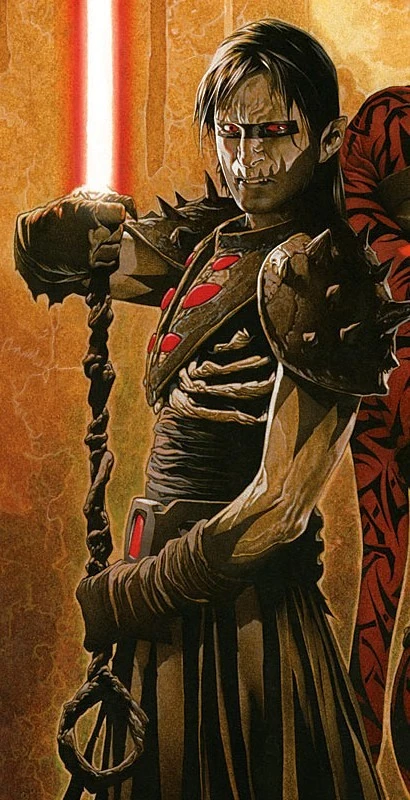
Darth Nihl began life as a Nagai warlord from Nagi in the Unknown Regions. Before becoming Sith, he used his latent Force ability while leading bands of marauders, giving him a political and military identity that predated Darth Krayt's order. Krayt recruited him while rebuilding the Sith and trained him as a Sith Lord. Nihl first served as Krayt's Fist, a military leadership role, and later rose to become one of the Dark Lord's Hands, placing a former regional warlord near the center of a galactic authoritarian project.
A Nagai warlord recruited into Darth Krayt's One Sith who rose from Fist to Hand, led the massacre at Ossus, killed Kol Skywalker, and survived to reorganize the Sith after Krayt's death. Within the Legacy era (Legends) continuity, Darth Nihl's role, loyalties, and circumstances change as the story develops. Work, training, displacement, promotion, survival, and personal choices all help explain how Darth Nihl reaches the position seen on screen or in the source material. Those changes matter because Darth Nihl is not defined by a single title or affiliation.
Relationships & belonging
Nihl's most important relationships are structured by rivalry, hierarchy, and earned status. Darth Krayt is his master and the source of his promotion, but Nihl does not follow him without private judgment. Darth Talon becomes both a fellow Hand and a competitor for access and trust. Darth Maladi later controls Nihl's treatment after his defeat by Cade Skywalker. Cade himself becomes a deeply personal enemy because Nihl killed Cade's father, Kol Skywalker, during the assault on Ossus. These relationships turn One Sith hierarchy into a field of competition rather than a simple chain of obedience.
The available sources do not identify close relatives for Darth Nihl. Most of Darth Nihl's important social ties are instead formed through One Sith. Command relationships, alliances, mentorship, friendship, rivalry, dependence, and betrayal can matter as much as kinship. These bonds help explain where Darth Nihl finds loyalty, support, pressure, and belonging.
Identity & social position
As a Nagai, former warlord, and One Sith Lord, Nihl combines identities that come from different political worlds. His pale appearance, black hair, Sith tattoos and armor, and unusually long-handled lightsaber make his One Sith status visually legible, but his earlier Nagai career matters because he was not raised inside Krayt's order. He enters the Sith as an already established leader and has to convert previous martial authority into a new institutional identity defined by service to a Dark Lord.
Darth Nihl is Nagai, with Nagi (Legends) serving as the documented homeworld or formative-home context. Sith Traditions provides an important cultural context for Darth Nihl. Darth Nihl's social identity is shaped by more than species or birthplace: occupation, reputation, institutional membership, status, and changing relationships all affect how the character is understood by others.
Institutions & power
Institutions organize nearly every stage of Nihl's power. Darth Krayt's One Sith gives him military command as Fist and enforcement authority as Hand. During the attack on the Jedi Praxeum at Ossus, that authority is exercised through coordinated Sith and Imperial violence, and Nihl kills Jedi Master Kol Skywalker while gravely wounding Wolf Sazen. Later, after failing against Cade Skywalker, Nihl loses status and is placed under Darth Maladi's control. Rank is therefore shown as conditional: authority comes from the institution and can be removed when performance no longer satisfies its ruler.
Darth Nihl serves as Nagai warlord · Sith Lord · Military commander / enforcer within One Sith. The documented rank or title is Fist of Darth Krayt. That position determines access to information, authority, resources, mobility, and the ability to give or resist orders. The institution surrounding Darth Nihl is therefore part of the character's story, not just a background affiliation.
Beliefs & worldview
Nihl's worldview follows the competitive political logic of the One Sith. He is loyal to Krayt but also studies older Sith traditions in which strength determines leadership, making him suspicious of privileges granted to Cade Skywalker and of Krayt's fixation on creating an heir. His loyalty is therefore neither passive nor sentimental. He accepts hierarchy while continually measuring whether leaders and rivals deserve their positions, a pattern that helps explain how a supposedly unified Sith order still contains internal competition.
Darth Nihl is associated with One Sith tradition. That tradition matters most where it shapes training, discipline, ritual, moral obligations, sacred objects, or decisions made under pressure. The character's actions can still differ from the expectations of the larger tradition, so affiliation does not automatically mean uniform belief or behavior.
Material life
Nihl's long-handled red lightsaber, armor, cybernetic replacement after Cade severs his arm, Sith facilities on Korriban and Coruscant, and the military resources placed under his command make authority material. The loss of his arm and later experimentation under Darth Maladi also show how the body itself can become an institutional resource. One Sith power is carried through weapons and fleets, but it is also written onto bodies through training, injury, punishment, medical intervention, and visible marks of rank.
Darth Nihl's work as Nagai warlord · Sith Lord · Military commander / enforcer is carried out through the material world of One Sith. Clothing, weapons, tools, vehicles, communications systems, workspaces, and other everyday objects make that role visible and practical. These objects can signal authority, extend physical ability, restrict movement, support labor, or reveal dependence on the larger institution around the character.
Historical significance
Darth Nihl remains historically important after Darth Krayt's final defeat. He survives the collapse of Krayt's immediate regime, orders the execution of the remaining Sith troopers, and directs surviving One Sith members to scatter, hide, infiltrate governments, and attack from within. That decision converts a defeated territorial empire into a clandestine network. In Legends continuity, Nihl therefore links the open Sith rule of the Legacy era to the possibility of a longer underground survival strategy beyond Krayt himself.
Darth Nihl's story belongs to the Legacy era (Legends). The character's importance comes from the effects of those actions on the people, institutions, and conflicts around them, whether or not Darth Nihl holds the galaxy's highest political or military office. Later alliances, losses, memories, and institutional changes can carry those consequences beyond the character's immediate appearances.
Anthropological assessment
Darth Nihl is especially useful for examining how individual choices are shaped by social position rather than occurring in isolation. Connections to One Sith, the work of Nagai warlord · Sith Lord · Military commander / enforcer, and the character's documented relationships show how authority, loyalty, reputation, and access to resources are produced through institutions and everyday interaction. The character also helps reveal how larger political systems become personal: rules are enforced by particular people, identities are negotiated in specific relationships, and material settings make differences in rank and power visible.
Read anthropologically, Darth Nihl's story connects personal behavior to the structures around it. Status, work, institutional membership, relationships, objects, and historical circumstances all affect what choices are available and how those choices are interpreted by others. That makes the character useful for studying power at the scale of everyday interaction rather than only through governments, armies, or major battles.
Character imagery
Darth Nihl in Knights of the Old Republic
Character-focused visual references replace generic planet and archive imagery.

IDS visual record
Character in context
Original IDS diagrams connect the biography to institutions, relationships, material culture, and related archive files.
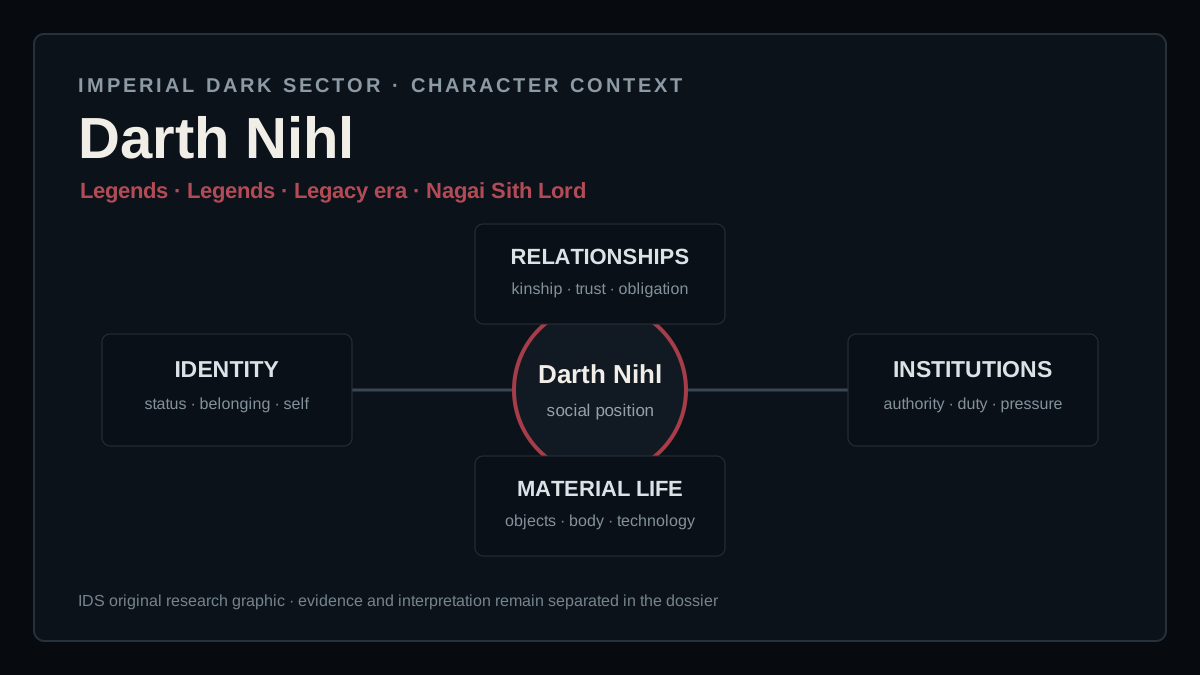
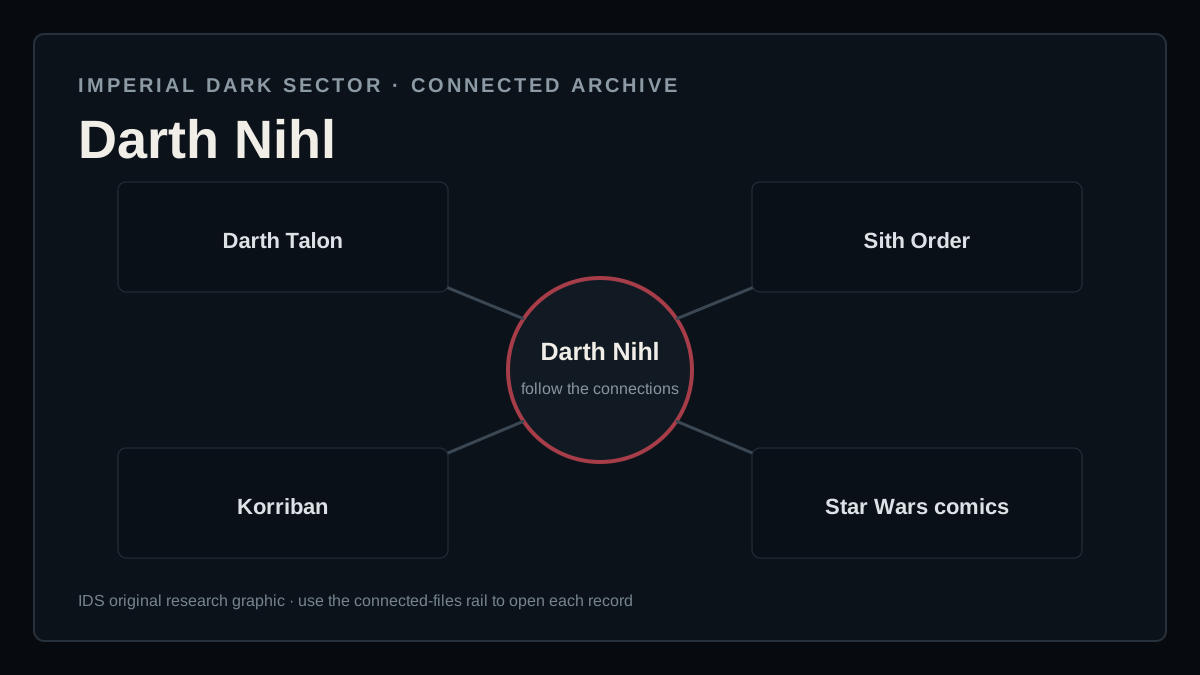
Original Imperial Dark Sector research graphics.
Material fandom · Collector reference
Collecting this Character
Source record
Sources & continuity
This file is explicitly labeled Legends. Documented story material is kept distinct from IDS anthropological interpretation, and continuity-specific biography is not silently imported into another timeline.