
Wredd attacks the One Sith while remaining a Sith himself. The page follows the stolen identity on Carreras, the pursuit by Jao Assam, and the revenge trap on his ruined homeworld.
Life and history
From a stolen identity to the Floating World
Select a stage to explore the event and its significance. BBY and ABY mean before and after the Battle of Yavin.
A homeworld destroyed
Sith weapons testing devastates his home and family.
Read the supporting sourceWhy this matters
A genuine injury becomes the foundation of a coercive campaign.
Biography
The Sith who attacks the Sith
Darth Wredd enters the second Legacy series after the apparent defeat of Darth Krayt’s regime. The throne has changed hands, the Galactic Federation Triumvirate has formed, and the One Sith have withdrawn from open government. Their survival creates a different kind of conflict: infiltration, concealed authority, and attacks within a galaxy that is trying to reconstruct its institutions. Wredd belongs to that surviving Sith world, yet sets out to destroy it. His opposition does not make him an ally of the people defending the new government. [1][2]
That distinction is essential to his biography. A character can oppose a murderous organization while continuing to use its methods. Wredd kills, impersonates, manipulates, and treats other people’s lives as instruments in a private campaign. The fact that some of his victims are Sith answers whom he attacks. It does not, by itself, explain the kind of society his success would produce. His story repeatedly asks readers to judge a purpose together with the conduct used to pursue it.
A homeworld made into a weapon
Wredd’s past gives that campaign a specific foundation. The One Sith devastate his homeworld, Mala, during a weapons test. His family is lost, the world is torn from its ordinary place in the planetary system, and the surviving landscape becomes known as the Floating World. Wredd is taken into the Sith system that inflicted the catastrophe. The injured survivor becomes an apprentice inside the organization he will later attack. [3]
The visible marks of his survival make the past present without telling its whole story. A scar is evidence of a body’s history, not an automatic explanation of everything its bearer does. Wredd’s account connects personal bereavement to institutional violence, but his later decisions remain decisions. The page therefore treats the destruction of Mala as an explanation of his hatred, rather than as permission for every action that hatred produces.
The Floating World is more than a dramatic destination. It is the material remainder of the One Sith’s use of an inhabited place as an experimental object. Ordinary boundaries between a home, a test site, and a battlefield have collapsed. When Wredd later arranges his final confrontation there, he turns the location of his family’s destruction into a stage for retaliation. The choice binds his insurgency to a place that the new government initially understands only in fragments.
The stolen identity of Yalta Val
Wredd’s public campaign begins through disguise rather than declaration. He overcomes the Imperial Knight Yalta Val and uses the knight’s identity to infiltrate Imperial communications activity in the Carreras system. A uniform and an accepted name let him move inside procedures designed for a legitimate officer. The resulting crisis brings Ania Solo, a scavenger with a famous family name but no command position, into contact with the struggle. A lightsaber discovered among salvaged material helps expose what has happened. [4]
The Carreras Incident shows why this enemy is difficult to categorize. The apparent officer belongs to a government committed to resisting Sith power. The person occupying that position is a Sith renegade pursuing his own agenda. Observers must separate a credential from the person presenting it. Wredd’s infiltration exploits the delay between seeing something that looks official and establishing who actually controls it.
Ania’s companions matter because they do not approach the crisis from a single military hierarchy. Sauk, AG-37, and the Imperial communications droid each contribute practical knowledge, transport, or evidence. Their involvement prevents the plot from becoming only a duel between Force-users. The ability to notice a discrepancy, keep someone breathing, preserve information, or reach another ship can determine whether the person with the lightsaber survives. [4][5]
Jao Assam and the danger of a vision
Imperial Knight Jao Assam becomes Wredd’s most important intended recruit. During the early conflict, Jao is severely wounded and survives through the intervention of Ania’s group and their droid companions. He also experiences a vision of Wredd attacking Empress Marasiah Fel. The vision gives him a reason to pursue the renegade even when his assigned duties point elsewhere. Wredd learns to use that urgency. [5]
Jao’s fear is not foolish. A ruler’s life is a legitimate concern for a knight sworn to protect her. The difficulty is that a vision does not provide a complete operational explanation. It can show an event without identifying the sequence of choices that will bring it about. Jao’s effort to prevent the attack can consequently be drawn into the attack’s preparation. Wredd turns a sincere protective obligation into an opening for manipulation.
This is also an institutional problem. A knight who leaves an assignment to pursue a private interpretation of the Force can regard himself as faithful to a higher duty. The government can regard the same departure as desertion. Neither description automatically settles the practical question of how a threat should be investigated. Jao’s story gives that disagreement consequences, including punishment and the need for Ania to seek help from the empress. [5][6]
A campaign against concealed Sith
Wredd moves against Sith operating in the postwar galaxy, while Ania and Jao encounter the wider effects of their activity. The Dac shipyard story and Darth Luft’s exploitation place local brutality inside a larger pattern of concealed Sith influence. Defeating an individual operator can save people and still serve a plan the rescuers have not understood. Wredd’s campaign repeatedly creates that uneasy overlap between immediate benefit and manipulation. [2][7]
He frames his opposition to the One Sith through a different conception of Sith survival. Krayt’s collective order demanded many Sith subordinate themselves to a single sovereign vision. Wredd favors the concentration associated with the Rule of Two. This is a disagreement about how Sith power should reproduce itself, not a conversion to the Jedi’s obligations or the Triumvirate’s laws. His proposed solution preserves domination while changing the size and shape of the organization practicing it. [1][2]
The difference matters when considering his interest in Jao. A possible apprentice is not simply a companion who shares his enemies. Recruiting Jao would turn the knight’s moral crisis into the next generation of Sith authority. Wredd attempts to determine both whom Jao fights and what Jao becomes afterward. He offers a future that depends on converting protective anger into obedience to another master.
The Floating World trap
The final campaign brings Wredd, Jao, Ania’s companions, Imperial forces, and a mass of One Sith to Mala. Wredd has arranged circumstances to gather his enemies on the damaged world. The confrontation is therefore not an accidental meeting between groups that happen to choose the same battlefield. It is the culmination of his effort to make several institutions and individuals converge on the place of his original loss. [8][9]
During the fighting, Wredd assists Jao and Ania’s companions against the One Sith. Marasiah’s reinforcements enter the battle, and the assembled Sith force is defeated. Cooperation in that moment is real: his attacks help destroy common opponents. It is also limited. Wredd has not accepted Imperial authority, and participation in a shared battle does not erase the separate objectives that brought each party there.
The language used to describe the outcome needs care. The defeat of the One Sith army on Mala is not proof that every Sith individual throughout the entire galaxy has ceased to exist. Wredd’s confidence in the completeness of his revenge belongs to the character’s perspective. An archive should preserve the difference between his conclusion, the force actually encountered, and the larger question of hidden survivors.
Refusal and the final shot
After the battlefield victory, Wredd attacks Marasiah from behind, bringing Jao’s feared vision into the present. The attack is meant to provoke the knight into a killing driven by rage. Jao pursues him and severs his hands, but refuses to complete the transformation Wredd wants. Ania then kills the renegade with her blaster. Wredd’s life ends through the intervention of someone outside the apprentice role he has been trying to create. [8][9]
The sequence gives Jao’s refusal an unusually concrete form. He does not deny the danger or stand aside while it continues. He defeats Wredd while rejecting the emotional and doctrinal meaning Wredd demands from the victory. Ania’s action is separately situated in the ongoing emergency. The scene does not require every person present to make the same choice in order for Wredd’s design to fail.
Wredd remains a disturbing figure because parts of his diagnosis are accurate. The One Sith have devastated lives and retained a dangerous presence after Krayt’s fall. Yet accuracy about an enemy does not make a manipulator reliable about himself. His last attempt to manufacture an apprentice reveals how tightly revenge and reproduction of Sith authority have become bound together.
Relationships and belonging
Wredd’s relation to the One Sith combines membership, injury, apprenticeship, and insurgency. The organization destroys his home and later forms him as a practitioner of its power. His campaign grows out of that proximity. He knows enough to attack Sith networks, but his own methods preserve coercion and secrecy. The relationship is best understood as a violent break within Sith history, with civilians and rival institutions drawn into its consequences. [1][2]
Yalta Val is the victim of an identity theft with public implications. Wredd uses a respected officer’s identity because other people have reasons to trust it. Jao Assam is a different kind of target: a potential successor whose loyalty and fear can be redirected. Val’s name gives access to existing institutions; Jao’s transformation would help create a future Sith lineage. These are related techniques, but they aim at different kinds of continuity. [4][5]
Ania Solo resists his design through actions that are often practical rather than ceremonial. She notices evidence, works with a mixed crew, seeks political intervention, and finally ends his threat. Her connection to Jao gives her reasons to pursue the case without turning her into a member of his order. Sauk, AG-37, and the communications droid reinforce the importance of people and machines that Wredd’s master-and-apprentice model treats as secondary. [6][9]
Marasiah Fel represents both a target and a competing answer to the postwar crisis. As empress and triumvir, she governs through institutions Wredd wants to manipulate. Her injury is designed to change Jao’s moral identity as well as to harm a ruler. Reading that attack only as an assassination attempt misses the apprentice-making purpose attached to it. Reading it only as a temptation misses the injured person whose body Wredd uses to make the argument.
Explore the character
Who does Wredd try to control?
Compare infiltration, pursuit, and the final trap.
Borrowing an official identity
His accepted name opens access.
Recovered evidence challenges the apparent identity.
Control of information extends the deception.
A credential and its bearer are separate questions.
Identity and social position
The Darth title locates Wredd inside a Sith tradition even while he attacks its collective organization. Calling him anti-Sith without qualification can conceal that affiliation. He opposes the One Sith as an arrangement of power, while continuing to seek a Sith future organized around a more exclusive succession. Identity here follows both the enemy rejected and the authority retained.
His damaged body and ruined homeland make survival visible, but his public presentation is not limited to the role of victim. He takes an officer’s identity, directs an insurgency, and claims the right to decide what kind of Sith should remain. Each position gives him a different way to explain himself to others. The biography avoids reducing all of them to a single label such as avenger, liberator, or monster.
IDS interpretation: Wredd’s most revealing transition is from a person whose life was controlled by the Sith to someone who attempts to control another survivor’s future. The historical injury is neither erased nor sufficient to justify the new coercion. His case demonstrates why identity after institutional abuse must be examined through present relationships as well as remembered suffering.
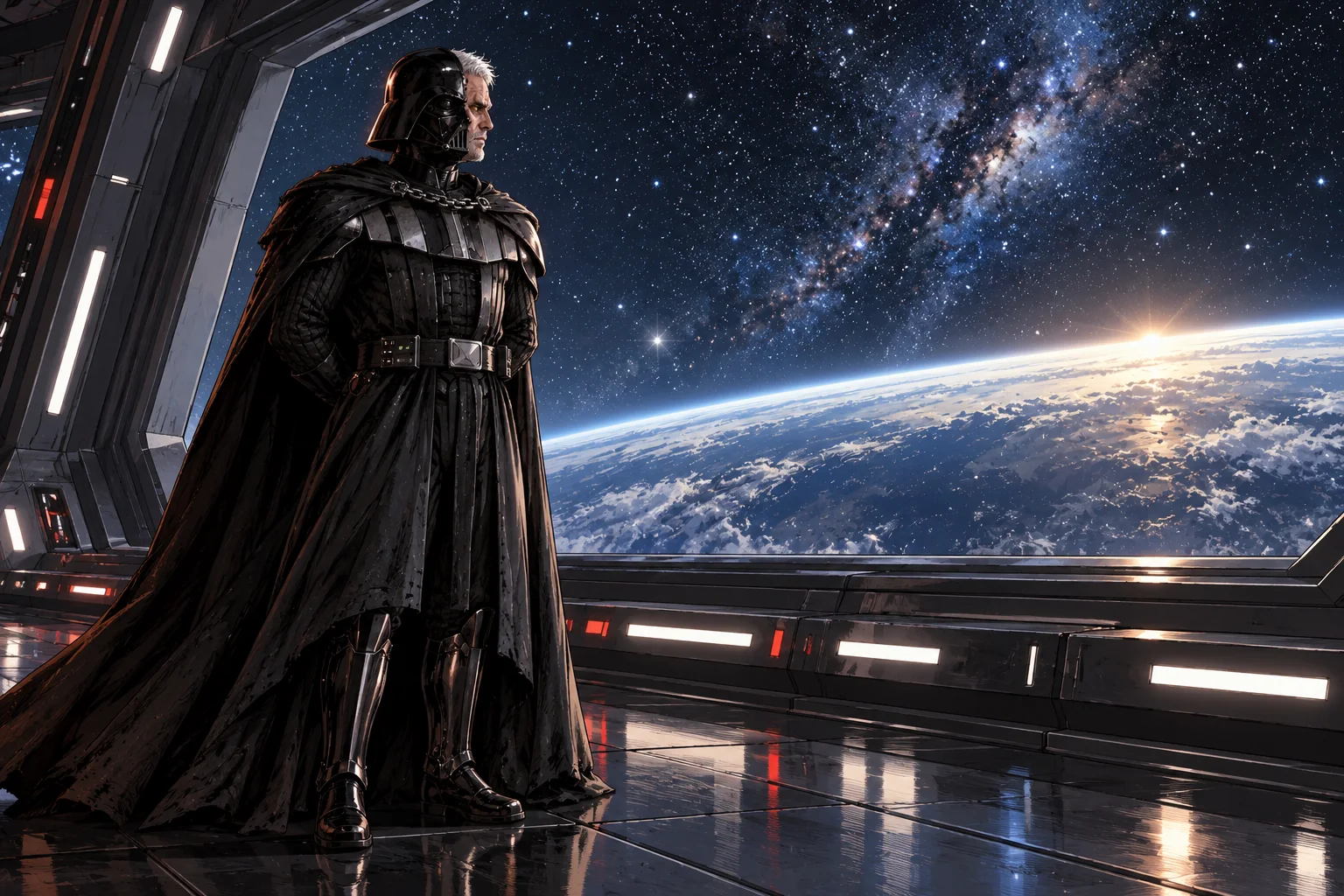
The illustrated face and clothing on this page are artistic interpretations of his published appearance. The portrait is not a medical record, a reconstruction of an unseen moment, or proof of the exact environment in which a particular conversation occurred. Its purpose is to make the character visually recognizable while the text supplies the evidence for his decisions.
Institutions and power
Wredd’s insurgency unfolds during reconstruction after a regime change. The Triumvirate brings Imperial, Jedi, and Alliance authority into a shared government, while Sith operators survive outside its visible command structure. This setting gives infiltration a different importance from the public rule of Krayt’s empire. The danger is not only an enemy fleet arriving under its own banner, but an enemy using the procedures of the institutions meant to stop it. [2][6]
The Imperial Knights’ organization produces Jao’s conflict between assigned service and a personal reading of the Force. It can mobilize aid and discipline a member, yet its procedures do not instantly resolve the information problem Wredd has created. Ania’s appeal to Marasiah shows how an outsider can bring knowledge into the state, rather than simply wait for an official chain of command to discover it. [6]
The One Sith’s survival also shows the difference between losing a capital and losing a network. Operators can withdraw, conceal affiliations, and exploit labor or communications without holding the throne. Wredd attacks that dispersed presence through another dispersed campaign. The conflict is consequently about identification and access as much as direct superiority in battle.
IDS interpretation: Institutions here should be assessed through what they enable and what they fail to notice. An official title permits coordination; the same title can be stolen. A knight’s oath creates discipline; a vision can pull the knight away from an assignment. These tensions do not make institutions useless. They show why authority requires methods for checking information, including evidence supplied by people outside its ranks.
Beliefs and worldview
Wredd’s doctrinal conflict concerns the reproduction of Sith power. The One Sith organize many practitioners under the authority of one ruler and a collective imperial project. The Rule of Two imagines a much narrower relationship between a master and an apprentice. Wredd’s campaign against the former does not abandon the expectation that Sith should preserve their power through controlled instruction and succession. [1][2]
His attempted recruitment of Jao gives that belief a practical test. Jao is valuable because he has training, courage, and a powerful attachment to the empress. Wredd does not merely seek agreement with a proposition. He stages a crisis meant to make rage feel like the natural completion of protective loyalty. The doctrine is introduced through a manipulated experience as well as an argument.
Jao’s refusal separates the need to stop violence from the demand to become what the perpetrator wants. That distinction is central to the ending. Wredd can predict anger and arrange danger, but he cannot wholly determine the meaning another person gives to a choice. A vision of the attack proves an event can occur without proving that its intended moral consequence must follow.
IDS interpretation: Wredd’s beliefs offer a case of opposition that remains inside the underlying system it condemns. He changes the proposed number of rulers while preserving coercive control over the next generation. His ideological difference from Krayt is historically significant, but it should not be mistaken for a general rejection of Sith domination.
Material life and appearance
Mala’s transformation into the Floating World turns a damaged environment into an enduring part of Wredd’s identity. A homeworld ordinarily supports settlement, memory, and movement within a stable planetary system. Here its displacement gives those ordinary conditions a catastrophic interruption. Wredd’s return to the place makes environmental ruin part of the final campaign rather than a distant detail in a childhood account. [3][8]
Communications equipment, a recovered lightsaber, ships, and droids shape the Carreras investigation. Their significance lies in their use. A lightsaber is evidence that something has happened to an officer; a communications droid can preserve information and assist survival; a ship can connect an isolated group to a government able to intervene. None of those objects is only decoration around the Force-user’s story. [4][5]
Disguise similarly depends on material expectations. An officer’s recognizable equipment and manner of access help make a false identity credible. The impersonator does not need to convince every observer of a complete invented life. He needs enough acceptance to pass through a particular procedure at a particular moment. That limited practical success can have extensive consequences.
The final blaster shot matters because Wredd’s plan concentrates on Force-trained succession. Ania’s weapon belongs to the broader world of people who can act without accepting the proposed master-and-apprentice relationship. The ending gives that world an effective intervention rather than leaving it as an audience watching Sith and Knights determine everything.
Historical significance
Wredd’s story extends Legacy beyond Krayt’s defeat. It asks what happens when a former ruling organization survives underground and when the society opposing it must govern instead of simply resist. The new political order faces both concealed Sith operators and a renegade who attacks them for his own purposes. The aftermath has conflicts with a different structure from the war that preceded it. [2][6]
He also provides a later counterpoint to Krayt’s Rule of One. Both figures imagine a solution to Sith instability, and both attempt to subordinate other people’s lives to that solution. Their organizational preferences differ, but each treats the future of the Sith as something he is entitled to direct. This comparison is more useful than placing them on a scale of which is simply more powerful.
The Floating World confrontation closes the published second Legacy series through intersecting choices by an empress, a knight, a scavenger, and a Sith insurgent. That combination widens the historical field. The future does not depend solely on a famous bloodline, the person holding the strongest Force technique, or the claimant who has the most elaborate plan.
The page does not extend Wredd’s death into an invented final census of the Sith. His historical significance is the insurgency shown in the published story and the crisis it creates for the postwar government. Questions about every hidden survivor, every future apprentice, or the Triumvirate’s entire later history remain larger than this account.
A plan built from other people’s trust
The Carreras impersonation and the final attack on Marasiah form two ends of the same strategy. At the beginning, Wredd uses a legitimate officer’s identity to gain access. At the end, he uses a legitimate knight’s protective loyalty to attempt conversion. In each case he borrows something other people have reasons to trust and redirects it toward his own purpose.
The forms of trust are different. Identity verification concerns whether the apparent officer is who he claims to be. Jao’s crisis concerns whether a sincere obligation should be fulfilled through the emotional response Wredd demands. Solving the first problem requires evidence about a person. Solving the second requires a choice about conduct even after the danger is correctly identified.
IDS interpretation: The ending shows the limit of treating manipulation as perfect control. Wredd arranges the battlefield and provokes the confrontation, but Jao refuses the intended transformation. Ania also acts from outside the role Wredd assigns central importance. The plan fails because the people within it remain capable of choices the planner cannot fully own.
Lore challenge
How well do you know Darth Wredd?
Five questions, with an explanation and a source after every answer.
Question 1 of 5
What is Wredd’s homeworld?
Anthropological assessment
Wredd is most useful as a study of how a victim of institutional violence can become an architect of new coercion. That statement does not equate his childhood loss with the later decisions he makes, and it does not require forgetting the perpetrators of the original destruction. It keeps the earlier injury and the later responsibility visible at the same time.
His insurgency also demonstrates that a shared opponent creates a limited relationship. Fighting beside Imperial forces against the One Sith does not supply a common political program or erase the threat he poses to their ruler. The meaning of cooperation must be tested against each participant’s continuing objectives and the actions taken after the immediate enemy falls.
The clearest analytical question is therefore how people refuse the futures that powerful actors prepare for them. Jao declines an imposed Sith succession; Ania prevents Wredd from continuing to dictate the emergency; Marasiah’s government brings organized assistance into the confrontation. Their actions do not make the damage to Mala disappear. They stop that damage from becoming a complete justification for control over everyone who comes afterward.
Collecting this character
For Wredd, begin with the second Legacy comic series and its collected editions. A useful reading sequence includes the opening Carreras material, the pursuit involving Jao and Ania, and the concluding Empire of One arc. Check issue contents before buying a collection, since the two Legacy series share a franchise title but follow different central casts.
A comic cover, interior appearance, and dedicated character collectible are different kinds of representation. Listings that use Wredd’s name should be checked for manufacturer, release information, and images of the actual item. This dossier does not certify an unverified figure, statue, or custom as an official release.
The two illustrations here are AI interpretations created for this character page. They are not collectible photography or scans of published covers. If collecting artwork, preserve the distinction between an original published panel, a licensed print, a commissioned fan work, and an AI illustration; the provenance changes what the object documents.
Sources and reading guide
Primary stories establish events. Community references help locate those stories and identify their chronology. AI artwork and IDS analysis are not additional story evidence.
Follow the story
- The opening of the second Legacy series establishes the Carreras Incident.
- The Dac material places the pursuit within the surviving Sith network.
- Empire of One concludes the insurgency, Jao’s crisis, and the Floating World battle.
- Legends reference and story locatorDarth Wredd
- Legends reference and story locatorDarth Wredd’s insurgency
- Legends reference and story locatorMala
- Legends reference and story locatorCarreras Incident
- Legends reference and story locatorJao Assam
- Legends reference and story locatorEmpire of One
- Legends reference and story locatorDarth Luft
- Legends reference and story locatorBattle of the Floating World
- Official publisher recordLegacy #17
Event statements follow the Legends stories listed here. Interpretive arguments and invented illustration settings are labeled separately.