
Darth Wyyrlok III stands beside Krayt as an attendant, scholar, and regent. His hereditary service gives him extraordinary access to the emperor. That access eventually allows him to kill his master, conceal the death, and govern through the authority of a man he claims is merely resting.
Life and history
From hereditary service to a concealed coup
Select a stage to explore the event and its significance. BBY and ABY mean before and after the Battle of Yavin.
A third generation of service
Wyyrlok inherits a title already held by his grandfather and mother. He expects his daughter Saarai to continue the line.
Read the supporting sourceWhy this matters
A hereditary name gives continuity to an office while the individual holding it changes.
Biography
A hereditary place beside a long-lived ruler
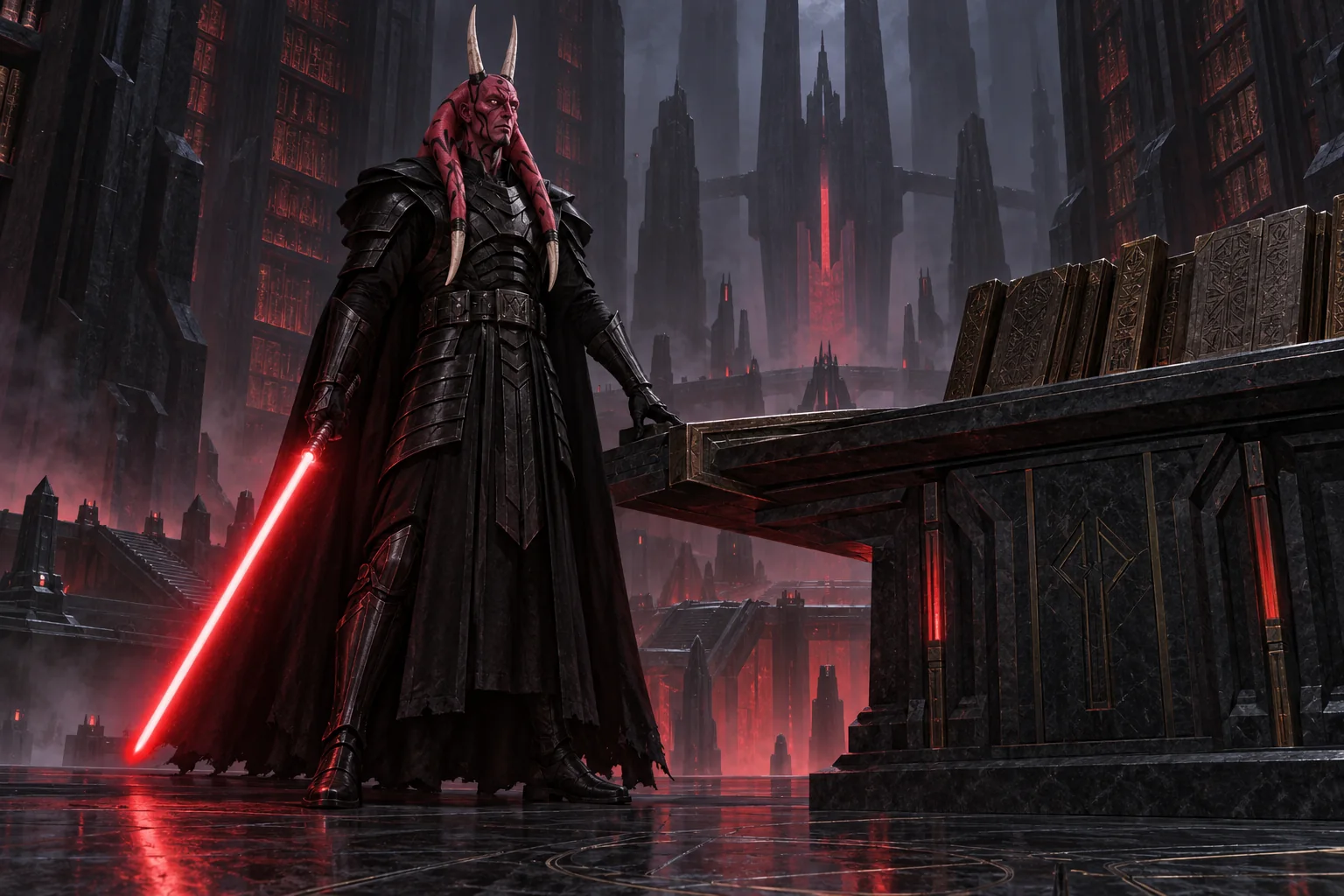
Darth Wyyrlok III is a Chagrian Sith Lord whose position carries an unusual family history. He is the third generation to serve Krayt under the Wyyrlok name. His grandfather and mother preceded him, and he expects his daughter Saarai to continue that service. The repeated name identifies more than a succession of individuals. It gives continuity to an office beside a ruler who survives across generations. [1]
His closest responsibilities concern the emperor’s health, knowledge, and access. Krayt’s Yuuzhan Vong alterations threaten his body, requiring periods of stasis. An attendant who can maintain the ruler during those absences also becomes an interpreter of his intentions. Wyyrlok’s learning makes him useful where a battlefield specialist would not suffice. He understands Sith ritual, consults archives, and can explain the leader’s condition to others.
IDS interpretation: Hereditary service and personal trust reinforce each other, but they remain different sources of authority. The family name supplies an expectation of competence and loyalty. The actual office supplies access to the ruler, his body, and his decisions. Wyyrlok’s eventual betrayal becomes possible through that access. His family’s long service helps make his explanations believable before anyone examines whether they are true.
The Sith seizure of Imperial government
When Krayt takes the Imperial throne in 130 ABY, Wyyrlok belongs to the inner circle supporting the takeover. The victim thought to be Roan Fel is a double, and the real emperor survives. A political victory therefore leaves an unresolved rival whose continued existence shapes the new regime’s security priorities. Wyyrlok serves a religious leader who has become a sovereign, while much of the machinery surrounding them remains Imperial. [2]
That overlap matters for the adviser’s work. A Sith order can be organized around masters, apprentices, and personal recognition. An empire requires officials, fleets, intelligence, and commands intelligible to people outside the order. Wyyrlok’s ability to speak for Krayt joins these settings. His influence cannot be measured only by whom he can defeat with a lightsaber. He can define what the institutions believe the ruler has ordered.
Cade and the problem of healing
Krayt’s effort to recruit Cade Skywalker brings the ruler’s private needs into the court’s public business. Cade’s ability to restore life appears to offer relief from the biological process consuming the emperor. Wyyrlok participates in the attempt to bring him under Sith control, but Cade’s escape exposes the limits of the plan. The desired healer remains an adversary with reasons to resist the institution demanding his service. [3]
The escape also damages the standing of Talon and Nihl. Wyyrlok helps manage the consequences of Krayt’s anger and the need to replace ineffective agents. This is an adviser’s political task as much as a medical one. He must preserve useful personnel, respond to failure, and keep a distressed emperor from destroying resources he may still need.
Into the Core: the encounter with Andeddu
In Legacy #27, Wyyrlok searches for answers in the lore of Darth Andeddu. The holocron directs him toward Prakith and the ancient Sith Lord’s true burial place. He overcomes the Malevolence cult through illusions, making its members attack one another. Gerlun, a surviving devotee, then helps him reach the deeper chamber. [4]
Andeddu returns through the joining of his remains and holocron, but refuses to become a cooperative teacher. The confrontation becomes a contest over perception. Wyyrlok wins by making the ancient ruler believe his accumulated writings are being destroyed. The threat targets something Andeddu values beyond his immediate physical safety. Wyyrlok recognizes that an opponent’s dependence can be intellectual and emotional as well as bodily. [5]
IDS interpretation: The episode also complicates the simple picture of Wyyrlok as an obedient keeper of tradition. He is willing to confront an ancient authority and defeat it through its own vulnerability. Learning does not make him deferential to every predecessor. He claims authority for the living One Sith against a dead ruler who treats knowledge as personal property.
Had Abbadon: service becomes murder
The trap on Had Abbadon brings Krayt into conflict with Cade’s allies and Celeste Morne, who carries Karness Muur’s talisman. The emperor is gravely injured. Wyyrlok reaches him afterward and kills him with Force lightning, justifying the act through the survival of Krayt’s larger project. The deed changes the relation between loyalty to the man and loyalty to the institution he founded. [6]
Wyyrlok does not announce an open succession. He places the body in stasis on Korriban and presents the emperor’s absence as another period of recovery. The explanation works because such absences are already familiar. A lie about a new event is supported by an established institutional routine.
Government through an absent emperor
As the concealed ruler of the Sith regime, Wyyrlok continues to invoke Krayt’s will. He also directs the Final Protocol on Dac. The campaign moves beyond punishment of selected opponents toward poisoning a planetary environment and exterminating its inhabitants. Its consequences show that scholarly skill and administrative composure do not restrain his willingness to authorize mass killing. [7]
The concealment produces a fragile arrangement. Stryfe can remain obedient because he believes the regent represents Krayt. Maladi suspects deception. Nihl investigates. These reactions do not make the whole court a single coordinated opposition. Each person has different access, interests, and reasons to doubt the official account.
Krayt returns
Krayt’s restored presence destroys the basic premise of Wyyrlok’s government. In Legacy: War #1, the returning Dark Lord reaches the temple with Talon and Nihl. Wyyrlok confronts him through combat and mental assault, using memories of suffering as a weapon. Krayt survives that challenge and kills the regent. Stryfe accepts the victor. [8]
Wyyrlok’s death ends his claim to supremacy, but it does not erase the institutional problem exposed by his coup. An order that treats its founder’s will as supreme still needs somebody to explain that will when he cannot speak. The regent’s crime reveals how much authority had already been delegated. His defeat restores personal command through violence rather than establishing a new system of succession.
Relationships and belonging
Wyyrlok’s relationship with Krayt combines care, intellectual service, friendship, and political subordination. He can challenge a decision without initially rejecting the ruler’s authority. That space for advice makes him more than a ceremonial attendant. Krayt relies on a person able to notice weaknesses and formulate responses. The eventual murder therefore arises inside a relationship that once rewarded close observation. [1]
His mother and grandfather connect the office to family continuity. Saarai extends that expectation forward. Wyyrlok wants her to inherit his name and place, but she is also a daughter whose safety matters to him. His concern for her during Krayt’s return should be understood as a specific personal tie. It does not cancel the violence he authorizes against unrelated populations.
Andeddu is an adversarial source of knowledge. Gerlun belongs to that encounter as a cult follower whose recognition can be manipulated. Neither becomes a durable ally in Wyyrlok’s court. Their episode illustrates a relationship organized around unequal access to a secret rather than shared political membership.
IDS interpretation: Stryfe, Maladi, and Nihl test the regent’s control of information in different ways. Stryfe needs an authorized commander. Maladi evaluates the credibility of the official story. Nihl’s investigation threatens to turn suspicion into evidence. A relationship guide should therefore identify changing expectations instead of assigning everyone a permanent label such as loyal or disloyal.
The people killed or endangered on Dac also belong in an account of his relationships. They are governed subjects and targeted populations, not merely background to a court drama. Wyyrlok’s authority reaches them through commanders and biological specialists whose work makes his decisions effective at a distance.
Explore the character
Who depends on Wyyrlok?
Choose a phase to see how personal service, information, and authority change his relationships.
Authority through proximity
Wyyrlok manages health, knowledge, and access while serving as a trusted interpreter.
Family continuity makes the office something he hopes to transmit to another generation.
Ancient expertise promises a cure but does not accept Wyyrlok as an entitled recipient.
Different dependencies meet in the same office.
Identity and social position
Wyyrlok III is a Chagrian, a Sith practitioner, and a hereditary officeholder. These categories describe different aspects of his position. Species identifies a biological classification. Sith membership identifies training and religious allegiance. The family name identifies a claim to continuity within Krayt’s household. None alone explains the full extent of his influence.
His title presents service as an inherited distinction. Repeating the name allows an institution to speak of continuity even when the individual changes. Krayt’s long life makes that continuity particularly useful: the same emperor can be attended by successive members of one family. A subject encountering the name may recognize an office without knowing the biography of its current holder.
IDS interpretation: The coup changes the meaning of that inherited position. The first servant claims the authority to decide that the master must die. His argument treats familiarity with the founder’s project as a qualification to replace the founder. The shift is not simply from low rank to high rank. It turns an office built around representation into a claim to independent judgment.
His tattoos and Sith presentation identify him with the order he serves. Their institutional meaning should not be replaced by assumptions about all Chagrians. The stories concern a particular Sith elite, not a claim that his species shares his political beliefs. The distinction matters because Dac’s fate likewise demonstrates the danger of treating entire populations as if they possessed one intention.
Institutions and power
Three institutions organize Wyyrlok’s work: the One Sith, the Sith-controlled Empire, and his hereditary service beside Krayt. The order supplies doctrine, training, and recognized status. The state supplies command over officials and armed forces. The household position supplies intimate access to the ruler and his condition. Wyyrlok’s political effectiveness comes from operating across all three.
A regent is supposed to maintain authority during a ruler’s absence. That arrangement requires trust because the ruler cannot personally verify every explanation. Wyyrlok’s deception exploits this ordinary delegation. He does not need to invent a wholly new office. He uses an existing responsibility to conceal a decisive change in who actually governs.
The Final Protocol demonstrates a second institutional relationship: a command must be carried out by other people and systems. Poisoning Dac requires specialists, delivery, enforcement, and naval power. Responsibility therefore has several levels. Wyyrlok authorizes the policy, while other officials make the destruction possible. Identifying that chain prevents the outcome from being explained as a single spontaneous outburst. [7]
IDS interpretation: Krayt’s return restores one ruler but leaves the underlying dependence intact. Large organizations need interpreters and delegates. A doctrine of absolute personal authority cannot remove the practical work those people perform. It can punish betrayal afterward, yet punishment does not explain how future absences should be governed or independently checked.
Beliefs and worldview
Wyyrlok endorses the One Sith’s collective project but concludes that Krayt’s continued life can obstruct it. His justification for murder separates the founder from the founder’s vision. This is the key ideological change in his story. He does not initially reject the order and become an opponent of Sith domination. He claims that domination will be better secured under his judgment.
His encounter with Andeddu also shows a disagreement within Sith tradition. Ancient knowledge is valuable, but an ancient practitioner’s authority is not beyond challenge. Wyyrlok answers refusal with contest rather than submission. The living order’s ambitions take precedence over the dead ruler’s desire to guard his secrets. [4]
IDS interpretation: The regent’s claims should be assessed alongside his actions. An appeal to collective purpose can justify removing an individual, but it does not establish that the collective benefits. On Dac, his government treats extermination as an acceptable policy. The language of unity therefore coexists with an extreme exclusion of people defined as obstacles.
The story also raises a question about sincere belief. Wyyrlok can care about the order’s future and still use that concern to authorize personal supremacy. Readers do not have to choose between a wholly sincere servant and a wholly cynical usurper. A committed believer can interpret institutional survival in ways that reward his own authority. The justification must be evaluated through its consequences and the alternatives it suppresses.
Material life and appearance
Stasis chambers are central to Wyyrlok’s position. They preserve Krayt’s body and make the emperor’s absence a recurring part of government. After Had Abbadon, the same kind of equipment helps conceal a death. A device used for care becomes an instrument of deception because the surrounding institution accepts the regent’s explanation of what it contains.
Holocrons, books, and scrolls organize his intellectual labor. The mission to Prakith depends on recognizing that a famous tomb can be false and that an archive can direct a search elsewhere. Knowledge is distributed across objects, locations, gatekeepers, and living interpreters. Having one artifact does not automatically supply the desired answer. [5]
The confrontation with Andeddu makes writings emotionally consequential. Wyyrlok threatens their destruction through illusion because he recognizes how closely their owner ties them to continued existence. The texts survive physically while the ancient ruler loses. The episode separates the preservation of information from the preservation of its author.
IDS interpretation: Wyyrlok’s material environment differs from the simple image of a Sith surrounded only by weapons. He works with medical equipment, archives, and controlled spaces. These objects give his decisions practical effect. A lightsaber can kill an opponent, but a stasis chamber and a credible account can keep an entire court from recognizing that its ruler has already died. Material arrangements help determine which facts become publicly visible.
Historical significance
Wyyrlok III gives Legacy one of its clearest examples of succession inside a religious government. His coup exposes a contradiction in the Rule of One: members are directed toward a unified purpose, but the founder’s survival becomes increasingly difficult to distinguish from the survival of that purpose. The regent resolves the contradiction by killing the founder, then avoids openly admitting that he has done so.
His family also makes the scale of Krayt’s life visible. Generations of attendants pass through the same office. The emperor’s exceptional duration is maintained through ordinary continuity in care, learning, and service. Wyyrlok’s story brings those usually less visible activities into the center of the political narrative.
The mission to Andeddu connects the contemporary One Sith to much older Sith archives. That connection is selective and conflictual. Earlier Sith do not simply endorse Krayt’s institution. Their preserved authority can obstruct it, and a living scholar can respond through force and reinterpretation.
IDS interpretation: His ending is significant because victory decides the claim to leadership without validating the principles behind it. Krayt wins the confrontation and retakes command. That result proves who prevails in that encounter. It does not prove that the order has solved the problems of absence, succession, information, or responsibility. The court survives the regent’s death with those problems still present.
Speaking for an absent ruler
Who may speak for an absent ruler?
Wyyrlok’s coup provides a focused case for examining representation. Before the murder, he legitimately explains Krayt’s condition and carries instructions into institutions the emperor cannot constantly supervise. After the murder, he continues similar actions while their factual basis has changed. To an official outside the inner circle, the form of government can look continuous even though the ruler’s body is no longer alive.
IDS interpretation: The deception depends on three conditions. First, Krayt has a history of withdrawing into stasis. Second, Wyyrlok controls access to him. Third, the court already recognizes the adviser’s ability to interpret his intentions. Those conditions make the invented explanation plausible. The regent’s authority is therefore supported by routine practices that predate his crime.
A useful question is not only whether Stryfe believes the account. It is what evidence Stryfe can access without challenging the very hierarchy he is supposed to obey. An institution that treats scrutiny as disloyalty can make verification difficult. Maladi’s suspicion and Nihl’s investigation matter because they challenge the account at the level of information, not simply through rival ambition.
An archive is not an obedient teacher
Andeddu’s holocron offers a different problem of representation. A preserved gatekeeper speaks for an absent Sith Lord and regulates access to his knowledge. Wyyrlok wants information useful to Krayt, but the representation does not accept his needs as sufficient qualification. The artifact has its own conditions of disclosure.
IDS interpretation: These two episodes should not be flattened into a claim that every representation is fraudulent. Wyyrlok’s statement about Krayt’s stasis is a deliberate concealment. Andeddu’s gatekeeper is an actual feature of the fictional technology. What they share is the practical question of how a seeker can verify an authoritative voice when the person being represented is inaccessible.
Government and extermination
The Final Protocol requires the analysis to move beyond the temple. Dac’s inhabitants do not get to debate the regent’s succession argument before its consequences reach them. They face decisions transmitted through military and biological systems. The difference between the court’s uncertainty and the victims’ vulnerability is essential to understanding the event.
IDS interpretation: Studying bureaucracy does not reduce responsibility to paperwork or make perpetrators less violent. It identifies how a decision becomes repeatable, distributable, and enforceable. Wyyrlok’s command is dangerous precisely because a state can transform it into coordinated action. His scholarship, composure, and family attachments coexist with that willingness to use the institution for mass destruction.
Lore challenge
How well do you know Darth Wyyrlok III?
Five questions, with an explanation and a source after every answer.
Question 1 of 5
What makes Wyyrlok’s title unusual?
Anthropological assessment
IDS interpretation: Wyyrlok III illustrates how hereditary service can create authority without initially creating a separate sovereign office. His family’s continuity makes him recognizable, while personal proximity lets him evaluate the ruler’s weaknesses. Medical attendance, intellectual expertise, and political interpretation accumulate in one position. The coup turns those combined responsibilities into a claim that he can decide the founder’s future.
His story also distinguishes personal loyalty from institutional loyalty. The two may support each other until the servant concludes that the person threatens the project. That conclusion needs scrutiny. It can describe a real conflict, but it can also authorize a follower to define collective survival around his own command. Wyyrlok provides no procedure through which the people affected by that judgment can challenge it.
The material side of the case is equally specific. Stasis equipment conceals the emperor’s death. Holocrons direct a search for immortality. Writings become the target of an illusion because they carry an ancient ruler’s investment in continued identity. The archive and the body are active resources in political practice, even though their meaning depends on the people using them.
The strongest assessment therefore connects the private chamber to the governed world. Wyyrlok’s access permits concealment inside the court, and Imperial command permits destruction on Dac. His family history and expertise help explain the form of his authority. They do not provide evidence that his authority is legitimate or that its consequences serve the populations subjected to it.
Collecting this character
Legacy #27, Into the Core, is the most focused single-issue starting point for Wyyrlok. Its confrontation with Andeddu gives the loremaster a story built around his own abilities rather than a brief appearance beside Krayt. Legacy #31 covers the decisive betrayal, and Legacy: War #1 shows its final consequence. Check an edition’s contents before buying a collected volume, because issue numbering and volume numbering describe different things.
For a character display, distinguish Wyyrlok III from the earlier family members sharing his title. A listing using only Darth Wyyrlok may not identify the intended generation. Comic art, issue covers, and licensed reproductions should be assessed by their actual image and publication record. The AI illustrations on this page are editorial interpretations. They are not photographs of manufactured collectibles or evidence that a particular figure, card, or statue was released.
Sources and reading guide
Primary stories establish events. Community references help locate those stories and identify their chronology. AI artwork and IDS analysis are not additional story evidence.
Follow the story
- Legacy #0 introduces the order’s major offices and figures. The regular series establishes Wyyrlok’s service beside Krayt.
- Legacy #14–19: Claws of the Dragon places the adviser inside the attempt to recruit and control Cade.
- Legacy #27: Into the Core is the essential Wyyrlok and Andeddu story.
- Legacy #28–31: Vector leads to the murder and concealment. Later issues develop the regency; Legacy: War #1 resolves it.
- Legends reference and story locatorDarth Wyyrlok III
- Legends reference and story locatorAttack on Emperor Fel
- Legends reference and story locatorLegacy #19
- Official publisher recordLegacy #27: Into the Core
- Legends reference and story locatorMission to Prakith
- Legends reference and story locatorLegacy #31: Vector conclusion
- Legends reference and story locatorFinal Protocol
- Legends reference and story locatorLegacy: War #1
Event statements follow the Legends stories listed here. Interpretive arguments and invented illustration settings are labeled separately.