
Muur’s talisman preserves an ancient will that seeks new bodies and armies. His page follows the Vector crossover through Celeste Morne’s resistance and the final destruction of the artifact.
Life and history
An ancient will across four eras
Select a stage to explore the event and its significance. BBY and ABY mean before and after the Battle of Yavin.
Conquest follows defeat
The exiles reach Korriban and acquire authority over the native Sith.
Read the supporting sourceWhy this matters
A displaced faction becomes a ruling group elsewhere.
Biography
A life extended through other lives
Karness Muur belongs to the ancient history of the Sith, but his most consequential later appearances depend on an artifact that outlives his original body. An exiled Dark Jedi, alchemist, and one of the early Sith Lords, he seeks domination through the Muur Talisman and the rakghoul transformation associated with it. His continuing presence connects the Hundred-Year Darkness to the four eras crossed by the Vector story. The connection is personal: a preserved will continues trying to acquire bodies and followers. [1][2]
Muur’s biography is therefore not an ordinary sequence from birth to death. His physical life, the creation of the talisman, the persistence of his spirit, and his attempts to use later hosts are separate stages. The distinctions matter because a character who survives in an object does not possess the same freedom as a living ruler. Muur needs contact, a susceptible bearer, and opportunities to overcome the person carrying him. The artifact preserves power while also creating dependencies.
The Dark Jedi Exiles
During the Hundred-Year Darkness, Dark Jedi fight the Jedi Order over practices that include manipulating life through the Force. Defeat and exile bring a surviving group to Korriban, where they acquire authority over the native Sith population. Ajunta Pall becomes the first Dark Lord, while figures including Muur and Sorzus Syn help establish the traditions later Sith will remember as their ancestry. The native Sith people and the visiting Dark Jedi are not interchangeable categories. [3][4]
Muur’s place in that history is the place of a conqueror and specialist, not a member of Krayt’s much later One Sith court. The shared Sith designation spans radically different political arrangements and periods. His association with the ancient exiles explains how alchemy, conquest, and secret instruction enter later Sith memory without making every later order identical to the first.
Sorzus Syn’s role is particularly important to the talisman. The artifact is made by Syn for Muur, rather than being simply an object he independently constructs in isolation. Muur’s later use and occupation of it do not erase the maker’s contribution. The history distinguishes the person who creates an instrument, the person for whom it is made, and the people subjected to its effects. [4][5]
The rakghoul project
The Muur Talisman can transform beings into rakghouls and place the resulting creatures under its influence. The transformation makes bodies into a route toward mass domination. An individual bearer carries an object whose effects can spread outward through others; the apparent scale of the object is consequently much smaller than the scale of its possible violence. [2][5]
The story also establishes limits. Early restrictions include resistance among Force-sensitive beings and some species. Infection and later circumstances complicate those limits, so it is unhelpful to turn the artifact into an unlimited device capable of instantly controlling everyone. Its specific workings produce the plot: whom it can affect, who can resist, and what kind of host Muur seeks all matter.
After Muur’s physical death, his spirit remains bound to the talisman. Preservation does not end desire. He continues to seek a body through which he can act more freely and a population through which he can rule. The object consequently combines a technical function with an occupant whose intentions must be considered. Handling it is not the same as discovering an inert piece of ancient jewelry. [1][2]
Celeste Morne on Taris
In 3963 BBY, Jedi Covenant agent Celeste Morne becomes involved in the search for the talisman on Taris. Her mission intersects with Zayne Carrick’s story and Mandalorian activity. When the artifact attaches itself to her, its ancient danger enters a living person’s immediate struggle. Morne becomes both a potential host and the person containing a threat that others cannot safely ignore. [6][7]
The Vector narrative makes that captivity central. Muur tries to overcome Morne’s will, while she resists becoming the means of his return. Her predicament is not simply the possession of a powerful tool that she could choose to use for good. The object contains a hostile intelligence attempting to redefine the person carrying it. Her ability to endure and resist is therefore part of the story’s continuing defense against Muur.
Dreypa’s Oubliette becomes a means of containment. Created by another ancient exile, Remulus Dreypa, it preserves someone within stasis and prevents the immediate spread of the crisis. Morne enters it, and the talisman’s danger is suspended across a vast interval. The solution saves others from an immediate outbreak while placing the burden of preservation on the captive herself. [8]
The interruption of ordinary time
Morne’s long confinement creates a strange chronology. For later observers, thousands of years separate the talisman’s ancient origin from the political world of Darth Vader. For Morne, confinement interrupts the ordinary passage through relationships, institutions, and generations. She emerges into a world where the people who could have understood her original mission are long gone. The artifact carries continuity at the cost of her continuity with a living community.
The Oubliette should therefore be read as more than an ingenious solution to a technical problem. Containment has a subject. It preserves a person and a threat together, making the person responsible for holding a danger across time. A story about successful quarantine can also be a story about isolation, lost ordinary life, and the difficulty of finding anyone able to relieve the burden.
Muur experiences the passage differently. His ambition is not tied to preserving Morne’s historical world. New rulers and new Force-users offer new possible vessels. Political change can remove familiar institutions while supplying another opportunity for possession. The contrast between their interests keeps the shared object from producing a shared identity.
Vader and the dark times
When Darth Vader encounters Morne and the talisman during the Dark Times portion of Vector, Muur recognizes a potential host of exceptional power. Vader’s interest in ancient power also makes the artifact dangerous to handle. Their encounter does not become a stable alliance between two Sith separated by millennia. Muur wants an instrument for his own return, and Morne continues resisting him. [9]
The resulting rakghoul violence demonstrates how quickly an archaeological encounter can become a biological emergency. Personnel who regard the object as a prize or a source of knowledge encounter consequences that do not remain confined to the original finder. Muur’s means of domination operates through the people around the artifact, not only through negotiations with its bearer.
Vader’s presence also clarifies a limit of Sith affiliation. Shared opposition to the Jedi does not make one Sith safe from another’s ambitions. A prospective host is valuable precisely because of his strength, and that value invites an attempt to dispossess him. The talisman’s preserved authority can threaten a later practitioner who imagines he is mastering an older tradition.
The Rebellion encounter
The Rebellion chapters bring Luke Skywalker and Leia Organa into contact with Morne’s continuing predicament. The encounter places the talisman in another political world without resolving the ancient occupant’s intentions. Once again, resistance and survival matter more than possession of the artifact as a trophy. Its movement across eras is a history of repeated danger, not a succession of owners who simply add its power to their own. [10]
Morne’s longevity should not be confused with ease or unrestricted immortality. The preservation of her body does not restore the relationships and choices lost through confinement. Her story gives Muur’s pursuit of endless existence a visible human cost. The same continuity he celebrates can become captivity for the person whose life makes it possible.
For readers, the four-series structure is part of the experience. Vector begins in Knights of the Old Republic, moves through Dark Times and Rebellion, and concludes in Legacy. Each setting supplies new people, but Morne and the talisman give the crossover a persistent conflict. Keeping those installments in order makes the final confrontation much clearer than treating the Legacy chapters as an isolated ancient-Sith cameo. [7]
Had Abbadon and the final host contest
In the Legacy era, the talisman enters the struggle around Darth Krayt and Cade Skywalker. Krayt’s failing health makes a promise of ancient power attractive, while Cade’s unusual abilities make him another potential vessel. Morne participates in the confrontation at Had Abbadon, but Muur’s interest remains his own emergence. He is not simply a cooperative member of the anti-Krayt group. [11][12]
This collision places several claims over bodies in one scene. Krayt wants a way to escape the deterioration of his own. Muur wants a powerful body through which to resume control. Cade can heal, kill, or become a target himself. Morne wants the captivity ended without releasing its occupant into a new victim. Their goals overlap only temporarily and incompletely.
Morne ultimately allows Cade to end her life and destroy the talisman. Muur’s attempt to secure a new future fails with the destruction of the object binding his spirit. The conclusion ends an ancient threat through the bearer’s decision and Cade’s intervention, rather than awarding the talisman to a stronger ruler. Morne’s release must remain central to that ending; it is not merely a final step in somebody else’s duel. [12]
Relationships and belonging
Sorzus Syn is the maker whose technical and ritual contribution underlies Muur’s later power. Their connection shows an ancient Sith world in which specialist knowledge is distributed among several exiles. Muur’s ownership of the talisman does not make him the sole author of its existence. Remulus Dreypa provides another relation among the exiles: rivalry and containment produce an object used much later to suspend the crisis. [4][8]
Celeste Morne is the person Muur most persistently attempts to subordinate. The relationship is coercive, yet it is not a successful erasure of her identity. Her resistance interrupts his plans over thousands of years. Calling her simply his host can obscure that continuing opposition. She is also an agent whose decisions determine whether others become victims. [6]
Vader, Krayt, and Cade are prospective bodies or instruments from Muur’s perspective. Their own ambitions do not make them interchangeable. Vader encounters the threat as an Imperial enforcer, Krayt seeks relief from a failing body, and Cade confronts it amid a mission against the One Sith. Each situation gives the ancient spirit a different opening, while none grants him unquestioned ownership. [9][11]
Zayne, Luke, Leia, and the other Vector participants connect Morne’s predicament to living communities she did not choose to leave. The relations are interrupted by the crossover’s chronology, but their actions help prevent Muur from converting endurance into final victory. The page’s connected files emphasize the ancient Sith and Legacy intersections without pretending that every encounter belongs to a single contemporary court.
Explore the character
Who makes, carries, and contests the talisman?
Separate the maker, the bearer, and the prospective hosts.
An artifact with several authors of its history
Her work enables the artifact.
He uses its transforming influence to seek domination.
Their bodies become the means of its violence.
Ownership does not erase craftsmanship or victims.
Identity and social position
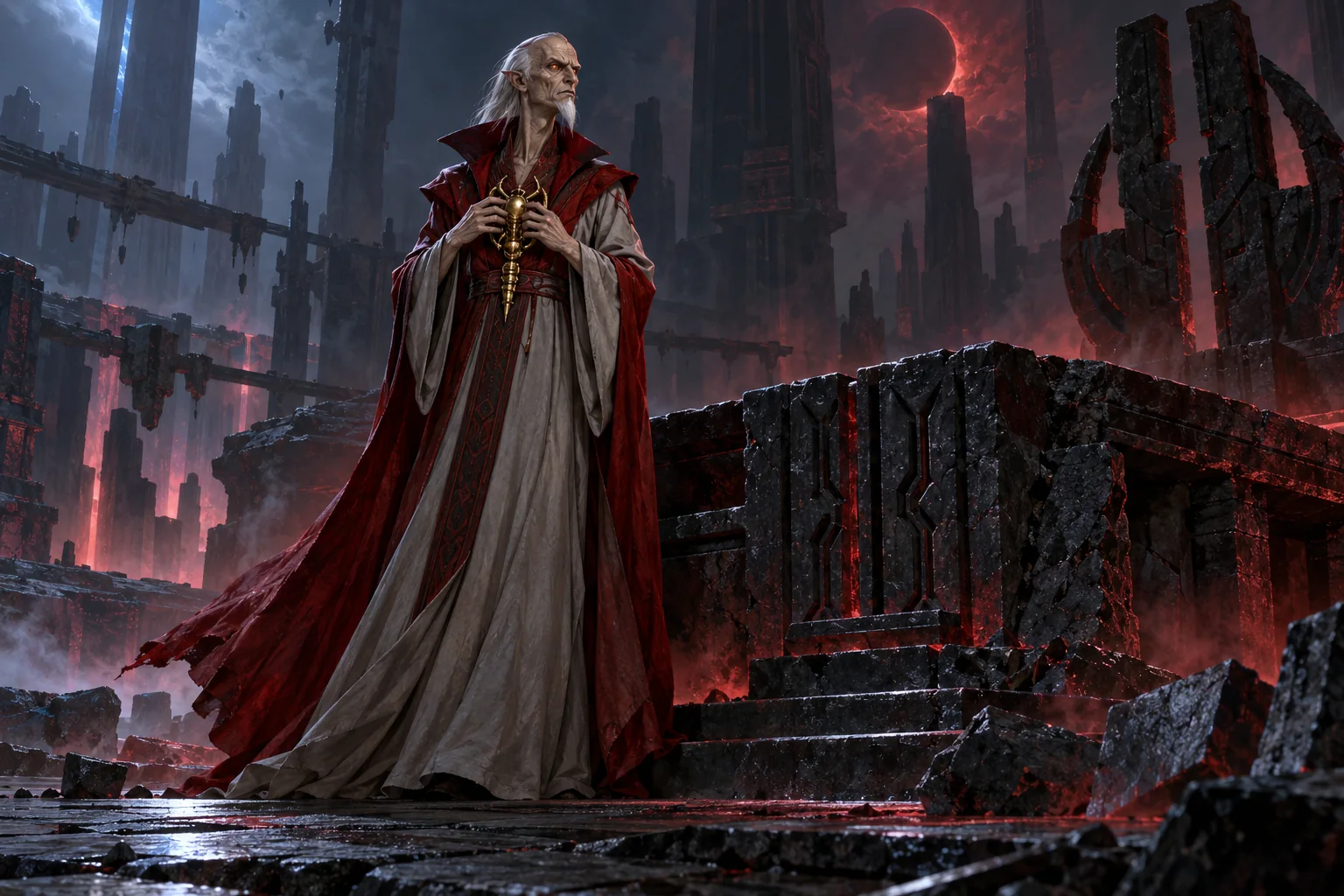
Muur is Human, despite the pointed ears and distinctive appearance used in his published design. Visual stylization should not silently change the species stated by the reference record. He is an ancient Dark Jedi exile who becomes a Sith Lord, rather than a native Sith whose entire life begins within the society the exiles conquer. Those distinctions affect how his authority is understood. [1][3]
His identity later becomes inseparable from an artifact, but not reducible to it. A talisman is a made object with a history of design and use; Muur is the hostile will that persists through it. Separating those categories permits a clearer account of what is preserved. The object can survive as material while the spirit depends on particular conditions for effective action.
IDS interpretation: Muur’s continued selfhood is organized around entitlement to other people’s bodies. He treats a possible host as a route back to agency, while giving the host’s own agency little weight. The wish to remain a person thus becomes a program for making another person into equipment. This contradiction gives his survival story its ethical force.
Morne’s identity offers the counterpoint. Her inability to leave the talisman does not mean she agrees with its occupant. Her personal history, resistance, and final choice must be kept separate from the ancient spirit’s ambitions. The artwork on this page concentrates on Muur alone so that a dramatic image does not accidentally imply that the bearer’s face or body belongs to him by right.
Institutions and power
The Dark Jedi Exiles emerge from a conflict within the Jedi world and establish a new ruling tradition on Korriban. Their use of the native Sith as subjects makes institutional origin a history of domination as well as doctrinal innovation. Later Sith memory can celebrate powerful ancestors while suppressing the ordinary inhabitants whose submission made their rule possible. [3]
The Jedi Covenant supplies the institutional setting for Morne’s original mission. Her duty to obtain and contain an artifact becomes far more extensive than any ordinary field assignment. Once the talisman binds to her, the organization’s capacity to issue orders is less important than the practical question of how a person can continue resisting the threat. Her confinement outlasts the world that sent her. [6]
Later institutions encounter a danger whose lifespan exceeds theirs. Imperial personnel, rebels, Jedi, and the One Sith each operate with contemporary goals, but the artifact contains an ancient agenda. No organization can assume that acquiring it makes that agenda obedient. Technical expertise and political authority face a problem of independent will inside the supposed resource.
IDS interpretation: Muur illustrates why archives and containment systems require an account of occupants as well as objects. Cataloguing the talisman’s origin is useful, but insufficient. A responsible institution also needs to ask who carries the danger, who can consent to its handling, and how the cost of containment is distributed. Morne’s story makes those questions impossible to treat as abstract administration.
Beliefs and worldview
Muur’s beliefs center on domination through transformed life and continued existence through possession. He regards his will as something that deserves preservation, even when preservation requires displacing another person. The rakghoul project extends the same priority outward: beings can become controlled bodies rather than participants whose interests constrain him. [2][5]
That view differs from a neutral interest in longevity. Wanting to survive does not by itself explain what a person is willing to do to survive. Muur’s particular method makes the distinction visible. A promise of preserved selfhood becomes a threat to the selfhood of the intended bearer, and a promise of a controllable army becomes a catastrophe for the people transformed into it.
Ancient Sith knowledge is not presented as universally accepted by every later Sith. Vader and Krayt encounter Muur’s power through their own needs and expectations, while Muur continues to seek priority over them. Shared vocabulary and hostility toward Jedi do not resolve the competition between sovereign wills. The artifact carries a tradition and a claimant, not an impartial lesson.
IDS interpretation: The final destruction refuses the assumption that every surviving source of power ought to be inherited. Ending the talisman’s continuity can be preferable to transferring its ownership. Morne’s release and Muur’s defeat are linked because the object preserves a relationship of captivity, not merely a valuable body of historical information.
Material life and appearance
The talisman, Dreypa’s Oubliette, and infected bodies are the central material forms of this biography. Their functions are different. The talisman carries Muur’s continuing will and transforming influence. The Oubliette suspends a bearer and the danger. The transformed body becomes a means through which the danger reaches others. A useful account follows how each changes what the next person can do. [2][8]
The talisman’s worn scale is part of its effectiveness. Something small enough to attach to one person can produce effects across a crowd. That mismatch discourages judging a threat by the apparent size of its container. The wearer’s proximity to others matters, as does the possibility that infection continues beyond the initial act of transformation.
Stasis also changes the meaning of an archaeological find. Opening a preserved chamber can release a person who belongs to another historical world together with a threat that remains active. The discoverer is not only observing the past. The act of opening creates a new encounter in the present, with consequences that require more than knowledge of the object’s date.
The interpretive illustration uses Muur’s distinctive hair, beard, robes, and talisman to distinguish him from later Sith designs. The imagined setting does not claim to reconstruct a documented room. Visual continuity helps readers identify the character; the numbered sources establish the talisman’s manufacture, its bearers, and the episodes through which it travels.
Historical significance
Muur provides one of Legends’ clearest examples of ancient Sith power surviving into distant eras through a specific object. The continuity is not a vague statement that the dark side never disappears. It has an artifact, a bearer, identifiable encounters, and an ending. That concrete chain allows the reader to ask who maintains the continuity and who suffers because it continues. [7]
Vector’s publication structure gives that chain an unusual reach. A conflict beginning inside Knights of the Old Republic affects the Dark Times, the Rebellion, and finally Legacy. It connects stories through Morne’s continuing resistance rather than requiring every protagonist to become part of a single organization. Muur’s presence supplies continuity while the surrounding politics change.
His final encounter also complicates a simple comparison of ancient and modern Sith strength. The outcome depends on opportunities for possession, Morne’s decision, Cade’s abilities, and the talisman’s destruction. Reducing it to an abstract ranking of combat power loses the conditions that make the scene intelligible. The historical question is how this particular danger ends.
Muur’s significance therefore includes both his role in early Sith alchemy and the later story of refusing inheritance. The ancient object is not passed safely to a worthy owner. It is ended because the continuity it offers has become inseparable from captivity and exploitation. That is a distinctive outcome within a setting filled with recovered teachings and weapons.
The object and the person carrying it
The talisman can be read through three questions: who made it, who carries it, and who controls its effects? Sorzus Syn’s craftsmanship answers the first. Morne’s long captivity answers much of the second. Muur’s struggle to dominate her and obtain other bodies makes the third persistently contested. Combining those answers into the phrase Muur’s artifact would hide the relationships that give the object its history.
Containment does not erase those relationships. Dreypa’s Oubliette suspends an immediate crisis while preserving the burden inside it. When later figures open or encounter the preserved danger, the ethical question returns. The bearer still has a claim to be treated as a person, and the threat still has an intention beyond the discoverer’s plans.
IDS interpretation: The final scene resolves the object’s history by prioritizing release over acquisition. Morne’s choice does not turn her suffering into a necessary sacrifice for someone else’s collection. It ends the relationship that has held her and others at risk. The case makes a useful distinction between preserving information about a dangerous object and preserving the object’s ability to continue harming people.
Lore challenge
How well do you know Karness Muur?
Five questions, with an explanation and a source after every answer.
Question 1 of 5
Who makes the talisman for Muur?
Anthropological assessment
Muur’s biography is a study of power that survives through captivity. His continued agency requires material preservation and access to a living bearer, while the bearer’s agency is continually threatened. The archive should consequently keep the ancient lord, the artifact’s maker, and the resisting person in view together. None can be understood fully through the object alone.
The story also asks what historical continuity is worth preserving. Ancient origin can make an object important without making its continued use desirable. A society may document a practice, remember its victims, and still end the mechanism through which it perpetuates itself. Destroying the talisman does not require forgetting Muur’s history; it prevents that history from claiming another person’s body.
The strongest reading follows Morne’s resistance alongside Muur’s ambition. His survival is spectacular, but it does not make him the only agent spanning Vector. Her decisions determine how much of that ambition becomes effective and whether it gains another future. The contrast gives the page a more complete account of endurance than a list of the ancient Sith’s powers could provide.
Collecting this character
Vector crosses four comic series, so a complete reading set needs more than the Legacy conclusion. Check collected-edition contents for Knights of the Old Republic #25–28, Dark Times #11–12, Rebellion #15–16, and Legacy #28–31. Packaging and collection titles can vary between publishers and reprints; the issue list is a useful way to verify coverage.
For character-specific material, distinguish Muur’s visible appearances from objects or covers associated with the wider crossover. A talisman replica, a comic issue, and a dedicated portrait document different parts of the character’s reception. Verify maker and publication details before treating a fan-made object as licensed merchandise.
The two AI images on this page interpret Muur’s published design. They are not scans of Vector art or photographs of manufactured collectibles. A collection record should preserve that distinction and identify its source, rather than treating every recognizable depiction as the same kind of object.
Sources and reading guide
Primary stories establish events. Community references help locate those stories and identify their chronology. AI artwork and IDS analysis are not additional story evidence.
Follow the story
- Vector begins in Knights of the Old Republic #25–28.
- Dark Times #11–12 brings the preserved threat into Vader’s era.
- Rebellion #15–16 carries Morne’s predicament into the Alliance period.
- Legacy #28–31 concludes the crossover at Had Abbadon.
- Legends reference and story locatorKarness Muur
- Legends reference and story locatorMuur Talisman
- Legends reference and story locatorDark Jedi Exiles
- Legends reference and story locatorSorzus Syn
- Legends reference and story locatorRakghoul
- Legends reference and story locatorCeleste Morne
- Legends reference and story locatorVector
- Legends reference and story locatorDreypa’s Oubliette
- Legends reference and story locatorDark Times #12
- Legends reference and story locatorRebellion #16
- Legends reference and story locatorBattle on Had Abbadon
- Legends reference and story locatorLegacy #31
Event statements follow the Legends stories listed here. Interpretive arguments and invented illustration settings are labeled separately.