
Andeddu guards an archive of survival methods and a hidden body on Prakith. Later seekers make the knowledge influential in ways the ancient ruler cannot control.
Life and history
A secret carried through several Sith eras
Select a stage to explore the event and its significance. BBY and ABY mean before and after the Battle of Yavin.
A ruler guards his learning
Andeddu withdraws with his archive rather than share it with rivals.
Read the supporting sourceWhy this matters
Exclusive control becomes part of personal identity.
Biography
The ruler who tried to keep everything
Darth Andeddu is remembered through a guarded body of knowledge, a hidden burial place, a cult, and repeated attempts by later Sith to obtain his secrets. His central concern is preserving himself and the power attached to his learning. The result is a biography in which physical absence does not end influence, but influence never guarantees that later seekers will obey the person whose teachings they acquire. [1]
His ancient dates are not fixed with the same confidence as the events involving Bane or Wyyrlok. The page therefore avoids assigning an unsupported precise birth year or calling him conclusively the first person to use the Darth title. Those uncertain traditions are different from the identifiable later encounters that give his surviving legacy its narrative shape.
Prakith and the threatened archive
Andeddu rules on Prakith and acquires a reputation for sorcery and survival beyond ordinary death. His knowledge attracts rivals who want what he refuses to share. He withdraws to his homeworld and seals himself away with his accumulated writings rather than surrender control of them. The withdrawal preserves an archive while ending ordinary access to its living owner. [2]
Korriban holds a false tomb associated with him, while his true remains lie within Andeddu’s Keep on Prakith. The distinction makes location a part of secrecy. A prestigious burial site can give outsiders a plausible answer while concealing the place where the body and guarded materials actually remain. Later seekers must solve a geographical information problem before they can confront the occupant. [3]
This is not simply a story of a scholar protecting books from theft. Andeddu’s archive contains methods through which one person can attempt to preserve consciousness at another’s expense. The value of secrecy is inseparable from the kind of power being withheld. Access promises more than historical understanding; it promises a possible route around mortality.
Essence transfer and the question of a vessel
Andeddu’s teachings center on essence transfer, a dark-side practice through which consciousness can move into another vessel. A physical body can be treated as replaceable while the practitioner imagines the self as the valuable element to preserve. The method is dangerous and contested, not a universal guarantee that any Sith can become immortal by reading a few instructions. [4]
The vessel also needs an ethical description. If it is another person, the promised survival of the practitioner threatens the person already inhabiting that body. Calling it a vessel can make dispossession sound like a technical step. The page keeps the prospective victim visible whenever survival is presented as an achievement.
Andeddu preserves his teaching in the Holocron of Heresies. The artifact can present a gatekeeper, deliver instruction, and play a role in the later reanimation of his remains. Those functions should not be assumed identical in every holocron. An instructional representation and a continuing spirit can have different relationships to their maker and to the material device. [5]
A cult waiting for return
The Malevolence maintains devotion to Andeddu on Prakith across a vast span of time. Members transmit teachings and remain in the keep, expecting the ancient master’s return. The cult supplies social continuity where the ruler’s direct public government has ended. A preserved archive is thus accompanied by a living community organized around its occupant. [6]
That community matters because it makes apparent isolation less complete than it looks. Andeddu can remain sealed away while followers preserve the location, traditions, and expectation of renewed authority. His survival project depends on people whose lives are not given the same narrative priority as his own.
The eventual fate of Gerlun makes the dependency especially stark. A devotee’s act can provide the energy for the master’s restoration while killing the devotee. The cult’s promise of return does not mean the returning ruler treats followers as people whose welfare constrains him. Devotion and protection are not equivalent relationships. [7]
Bane’s search for an escape from death
Darth Bane encounters the surviving teaching during the period covered by Dynasty of Evil. Having established the Rule of Two, he turns toward questions of succession and personal survival. Andeddu’s knowledge appears to offer a way around the vulnerability of a body and the possibility that an apprentice will end its master’s life. [8]
The holocron’s gatekeeper does not become a compliant adviser. Bane forces access to the secret rather than receiving it through peaceful instruction. The exchange reveals a conflict inside preservation: an artifact can maintain a teacher’s voice, but a later powerful student may treat that voice as an obstacle to be overcome.
Bane’s interest also connects immortality to his institutional project. The Rule of Two expects power to pass through a struggle between master and apprentice. A master seeking to preserve himself indefinitely raises questions about whether he is protecting the order or protecting his own place within it. Andeddu’s teaching enters that tension instead of solving it automatically.
Set Harth and knowledge leaving its owner
Set Harth becomes another important recipient of the holocron’s survival methods. His later use of cloned bodies supplies a different practical context for essence transfer. The archive’s influence extends through a seeker whose goals do not simply reproduce Bane’s plan or Andeddu’s original authority. [9]
The distinction matters to the meaning of inheritance. A teaching can survive because someone uses it differently from its maker’s intended audience. Andeddu’s knowledge continues, but the continuation is not necessarily the continuation of his command. The person guarding the archive cannot fully determine every later reader, application, or institutional setting.
Set’s case should also not be converted into a claim that all cloning solves mortality or that every practitioner can repeat his history without risk. It is a particular narrative example. The page follows what the story establishes about that user rather than presenting the technique as a general scientific rule of the setting.
A holocron in the Clone Wars world
The holocron later appears within the conflicts surrounding the Clone Wars, where Count Dooku’s interest in ancient Sith knowledge gives the artifact another route through living hands. The object’s movement shows that a secret can remain prestigious even when its original ruler has disappeared from ordinary history. Its crystal and teachings make it valuable to later practitioners. [5][10]
This stage also distinguishes the surviving object from the hidden remains on Prakith. Finding a holocron associated with Andeddu does not automatically disclose every fact about his burial or restore his original body. The archive’s circulation and the corpse’s concealment are connected histories with different locations and functions.
For the character page, that distinction prevents a confusing account in which Andeddu personally appears in every era where his artifact is found. Sometimes later people encounter a device and a teaching. Sometimes they encounter a reanimated ruler. The difference changes both the danger and the kinds of action available to the seeker.
Krayt asks the ancestors
Darth Krayt consults ancient Sith holocrons while trying to address the deterioration caused by his Yuuzhan Vong infestation. Andeddu’s surviving representation joins those of Bane and Nihilus in rejecting aspects of Krayt’s approach. The One Sith founder wants useful knowledge, but the ancestral voices do not simply validate his institution because he bears a Sith title. [11]
The exchange makes Sith history argumentative. Ancient authority can be invoked and still refuse the claimant’s interpretation. Krayt’s collective order differs from Bane’s concentrated succession and from Andeddu’s insistence on individual mastery. Shared hostility toward the Jedi does not make the traditions agree about what a true Sith should do.
Wyyrlok undertakes the practical search that follows. His goal is to help Krayt, which makes him a seeker acting for another sovereign’s benefit. That service is precisely the kind of relationship Andeddu is inclined to disdain. The mission consequently contains a doctrinal conflict before the final duel even begins. [12]
Gerlun’s fatal restoration
At the keep, Wyyrlok defeats the Malevolence and forces Gerlun to guide him to the concealed tomb. The holocron directs him toward placing it on Andeddu’s corpse, but Wyyrlok does not comply. Gerlun acts instead, hoping to reverse the defeat inflicted on the cult. The act drains his life and restores Andeddu’s body. [7][12]
The sequence separates devotion from informed control. Gerlun initiates the restoration, but the restored being determines the result. A follower’s willingness to serve does not make the cost transparent or safe. His life becomes the means through which the master re-enters action.
Andeddu refuses to share his knowledge with Wyyrlok and attacks him. The promised source of a cure becomes a hostile claimant rather than a cooperative researcher. Wyyrlok must survive the encounter before he can assess what the archive actually contains. [13]
The fear beneath the illusions
Their contest centers on illusion and belief. Andeddu conjures a threatening environment, but Wyyrlok turns the psychological struggle toward the ancient lord’s attachment to his writings and legacy. Apparent destruction of the archive makes Andeddu confront the loss he has spent ages trying to prevent. His own fear becomes the route to defeat. [13]
The books and scrolls are not actually destroyed in the imagined fire. Wyyrlok later examines the surviving materials and finds no solution to Krayt’s specific condition. That result is important. The archive can be ancient, dangerous, and prestigious without containing the answer the visitor needs. Historical significance is not the same as universal practical usefulness.
Andeddu’s restored body is returned to its sarcophagus. The ancient ruler’s final contest ends, while some writings leave with the seeker who defeated him. His wish to preserve both self and exclusive control has failed in different ways: the self cannot withstand the encounter, and the knowledge no longer remains entirely under his authority.
Keeping continuities separate
Andeddu’s name also receives a limited acknowledgment in current canon through Sith Eternal naming. That acknowledgment does not import every event in his Legends biography into current continuity. The full Prakith, Bane, Set Harth, and Wyyrlok history presented here belongs to Legends. [14]
The distinction is especially important for ancient characters whose names can be reused as fragments of later worldbuilding. A name can be recognized without confirming a precise birth date, every power, or every story associated with the older version. This file labels the continuity before drawing comparisons.
Andeddu’s lasting interest is the mismatch between preserving knowledge and controlling its future. His archive survives long enough to affect several eras, yet he cannot make those eras obey him. The knowledge becomes historically effective precisely through encounters that expose the limits of its owner’s control.
Relationships and belonging
The Malevolence gives Andeddu a community of followers whose devotion maintains an expectation of return. Gerlun supplies the fatal act that makes the expectation real for a moment. Their relation is asymmetrical: the master’s survival is valued above the follower’s life. Naming that cost prevents the cult from appearing merely as a picturesque guardian force. [6][7]
Bane and Set Harth are later seekers whose use of the holocron gives the teaching different futures. Bane’s concern intersects with the Rule of Two and a possible conflict with his apprentice. Set’s use intersects with cloned bodies and personal longevity. Neither simply restores Andeddu’s ancient government. A shared technique can support different projects. [8][9]
Krayt is the ruler whose failing health gives Wyyrlok a reason to seek the archive. Wyyrlok is both the practical investigator and the adversary who defeats the reanimated master. Their relationship reverses Andeddu’s assumed hierarchy: the visitor he dismisses as subordinate proves able to control the contest of minds. [12][13]
Karness Muur provides a useful earlier comparison in the tradition of preserving a will beyond bodily death. Muur’s talisman and Andeddu’s holocron are not identical technologies or histories. Reading their pages together reveals different routes through which ancient ambition depends on artifacts, followers, and prospective bodies.
Explore the character
What survives of Andeddu?
Compare cult devotion, transmitted teaching, and the final research mission.
The master’s return and the follower’s cost
The place anchors transmitted devotion.
Followers maintain the expectation across generations.
His act supplies life energy and kills him.
Social support does not guarantee reciprocal protection.
Identity and social position
Andeddu’s identity is distributed among a name, a reputation, an instructional representation, hidden remains, and a revived body. Those forms have different capacities. A reputation draws seekers; a gatekeeper controls access to teaching; a corpse can become the site of restoration. A complete account follows the transitions instead of assuming each form is simply the living man continuing unchanged.
The Darth title is part of his established name, but traditions about its earliest use remain uncertain. The page does not convert an ancient claim into a precise chronological record where the sources do not support one. Uncertainty is most useful when stated at the point where a reader might otherwise infer a false date or priority.
IDS interpretation: Andeddu defines himself through ownership of knowledge and refusal to be dispossessed. That definition makes the archive more than a resource. It becomes a vulnerable extension of the self. Wyyrlok’s apparent destruction of the writings succeeds because losing them threatens the identity the ancient lord has worked to preserve.
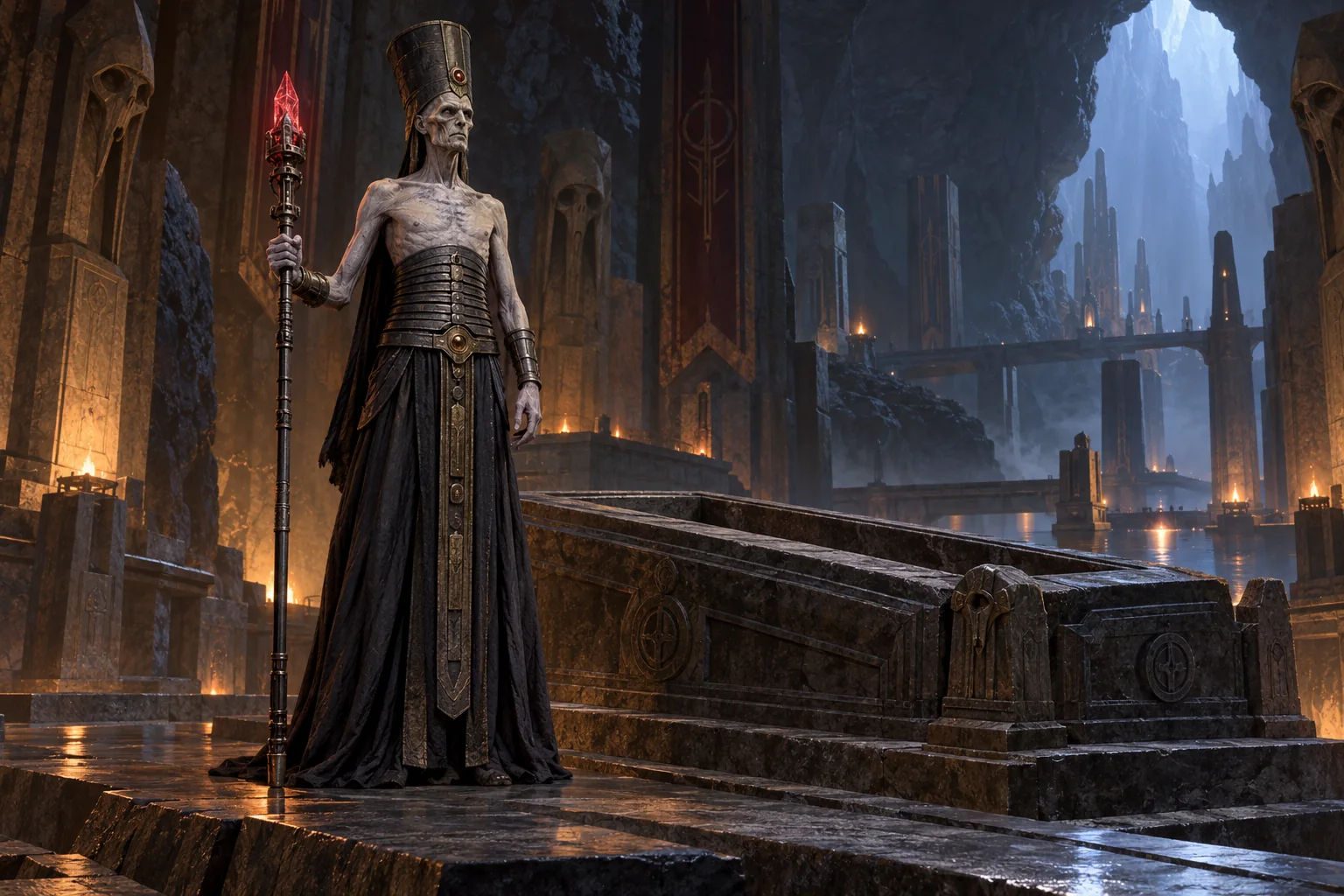
The AI illustrations depict a skeletal ancient Sith figure using published design cues. Their imagined architecture does not locate a newly discovered chamber or establish the exact condition of the keep at a named date. The sources, not the atmosphere of the images, establish where the body and archive are found.
Institutions and power
Andeddu’s rule on Prakith, the Malevolence, and later Sith orders are separate institutional settings. The first supplies a sovereign and territory; the cult supplies devotion across generations; Bane’s and Krayt’s projects supply later audiences with conflicting doctrines of succession and service. Ancient teaching moves through these settings without making them identical. [2][6]
The cult’s persistence shows how social transmission can extend a ruler’s influence beyond ordinary government. A community can preserve a location, practices, and a promised return after the ruler ceases to govern publicly. That preservation creates opportunities for later visitors, but it also creates people whose inherited duty exposes them to danger.
The holocron operates as a portable gate to knowledge. Access can be restricted through a surviving representation rather than through the physical presence of a teacher. Bane’s coercive acquisition demonstrates a limit: a sufficiently forceful seeker can attempt to break the gate rather than accept its terms. The archive’s institution of access is powerful without being invulnerable.
IDS interpretation: Wyyrlok’s visit separates institutional prestige from demonstrated relevance. The keep has antiquity, a cult, and guarded texts, yet lacks a cure for Krayt’s condition. An organization’s ability to preserve knowledge does not establish that the knowledge answers every later problem. The practical investigation has to occur rather than being replaced by reverence.
Beliefs and worldview
Andeddu treats self-mastery and exclusive control as central to Sith identity. Service to another ruler appears inferior from that perspective, even when the servant is a formidable practitioner. This belief shapes his contempt for Wyyrlok, whose mission is undertaken for Krayt’s benefit. The doctrinal judgment precedes and contributes to the failed assessment of his opponent. [13]
Essence transfer gives the belief a technique. The self is to be preserved while bodies become replaceable vessels. That promise requires attention to the people displaced or consumed by the process. Gerlun’s death reveals the cost at the moment the ancient lord returns. A doctrine of exceptional selfhood can make followers’ lives appear expendable.
The archive’s exclusivity also conflicts with inheritance. Knowledge can persist through transmission, but transmission gives another person possibilities the owner cannot wholly direct. Andeddu wants the authority of preserved learning while resisting the independence of later users. His dealings with Bane, Set, and Wyyrlok expose different versions of that contradiction.
IDS interpretation: His defeat does not prove that learning itself is weakness. The vulnerability is the identification of personal worth with an untouchable hoard and a permanently superior position. Wyyrlok attacks that attachment. The lesson concerns the possessive relationship to knowledge, rather than a rejection of historical inquiry.
Material life and appearance
Prakith’s keep, the concealed sarcophagus, the false Korriban tomb, the holocron, and the surviving texts each manage access differently. Architecture restricts movement. A decoy site misdirects inquiry. A device regulates instruction. Written materials preserve learning beyond conversation. Their combination makes secrecy a material system rather than only an attitude. [2][3][5]
The corpse’s condition also matters. Restoration requires a specific encounter between artifact, remains, and life energy. Gerlun supplies the final element at the cost of himself. The scene is not an abstract declaration that Andeddu is immortal; it is a process with an identifiable victim and an interruptible outcome. [7]
The imagined fire in the duel gives material objects psychological force without physically consuming them. Andeddu responds to what he believes is happening, while Wyyrlok later handles the intact archive. The distinction between perceived and actual destruction is necessary to explain both the defeat and the subsequent research.
The images present atmosphere and visual recognition rather than an inventory of the archive. A dramatic staff, robe, or chamber does not establish the contents of a manuscript or a cure hidden in a shelf. The biography keeps the practical result of Wyyrlok’s examination separate from the prestige suggested by ancient surroundings.
Historical significance
Andeddu links several Sith histories through the survival of a teaching. Bane seeks it during a succession crisis, Set uses it for longevity, and Krayt’s court seeks it for a failing sovereign. The same archive enters different projects, making its influence broader than the continuation of its original ruler. [8][9][12]
His encounter with Wyyrlok is also one of the clearest confrontations between ancient individualist Sith authority and service inside Krayt’s collective order. The ancient lord assumes service means inferiority. The servant defeats him, then discovers that the expected cure is absent. Both ideological prestige and technical promise are tested through events.
The story contributes a distinct account of failed immortality. The body returns, but the return does not create uncontested command or permanent safety. Preservation postpones a crisis without eliminating dependence, fear, or the possibility of defeat. The ancient ruler’s second emergence makes those limits visible.
For the archive, his significance is therefore a history of guarded knowledge escaping its owner’s control. The teaching travels farther than the ruler can govern. The page preserves that difference and avoids turning every later use of his name into evidence that his entire Legends biography belongs to another continuity.
Expertise tested against a particular need
Wyyrlok’s mission begins with an apparently sensible research question: can an ancient expert’s survival methods address Krayt’s failing body? The process requires locating the true remains, passing a hostile cult, resisting a restoration demand, surviving the revived expert, and examining the writings. Each step tests a different assumption about access, authority, and relevance.
The final answer is negative for the particular cure sought. That does not make the trip historically insignificant, and it does not make the archive harmless. It means that the initial promise should be evaluated against the actual question. A famous method of surviving death is not automatically a solution to every biological condition.
IDS interpretation: The mission is a useful case of expertise whose prestige exceeds its relevance. Wyyrlok succeeds in access and confrontation but fails to find the desired treatment. Andeddu succeeds in preserving materials but fails to control the visitor. Separating those outcomes gives the episode more clarity than a single declaration of victory or failure.
Lore challenge
How well do you know Darth Andeddu?
Five questions, with an explanation and a source after every answer.
Question 1 of 5
Where are Andeddu’s true remains?
Anthropological assessment
Andeddu studies preservation as a relationship among bodies, objects, and followers. His survival is not solitary even when he presents himself as master of his own destiny. A cult maintains his world, a device mediates access, a follower supplies life energy, and later seekers determine what the learning becomes. The independence he prizes depends on others.
The archive also becomes an extension of personhood. Wyyrlok’s illusion threatens the writings because Andeddu experiences their loss as the loss of his own meaning. That attachment makes knowledge psychologically vulnerable while its physical copies remain intact. The episode separates the survival of information from the survival of the identity claiming it.
The final assessment keeps antiquity, danger, and usefulness distinct. Andeddu’s knowledge is ancient and consequential, but not universally applicable. His methods can prolong influence without guaranteeing freedom from fear. His name can survive without bringing every older story into current canon. Those distinctions are the foundation of a reliable character history.
Collecting this character
Andeddu’s essential appearances span more than one medium. Dynasty of Evil supplies the Bane-era search; Republic material supplies part of the holocron’s later circulation; Legacy #5 and #27 establish the conflict with Krayt’s project and Wyyrlok’s visit. Verify contents when choosing collections, since a cover or title alone may not identify the episode needed.
For objects modeled on a holocron or ancient Sith equipment, check whether the item is licensed, a custom, or a general design given Andeddu’s name by a seller. A replica can be interesting without documenting an official character-specific release. Provenance should distinguish the design inspiration from the manufacturer’s actual claim.
The AI portrait and interpretive scene on this page are newly generated artwork. They are not comic scans or photographs of a collectible. Record their origin separately from published story material if preserving them in a character-focused collection.
Sources and reading guide
Primary stories establish events. Community references help locate those stories and identify their chronology. AI artwork and IDS analysis are not additional story evidence.
Follow the story
- Dynasty of Evil places the holocron in Bane’s succession crisis.
- Republic #63 supplies the Clone Wars-era artifact appearance.
- Legacy #5 stages the dispute with Krayt’s project.
- Legacy #27 is the essential Prakith and Wyyrlok encounter.
- Legends reference and story locatorDarth Andeddu
- Legends reference and story locatorAndeddu’s Keep
- Legends reference and story locatorPrakith
- Legends reference and story locatorEssence transfer
- Legends reference and story locatorHolocron of Heresies
- Legends reference and story locatorMalevolence cult
- Legends reference and story locatorGerlun
- Legends reference and story locatorDynasty of Evil
- Legends reference and story locatorSet Harth
- Legends reference and story locatorRepublic #63
- Legends reference and story locatorLegacy #5
- Legends reference and story locatorMission to Prakith
- Official publisher recordLegacy #27
- Legends reference and story locatorAndeddu in current canon
Event statements follow the Legends stories listed here. Interpretive arguments and invented illustration settings are labeled separately.