

Continuity note: This story is Legends, not Canon. Its Fel Empire, Krayt's One Sith and the Skywalker descendants belong to the published Dark Horse Legacy timeline, distinct from events after the Battle of Exegol.
A hidden weakness threatens the Emperor
Darth Krayt's dependence on healing and the effects of Yuuzhan Vong biots weakened his position. His attempts to recover power involved dangerous confrontations on Had Abbadon, including forces associated with Celeste Morne and the ancient Muur Talisman.
A trusted adviser chooses betrayal
Darth Wyyrlok III believed that Krayt's decisions threatened the survival of the One Sith. He intervened when his master was critically wounded, leaving Krayt apparently dead. Wyyrlok concealed what had happened and sought to maintain political continuity.
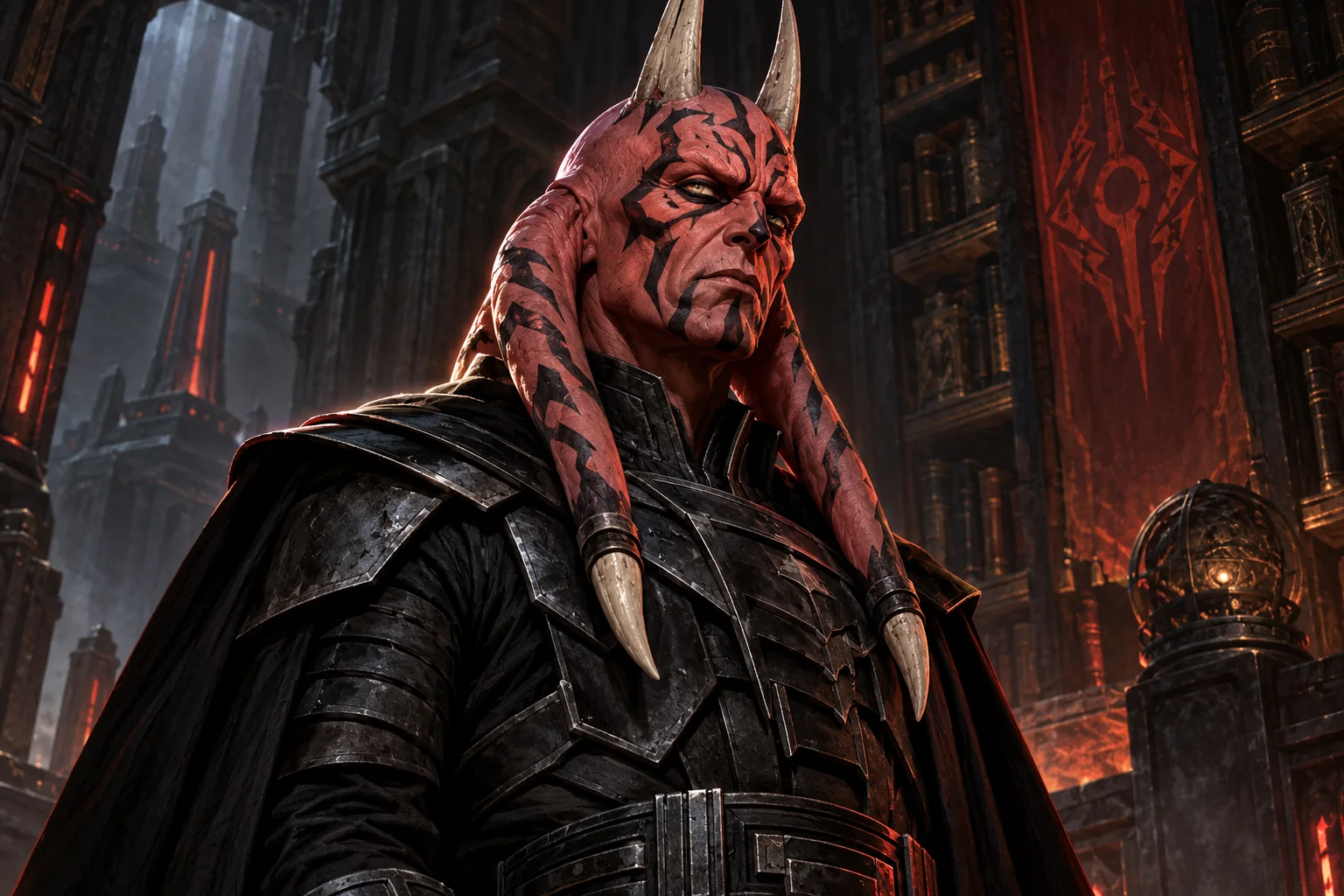
Rule is exercised under another's authority
Wyyrlok governed through Krayt's name rather than openly presenting the true succession. Regent Morlish Veed and other officers continued carrying out the regime's orders without an accurate understanding of the Emperor's condition.
The original ruler survives
Krayt later returned from near death, making Wyyrlok's secrecy untenable. Their conflict revealed that an authoritarian order whose ideology demanded unity was vulnerable to personal competition and deliberate misinformation at its highest levels.
Anthropological assessment
The betrayal illustrates the use of a leader's public image as an institution in itself. Orders can retain apparent legitimacy when issued in the name of an absent ruler, but that legitimacy depends on controlling information about succession and authority.
Interactive evidence lab
Did Wyyrlok publicly announce that Krayt had survived and approved every order?
No. Wyyrlok concealed Krayt's apparent death while ruling through the Emperor's name.
Explore the published event from different perspectives.
Ethics and institutions scenario
Choose a research approach to see its implications.
Select one option above.
These are interpretations, not rewritten outcomes for the Star Wars story.Read the original series: evidence and interpretation
Original publication
The publisher description of issue #31 presents the outcome of a trap set by Cade Skywalker and Celeste Morne as uncertain, and asks whether another Sith Lord may become more powerful. It is evidence for an unstable transition, not a conclusive death certificate for Krayt.
Follow-up evidence
Issue #42 explicitly describes the factions reacting to reports of Darth Krayt's death. Taken together, these descriptions support the political consequences of a ruler believed lost. The precise actions of Darth Wyyrlok require the original comic panels, not an inference from the summaries.
Source judgment: Can the published summaries alone establish exactly how Wyyrlok dealt with Krayt's body?
Historical correction: No. They support a succession crisis and Krayt's reported death. Wyyrlok's individual actions must be checked against the narrative pages.
The linked publisher summaries establish the original publications and limited story claims. Scene-by-scene verification requires checking the actual comic pages.
Legends · Original comic research · 127–139 ABY
A ruler's reported death is not an established death
Darth Wyyrlok's actions following Krayt's apparent defeat created a succession crisis inside the One Sith. The system could operate in the absent ruler's name even when its members lacked reliable knowledge about whether he was alive. A chronology must distinguish the report that reached political actors from the physical reality disclosed in later issues. Otherwise a brief period of uncertainty is converted into an inaccurate definitive death date.
Marvel's summary of Legacy #42 describes Alliance, Fel loyalist, Jedi and Sith Imperial factions responding to news of Krayt's death. This is publication evidence for the consequences of that report. It does not identify the precise manner of Wyyrlok's earlier action or prove that all factions knew the same information. Those details require checking the comic panels. The original publisher record therefore serves as a guide to the source corpus, not as a substitute for unquoted scenes.
IDS interprets the sequence as a conflict between office, symbolic loyalty and control of authoritative information. The return of Krayt ends Wyyrlok's claim through violence. The later Triumvirate offers a contrasting form of shared authority after the Sith regime is displaced.
Publisher record: Marvel Comics issue or collection. Original panels are required for precise scene dialogue and claims not supported by the catalog. The fictional year is not the publication year. Analysis of institutions and cultural practice is IDS interpretation.
Primary comics and research background
Star Wars: Legacy (2006) #31–36; Darth Krayt and Darth Wyyrlok chronology. See Marvel’s relevant original issue record →.