
- Year
- 44 ABY
- Continuity
- Legends
- Setting
- Coruscant, Kesh and the Maw
Archive methodology: This is Legends, not current film Canon. Dates correspond to published narratives. Illustrations may be later character portraits; source-based history is separated from editorial anthropology.
A secret history returns to the present
The Lost Tribe of Sith had originated on Kesh millennia before and remained isolated for generations. By 41–44 ABY its members were entering the wider galaxy, seeking power as the Jedi and Galactic Alliance struggled with new crises. Their history connected the modern Legends era to the much earlier Lost Tribe stories already included in the Imperial Dark Sector timeline.
Abeloth alters the stakes
The dark-side entity Abeloth exploited political turmoil and unusual Force disturbances. Her abilities enabled manipulation of individuals and apparent identities, and she became a threat to Jedi, Sith and civilians. Understanding her required more than treating her as a conventional faction commander.
Battles endanger civilian Coruscant
In 44 ABY, fighting involving the Lost Tribe, the Jedi and Abeloth reached Coruscant. The conflict devastated districts and produced civilian suffering while competing parties attempted to control political institutions.
The crisis ends without simple certainty
The Tribe's offensive was defeated and Abeloth was temporarily driven back. The ending of Fate of the Jedi leaves open the danger that Abeloth could return; it is inaccurate to claim this permanently removed her from all future possibility.
Anthropological assessment
The storyline illustrates the return of a long-isolated group and the difficulty of mapping historical identity onto current political aims. Shared Sith ancestry does not make every individual in the Lost Tribe identical in belief or action.
Interactive history lab
Did the 44 ABY battle permanently prove Abeloth could never return?
Documented answer: No. The published story treats her defeat as temporary, with the possibility of renewed danger.
Choose which perspective to investigate:
Primary-source evidence and limitations
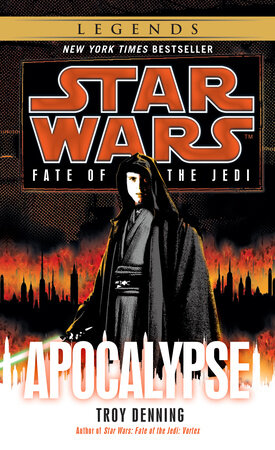
The publisher describes Apocalypse as the Fate of the Jedi finale, with Jedi and Sith forces fighting on Coruscant while Abeloth pursues a separate objective. The book's battle is not evidence that every Lost Tribe member has identical aims, or that Abeloth's future is finally resolved. The date is part of the Legends sequence, not the continuity of the sequel films. A publisher cover supplies source context, not a literal photograph of a scene.
Read the published evidence: Apocalypse, Troy Denning (publisher) · Troy Denning bibliography (publisher).
Legends · Original publication analysis · 6–45 ABY
Coruscant becomes the battlefield of an infiltrated political order
The Lost Tribe of the Sith carries an isolated historical tradition into the Galactic Alliance's political center during the later Legends era. Its presence in the wider galaxy is not evidence that every Sith order was continuously governed by the same leadership. In Fate of the Jedi: Apocalypse, the conflict brings Jedi, Sith and Abeloth into Coruscant's streets and governing institutions. The publisher's synopsis specifically mentions Sith infiltrators, a planetwide strike and Abeloth's intention to dominate life. These are substantiated story stakes, although the summary cannot confirm the exact itinerary of every combatant.
Abeloth is an exceptionally powerful being whose activities disrupt normal assumptions about identity, perception and authority. Treating her as simply another Sith official would erase the difference between the Tribe's organized ambition and an entity attempting to exploit multiple groups. The resulting conflict takes place among an enormous civilian population that has no automatic allegiance to either faction. The existence of secret infiltrators demonstrates a problem of institutional trust, but does not prove that every government official secretly belongs to the Lost Tribe.
IDS examines how long-isolated communities can preserve traditions and how the meaning of those traditions changes when they enter a different political setting. It also distinguishes the contested power of individual Force users from the experiences of inhabitants who face disruption of everyday urban life. The Dark Nest aftermath predates this crisis and provides another example of identity complicated by hidden influence. Crucible follows different challenges and should not be called an immediate victory celebration for the Coruscant fighting.
Test the evidence: Does the Apocalypse publisher record show that Abeloth was an ordinary officer of the Lost Tribe?
Source judgment: No. The publisher distinguishes the ambitions of the Sith from Abeloth's different, potentially catastrophic designs. Their temporary alignment does not establish identical command structures.
Primary-work publisher record: Troy Denning, Fate of the Jedi: Apocalypse. The source links establish published books, the narrative premise and specified supporting claims; they do not replace close reading of every novel chapter or comic panel. Historical and institutional conclusions are original IDS interpretation, not additional Legends dialogue.