

After the apparent destruction of Revan's flagship in 3957 BBY, Darth Malak declared himself the new Dark Lord of the Sith. He inherited Revan's fleets, institutions, academy network, and access to the Star Forge. Under Malak, the Sith campaign increasingly emphasized annihilation and terror rather than Revan's more selective preservation of useful infrastructure.
3957 BBY · Legends · Evidence review
MALAK SEIZES COMMAND
Documented history and chronological boundaries
Believing Revan dead following the strike on his flagship, Darth Malak assumed the title of Dark Lord in 3957 BBY. He inherited access to the Star Forge and many of Revan's Sith fleets, officers and academies. His operations increasingly relied on terror and destruction, making especially visible the difference between capturing useful infrastructure and treating civilian communities as expendable. The transition was a takeover from inside the Sith hierarchy, not the creation of a wholly new army that day.
People, political institutions and material life
The speed of Malak's accession reveals a political structure strongly dependent on personal rule and control of coercive assets. Whoever secured loyal officers and the industrial base could claim legitimate authority without a public election. Continued obedience of institutions does not prove their members had identical motives. The violent succession also foreshadowed the fragmented rivalries after Malak's eventual defeat.
Source trail: Knights of the Old Republic (2003), Malak's accounts; Campaign Guide, Sith military command. Explore source and bibliography →. The original conceptual banner is not documentary or game footage. Dialogue and print-page-level citations remain subject to primary-source checking.
Succession occurs through attempted murder
Malak's authority depended on the assumption that he had successfully eliminated his master.
Sith hierarchy treated violent replacement as a recognizable route to legitimacy.
The same military apparatus serves a different strategy
The Star Forge, fleets, and officers did not disappear when Revan did.
Changing leadership altered how existing institutions were used.
Anthropological assessment
Malak's succession illustrates the difference between institutions and leaders.
A bureaucracy and military can preserve enormous coercive capacity while a new ruler rapidly changes the purposes and intensity of its use.
The attack is a bid for succession
Malak turned his weapons on Revan's flagship while Bastila Shan's Jedi strike team attempted to capture Revan. His decision was not ordinary friendly-fire confusion. Malak intended to kill his master and replace him as ruler. Because Revan survived, the act also created an unfinished personal conflict that would return at the Star Forge.
Power changes hands without institutional reform
Malak inherited Revan's Sith military structures, including the Star Forge and the officers needed to direct the war. He did not need to invent a new army before launching campaigns. At the same time, the change in leadership changed the uses of that power. His increasing reliance on terror, destruction and the pursuit of Bastila would shape the next phase of the conflict.
The Star Forge strengthens a fragile succession
An empire organized around a dominant military leader can be vulnerable when that figure disappears. Control of the Forge gave Malak a continuing material advantage even though the coup was violent. Machinery, shipbuilding and command networks helped preserve a regime through a change of ruler that might otherwise have fractured it more quickly.
What the event does not establish
The capture of Revan and Malak's succession are linked, but Malak did not know the Jedi had successfully recovered Revan alive. The original narrative should not be rewritten as a planned collaboration between Malak and the Jedi. The succession also precedes the opening Endar Spire mission in the later chronology.
Anthropological assessment: personal rule
The coup highlights a weakness in political systems where leadership legitimacy is tied to victory and domination rather than a stable succession process. Malak used force to claim a position that Revan had held through military power. His control remained effective while he commanded ships and production, but the political basis of the regime became increasingly personal and coercive.
Source interpretation
How firm is the dating?
See the source caution above. The in-universe year or approximate range follows the listed Legends references. The original RPG's variable quests should not be misrepresented as a day-by-day universal calendar.
Does the visual portray an actual game screenshot?
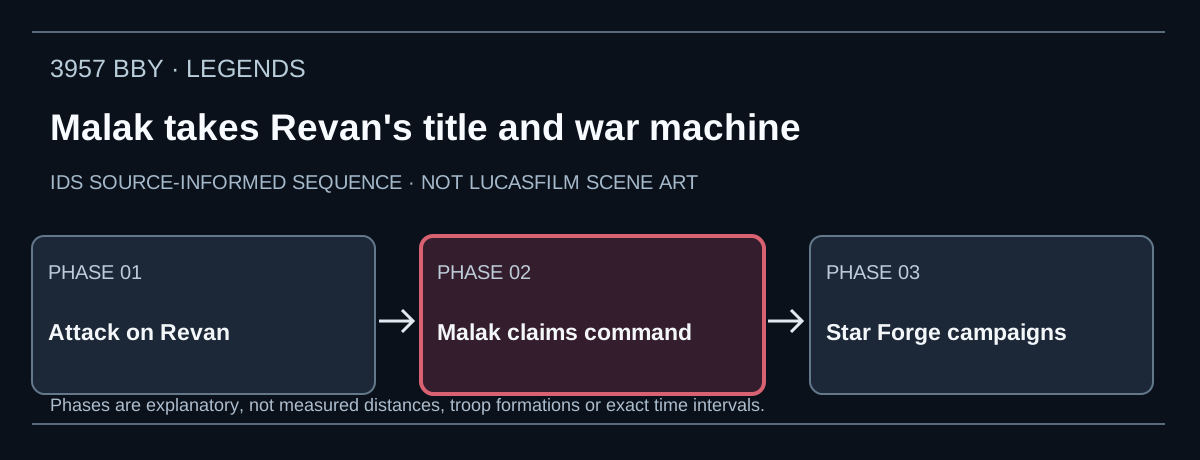
No. The illustration organizes narrative phases only. A verified event-specific publisher illustration is a separate editorial requirement.
Interactive evidence test · 3957 BBY
Test your historical judgment
Answer both questions for corrections, documentary context and a score. You can revise answers and try again.
3957 BBY · Legends · Narrative vs. later chronology
Malak takes Revan's title and war machine
Succession through an attempted killing
Malak's attack on Revan's flagship was simultaneously a blow against Republic-Jedi attackers and a bid to remove his own master. After Revan disappeared, Malak presented himself as the new Dark Lord. He did not gain that position through a documented constitutional election or a convention of all Sith subjects. The transfer of authority depended on his control of military force and the expectation that Revan was dead. It is misleading to treat Malak's assertion of rule as a transparent expression of consensus.
Continuity of the institution below the leader
The Sith fleets, academies, command relationships and access to the Rakatan Star Forge had been developed under Revan. Malak took possession of this machinery and put it to increasingly destructive uses. The Star Forge mattered because it could sustain the production of warships and matériel far beyond the output of conventional supply facilities. The wider war therefore continued despite the break in leadership. A new ruler's personal ideology should not hide the technical and administrative systems on which his power relied.
From a secret command change to a planetary war
Revan's survival remained hidden from many participants. Malak's later attacks on Taris and his hunt for Bastila show how the new leadership was pursuing immediate military goals while the Republic was attempting to recover an advantage. The historical distinction is between the moment Malak claimed office and the subsequent campaigns he conducted. Lucasfilm's description of the game confirms a player-controlled light/dark storyline, but does not alone prove an exact troop tally, Star Forge production rate or death count.
Check your historical interpretation: Did taking the Sith title require Malak to build a new fleet from nothing?
Explanation: No. Malak inherited much of Revan's existing war-making organization and access to the Star Forge. The change of ruler altered strategy without first destroying the state's material infrastructure.
Original publication: Lucasfilm: original KOTOR. Publisher overviews confirm the RPG and its branching design, not every cutscene or exact 3950s BBY event date. Continue this timeline sequence →
Jedi Civil War · Legends evidence file
Malak's succession: a Sith empire changes rulers without changing its machinery
Event and historical sequence
When Malak's attack on Revan's flagship left his master apparently dead in 3957 BBY, Malak declared himself the Dark Lord of the Sith. He inherited forces that had already been organized around the Star Forge, Sith academies, war-trained defectors and Republic officers who had changed allegiance. Malak could issue orders on a galactic scale because this administrative and material structure remained in place. His operations increasingly relied on terror and destruction rather than Revan's more selective plans to capture and use existing Republic infrastructure.
Institutions, everyday life and political power
The rapid transfer of authority demonstrates how political power can rest on controlling weapons, transport, institutions and recognition by armed subordinates rather than broad consent. Malak's title mattered within Sith ideology, but control of the fleet and Star Forge made it enforceable. The resulting war changed in degree of destruction without becoming a wholly new conflict on the day of succession. Soldiers who had followed Revan now found themselves subject to a new leader whose policies were not identical. These differences help explain why later sources distinguish Revan's calculated conquest from Malak's coercive strategy, without implying that Revan's own earlier invasions were harmless.
Limits and conflicting evidence
Malak's 3957 BBY accession follows his attempt to kill Revan, but the later revelation that Revan survived complicates the legitimacy of that claim. Telos's 3958 BBY bombardment preceded the 3957 betrayal in the later campaign chronology, so it should not be described as an order Malak issued for the first time only after becoming Dark Lord.
Historical judgment: Did the Star Forge cease functioning the moment Malak claimed the Sith title?
Correction and educational insight: No. Its industrial power and the existing military chain of command continued to support the Sith fleet.
Source trail: Knights of the Old Republic (2003), Malak and Leviathan dialogue; Knights of the Old Republic Campaign Guide. Reference and bibliography ↗. Primary-source location checks remain in progress.
Sources and further reading
- Star Wars: Knights of the Old Republic.
- The Essential Guide to Warfare.