
- Date
- c. 3961–3960 BBY
- World
- Onderon
- City
- Iziz
- Outcome
- Republic / Onderonian victory
- Known participant
- Vaklu
Historical narrative and evidence
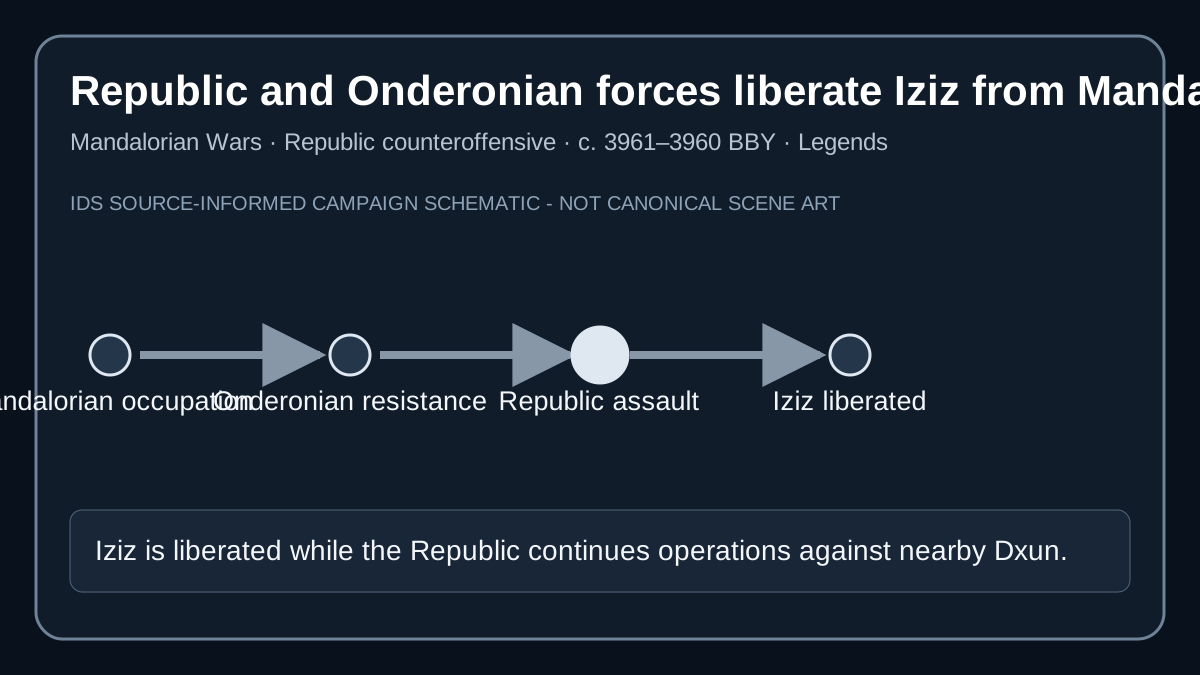
Republic forces and Onderonian resistance fighters liberated Iziz during the late Mandalorian Wars, approximately 3961–3960 BBY. The victory reversed the occupation established after Mandalorian forces descended from Dxun and seized the walled capital. Revan's campaign, Meetra Surik's forces, and local fighters all belong to the history of the recovery.
3961–3960 BBY · Legends · Source analysis
IZIZ FREED: source and society
Historical evidence and chronology
The Republic and Onderonian forces retook Iziz during the late-war counteroffensive, conventionally dated to the 3961–3960 period. Onderon's capital had been occupied in the 3963 Mandalorian invasion launched from Dxun. A victory on the planet did not automatically end every Mandalorian presence on the nearby moon. Revan's strategic command, Meetra Surik's forces and local defenders each appear in different layers of later history.
Institutions, people and material consequences
The event shows that liberation was produced by local resistance as well as outside military intervention. For Onderonians, sovereignty and civilian survival in Iziz were immediate concerns, while Republic accounts emphasize theater-wide recovery. General Vaklu's military experiences later became political capital in a different Onderonian crisis. The account must not merge all wars on Onderon into one episode.
Research trail: Knights of the Old Republic II; The Essential Atlas; The Essential Guide to Warfare. Further source and chronology notes →. IDS interpretations are editorial analysis. The locally hosted illustration is original conceptual art, not a comic scan or an exact battlefield photograph.
For Iziz, liberation was not a secondary battle
From the perspective of Revan's overall campaign, Dxun carried enormous military importance because it was a fortified Mandalorian stronghold. For Onderonians living under occupation, however, the recovery of Iziz was not secondary. It restored control of their capital after years in which an outside military force had shaped political life.
That difference in scale matters. Strategic histories rank battles by their effect on the war. Local histories often rank them by what happened to homes, institutions, and political authority.
Local resistance and Republic power overlap
Onderonian fighters did not simply wait for an external army to save them. Local resistance formed part of the liberation. The Republic provided military capacity, while Onderonians supplied knowledge, personnel, and a political stake in the outcome.
This coalition complicates the idea of liberation as something delivered from outside. The outcome depended on actors who could later disagree sharply about what Onderon's postwar relationship with the Republic should be.
Vaklu's war record becomes political capital
Vaklu's participation in the anti-Mandalorian struggle later contributed to his status as a war hero. Participation in liberation can become a credential used in later political disputes.
That later legitimacy is one reason the battle matters beyond 3960 BBY. Military memory can be carried into peacetime politics and used to justify competing visions of sovereignty.
Anthropological assessment
The second battle of Onderon shows how liberation creates contested ownership of victory. Republic commanders, Jedi, soldiers, and local resistance can all claim a role, but they do not necessarily agree on what the victory should mean afterward.
War memory can therefore become a political resource. A veteran such as Vaklu can point to resistance against occupation as evidence of loyalty to Onderon, even when his later politics bring him into conflict with Republic-aligned institutions.
Evidence check
What is firmly established?
The date or range, continuity, broad combatants, outcome, and campaign placement are included only where the cited sources support them.
What has IDS deliberately not invented?
Unnamed commanders, exact force sizes, casualty totals, tactical phases, dialogue, and civilian experiences remain unknown unless a cited source establishes them.
Why use a schematic?
The visual is an original IDS reconstruction used where verified event-specific artwork is unavailable or rights status is unclear. It is labeled so it cannot be mistaken for canonical scene art.
Historical judgment · 3961–3960 BBY
Interpret the source evidence
Choose an answer to each question. The assessment explains the correct answer and any error, rather than only displaying a score.
Sources and further reading
- Star Wars: Knights of the Old Republic II: The Sith Lords (2004), later Onderonian dialogue and Vaklu's war record.
- The Essential Atlas (2009), battle placement.
- The Essential Guide to Warfare (2012), campaign context.