
- Location
- Rekkiad
- Target
- Mandalore the Ultimate
- Hidden sponsor
- Vitiate
- Method
- Vision + manipulation
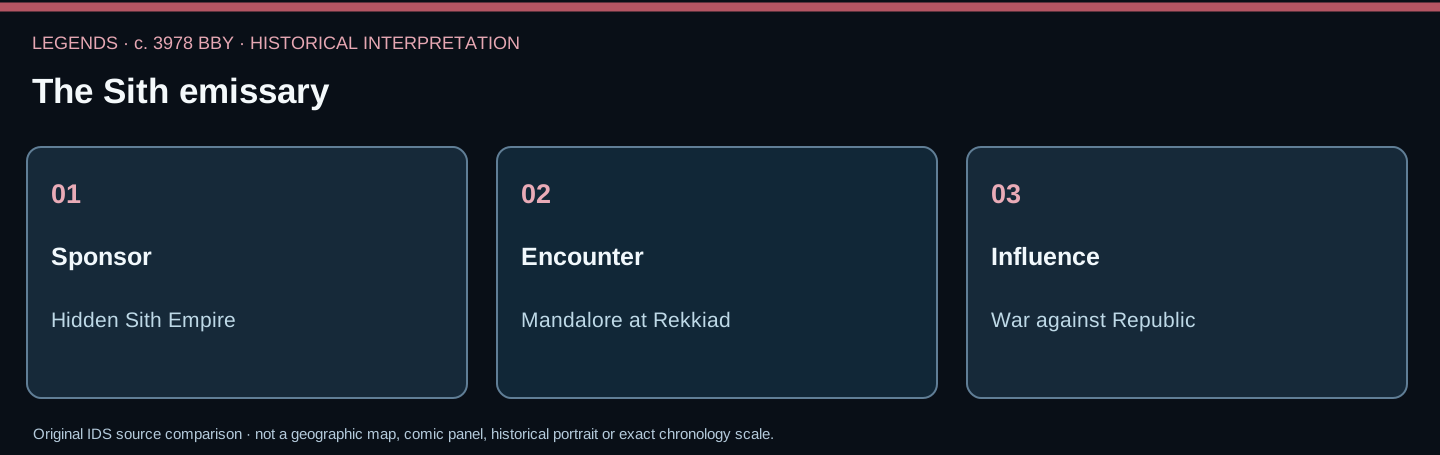
Around 3978 BBY, a Sith Pureblood emissary from Vitiate's hidden Empire approached Mandalore the Ultimate. The two traveled to Rekkiad and located the tomb of Dramath the Second. After recovering the remains, the emissary told Mandalore that his master had foreseen a Mandalorian conquest of the Republic and secretly reinforced the message through dark-side influence.
3978 BBY · Legends · Source and culture
THE SITH EMISSARY
What the published record supports
An emissary sent from Vitiate’s hidden Sith Empire sought the tomb of Dramath the Second with Mandalore the Ultimate on Rekkiad. After the remains were recovered, he presented an image of a triumphant Mandalorian conquest of the Republic. The account comes through Drew Karpyshyn’s Revan and retrospective testimony, not an independently preserved Mandalorian diplomatic record.
Power, society and interpretation
Mandalore was already seeking a war worthy of his growing Neo-Crusader movement. The Sith intervention did not create that political aspiration. It redirected an existing ambition toward a conflict intended to measure the Republic’s defensive capacity while concealing the sponsor. Distinguish an intermediary’s promise from a guarantee of victory, and the subsequent Outer Rim raids from a formal Republic invasion.
Was Mandalore simply forced to begin a war?
No. The novel describes Sith mental influence, but it also describes Mandalore’s prior appetite for conquest.
Did Mandalore know the full Sith strategic purpose?
No. The concealed Sith Emperor intended to test the Republic through Mandalorian aggression.
Evidence trail: Drew Karpyshyn, Revan (2011), Mandalore’s account of the emissary; The Old Republic Encyclopedia. Exact print pages and edition remain to be checked. Compiled source bibliography →. The image above is original IDS symbolic art, not a source panel.
The Republic is tested by proxy
Vitiate did not reveal his Empire or attack directly.
The Mandalorians became an instrument for measuring Republic military strength.
Manipulation works through existing values
The emissary appealed to Mandalorian ideals of worthy conflict and remembered glory.
The message succeeded because it fit ambitions already meaningful to Mandalore.
The hidden Sith Empire tests the Republic through a proxy
Vitiate did not need to expose Dromund Kaas to weaken the Republic. Encouraging Mandalore toward conquest allowed the Sith Emperor to observe Republic military capacity while another society paid the immediate cost of the war.
The strategy depended on plausible autonomy. Mandalore already wanted a great campaign. The emissary's intervention worked because it amplified an ambition that fit Mandalorian ideas of glory and worthy conflict.
Explore this entry
Did the Sith create the Mandalorian desire for war?
No. The manipulation is best understood as direction and reinforcement of ambitions that already existed.
Why use Mandalorians instead of attacking directly?
A proxy war allowed the hidden Empire to test and weaken the Republic without revealing its own location, strength, or long-term plans.
Anthropological assessment
The episode shows how external manipulation often works by amplifying existing cultural desires rather than inventing new ones.
Proxy warfare allows a hidden state to gather information while transferring the human and political costs to another society.
c. 3978 BBY · Legends · Historical evidence
Political manipulation works through an existing military culture
In the later Legends account, a Sith Pureblood emissary representing Vitiate approached Mandalore the Ultimate and guided him toward the tomb of Dramath the Second on Rekkiad. The emissary framed a possible Mandalorian war against the Republic as part of a grand destiny, adding supernatural influence to an appeal shaped around Mandalorian ambition.
This episode should not be confused with the beginning of the Mandalorian Wars themselves. A proposal and ideological manipulation are not identical to the subsequent military decisions, alliances, mobilizations and attacks. Mandalore and the Neo-Crusaders remained political actors within their own social system, even when a Sith power sought to redirect them.
The narrow original reference does not give an independently verified transcript of all Mandalorian councils or prove that every warrior knew about Sith involvement. A study of causation should therefore treat the emissary as an important influence, not automatically the sole cause of every later raid.
Historical judgment: Does Sith manipulation mean all Mandalorian fighters knowingly served Vitiate?
Explanation: No. The account identifies an effort to influence Mandalore, not the knowledge or motives of every warrior.
Read a related historical dossier → · Complete timeline →
Primary story: Drew Karpyshyn’s novel The Old Republic: Revan (publisher listing); supplementary chronology: The Old Republic Mandalorian Wars Legends origin account. Explanations distinguish source-reported facts from editorial inference; original editions require page-level proofing where only summaries are available.
Sources and further reading
- Drew Karpyshyn, The Old Republic: Revan.
- Star Wars: The Old Republic Encyclopedia.