
- Recorder
- Vima Sunrider
- Archive
- Great Holocron
- Subject
- Ulic Qel-Droma
- Theme
- Redemption
In 3980 BBY, Vima Sunrider made an entry in the Great Holocron concerning Ulic Qel-Droma's redemption and death. The record transformed her personal experience with Ulic into institutional Jedi memory available to later generations.
3980 BBY · Legends · Historical source notes
Vima's record turns Ulic's life into history
What the record establishes
Vima Sunrider later recorded Ulic Qel-Droma's redemption and death for the Great Holocron. The record is placed around 3980 BBY, six years after his death on Rhen Var. It was retrospective testimony from a person who had learned from him, not a recording made during his last conversation or an endorsement signed by every surviving Jedi.
People, institutions and interpretation
The difference between memory and witnessed event matters. Sylvar, Nomi and Vima remembered Ulic from different positions and could disagree about what his final acts meant. When an institution preserves one testimony in an archive it chooses a particular perspective to pass to future students. Recognizing that choice does not make the memory worthless. It makes provenance essential to interpreting the record.
Was the entry recorded while Ulic was alive?
No. Its chronology is 3980 BBY, later than Ulic's death in 3986 BBY.
Source trail: Jedi vs. Sith: The Essential Guide to the Force; Great Holocron Legends history. Publisher or compiled bibliography →. Printed page details need primary-edition review. Art: original IDS symbolic reconstruction, not a verified comic panel.
Personal memory becomes official archive
Vima had known Ulic directly as a teacher.
Recording him in the Great Holocron converted private testimony into durable institutional knowledge.
Redemption enters Jedi history
The archive preserved Ulic as more than a traitor.
Future Jedi could encounter a narrative in which grave wrongdoing and genuine moral change coexisted.
A private memory becomes official Jedi history
Vima had known Ulic personally as a teacher. Recording his story in the Great Holocron transformed an intimate experience into institutional evidence that future Jedi could consult.
That matters because archives do not simply preserve events. They preserve selected interpretations. Vima's entry ensured that Ulic would be remembered not only as a Sith warlord and traitor, but as someone whose final years complicated that identity.

Explore this entry
Why put Ulic's redemption in the Great Holocron?
Because the Jedi needed a durable record showing that moral change after catastrophic wrongdoing was possible, even if restoration to former status was not.
Do we have Vima's full recording?
No. Later sources establish the existence and subject of the entry more clearly than its complete wording.
Anthropological assessment
Holocrons turn memory into curated institutional heritage.
What later generations learn depends on whose testimony is preserved and which interpretations are given archival authority.
3980 BBY · Legends · Historical source and institutions
Vima's account turns Ulic's redemption into Jedi memory
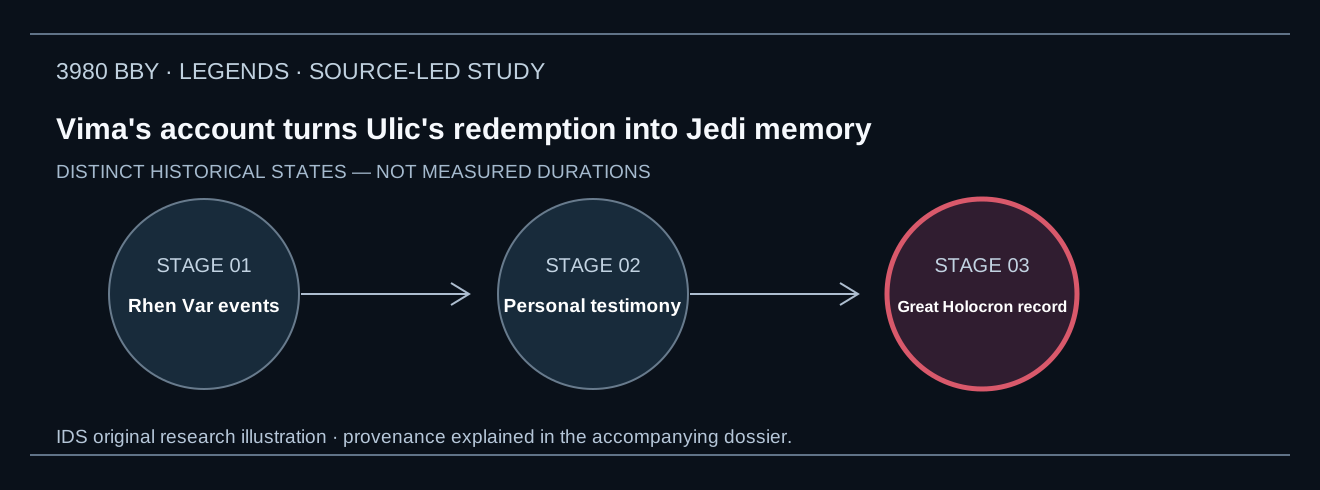
Personal testimony enters institutional history
Legends reference history places a record attributed to Vima Sunrider within the Great Holocron in 3980 BBY. The entry concerned the later years and redemption of Ulic Qel-Droma, whom she had sought as a teacher. The source usually identified for the Holocron detail is Jedi vs. Sith: The Essential Guide to the Force, rather than a scene of a recording device used in the final page of every Redemption issue. That distinction matters when the date is used as if it were the original comic's publication chronology.
The comic establishes a complicated relationship
Marvel's synopsis of Redemption #5 confirms that Nomi Sunrider traveled to Rhen Var to recover Vima from Ulic's instruction and ultimately recognized the importance of Vima's choices. Sylvar also sought revenge on Ulic and began confronting her own anger. Those are not simple demonstrations of an organization forgiving a former enemy in unanimity. The story reveals disagreement over whether a person's later actions can give new meaning to past wrongdoing.
An archive is a selective kind of memory
Preserving Vima's understanding in a Holocron makes it available to later teachers and readers, but the archive's existence cannot prove that all conflicts over Ulic's responsibility were resolved. An anthropological approach treats institutional memory as created by identifiable people, with choices about whose testimony is authoritative. A first-hand student's account can preserve experiences not captured in battlefield reports. The Great Holocron reference should be cited separately from the comic material that supplies the personal history.
Source judgment: Does the surviving record establish that every later Jedi interpreted Ulic's redemption identically?
Explanation: No. A Holocron entry records one perspective for later teaching, not proof of unanimous institutional agreement or the absence of competing memories.
Publication provenance: Marvel original issue: Tales of the Jedi — Redemption #5. The publicly available summaries are evidence of the source corpus and selected scenes; dates from later companion or reference chronology must be independently checked against print. Continue related event →
Sources and further reading
- Jedi vs. Sith: The Essential Guide to the Force.