
In 4086 BBY, Trampeta's Star Guide was first published. Unlike military histories and political chronicles, the guide evaluated destinations from a traveler's perspective. Its most famous surviving review was harshly critical of Taris after T3-series droids stole the authors' baggage at the starport.
Everyday mobility becomes a literary genre
Interstellar travel had become ordinary enough to support consumer guides.
Readers wanted practical information about starports, security, hospitality, and entertainment.
A bad review preserves ordinary urban experience
The Taris review focused on stolen baggage rather than Senate politics or war.
Small complaints can preserve social conditions that grand historical narratives ignore.
Anthropological assessment
Trampeta's Star Guide is valuable because it treats the galaxy as lived space rather than a map of battles.
Travel writing preserves judgments, stereotypes, annoyances, and consumer expectations that political archives rarely record.
Legends · Post-Manderon source research
A travel guide records the galaxy people actually experienced
Trampeta's Star Guide began publication in 4086 BBY and became remembered for its evaluations of places from the perspective of ordinary travelers. The surviving references include a sharply negative description of Taris connected to baggage theft at a starport. Compared with chronicles of battles and Jedi Councils, this is an unusually mundane kind of historical evidence. A complaint about safety, hospitality or transit can reveal what visitors expected from the institutions that made interstellar travel possible.
Travel guides depend on the assumption that people have enough mobility and purchasing choice to compare destinations. An editor may describe one world as attractive, unsafe or unpleasant based on limited encounters, and those judgments can influence the decisions of readers who have never traveled there. A harsh Taris review should not be read as a complete ethnography of its millions of inhabitants. It preserves a visitor's perspective, including the stereotypes and frustrations embedded in that perspective, while offering a rare glimpse of everyday conditions before later catastrophes transformed the city.
Public reputation shapes economic geography
When a place becomes known through widely circulated reviews, remote readers form expectations about its services and dangers. Travel writing can influence where people spend money and how destinations seek to present themselves. It has practical consequences beyond literature.
A traveler's complaint is evidence with limits
The guide's report about stolen baggage shows an experience and an interpretation, not the universal behavior of Tarisian residents. Comparing travel accounts with local sources is important because outsiders usually see only selected streets, businesses and encounters.
Does the surviving record contain a complete original edition of the 4086 BBY guide?
No. The guide is known through later references and quoted material, so its broader coverage should not be invented.
Evidence: The New Essential Guide to Droids; Trampeta's Star Guide reference. Source reference and bibliography →. Distinguishes contemporary evidence, later historical summaries and IDS interpretation.
4086 BBY · Legends · evaluated historical source
Trampeta's Star Guide: a source about everyday travel
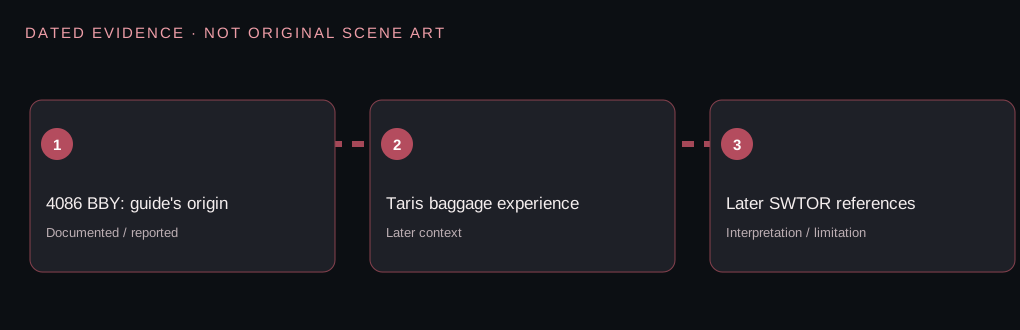
How the event is dated
The New Essential Guide to Droids preserves a reference to the 4086 BBY travel guide, including a highly negative assessment of Taris after baggage theft involving T3-series droids. SWTOR later mentions the guide in the Beryl's Bargain story.
What the source documents
The guide reveals a very different kind of historical judgment from a Jedi chronicle or a battlefield report. It evaluates ordinary travel experiences, including handling baggage, local service and a destination's reputation. Its surviving references do not constitute an extant complete edition, so individual ratings and reviews for other worlds should not be invented.
Institutions and culture
Travel writing is evidence about its authors' expectations and the circumstances of a particular visit. It does not prove that every resident or starport in a world behaved the same way. The guide's enduring reputation suggests how a mundane failure could shape the public perception of a major planet within a fictional travel culture.
Limits of reconstruction
The guide's surviving references are fragmentary. A reconstructed cover, itinerary, editorial board or ranking table would be imaginative extrapolation, not an illustration of an original published travel volume.
Test your source judgment: Can a single negative Taris review stand for the experience of all visitors?
Explanation: No. It records one author's evaluation, which must be separated from a representative survey.
Source trail: The New Essential Guide to Droids; SWTOR Smuggler mission Beryl's Bargain. Read the reference record and bibliography →. The original publication may require page-level verification.
Sources and further reading
- The New Essential Guide to Droids.
- Trampeta's Star Guide, Wookieepedia