
Jedi Knight · Character dossier
Investigate Sergeant Fideltin Rusk
Original class story details and later game content. Some relationship paths depend on choices. The interactive examples are IDS interpretations, not game dialogue.
A life beyond the crew slot
A decorated Chagrian Republic sergeant who completes nearly impossible operations at devastating cost to his squads, challenging the idea that victory alone proves responsible command.
An ordinary colony before the war
Sergeant Fideltin Rusk was raised in a small and peaceful Chagrian colony. The publisher's Holonet says little about his parents beyond the fact that both are deceased. It would be inaccurate to invent their occupations or use the character's species as an explanation for his later command decisions.
The colony's destruction came after Rusk had already joined the Republic military. BioWare identifies an Imperial incursion as the cause. The loss connected galactic conflict to the personal environment in which he had grown up, changing the meanings attached to his work as a Republic soldier.
His story is therefore grounded in a particular history of displacement and violence. The original profile notes that concerns about his recklessness emerged after this event, but correlation is not a complete account of motivation. A responsible biography leaves room for uncertainty about how personal grief and professional culture interacted.
An officer's record of spectacular success
Rusk is a decorated soldier whose battlefield actions produced important Republic victories. The Holonet portrays him as a determined leader committed to perfect execution of orders. He does not ordinarily argue with superiors or refuse difficult objectives.
The problem is not an absence of competence. He repeatedly succeeds at operations other officers might consider impossible. The cost is borne by the people he commands. Reports describe high casualty rates among his squads while Rusk himself survives to assemble new teams.
A simple measure of mission success conceals this distribution of risk. If the Army praises captured positions without examining preventable losses, it can reward tactical results while leaving the people who perform the mission with very different outcomes.
The destruction of home and an escalating risk appetite
BioWare says that concern about Rusk's reckless tactics grew after the destruction of his Chagrian colony. The detail provides a temporal link, not proof of a fully specified medical condition or a singular psychological explanation. The game does not provide grounds for assigning an invented clinical diagnosis to his decisions.
His stated dislike of weakness and unwillingness to avoid fights can reinforce an occupational culture that treats hesitation as failure. Yet a commander must distinguish fear from justified caution. Soldiers may recognize risks that are invisible to a leader focused exclusively on an objective.
Rusk's record invites questions about whose lives count when planning an operation. The political language of defeating an enemy cannot settle whether a less dangerous method was possible or whether his soldiers understood the hazards they faced.

A Jedi Knight working with a Republic professional
The Knight's story centers on extraordinary threats, but the crew also includes ordinary service professions. Doc treats people injured by conflict, T7-O1 maintains and interprets technical systems, Kira works within the Jedi tradition and Lord Scourge brings experience of Sith power. Rusk makes the cost of military victory an issue inside that coalition.
A Jedi protagonist may value sacrifice in the defense of others, yet that does not imply unlimited authority to sacrifice subordinates. Rusk's willingness to charge against overwhelming odds can be useful in a crisis and irresponsible in a mission where alternatives exist.
His presence allows the story to contrast obedience to an order with responsibility for its execution. An officer who never challenges a superior can still exercise discretion in planning. The obligation to protect a unit does not end when an objective is difficult.
The Alliance Alert and a later model change
SWTOR's later Alliance system provides a route through which Rusk can be reunited with the Commander. The specifics depend on campaign progression and are more appropriate to a current mission walkthrough than to an unconditional biography of the original class story.
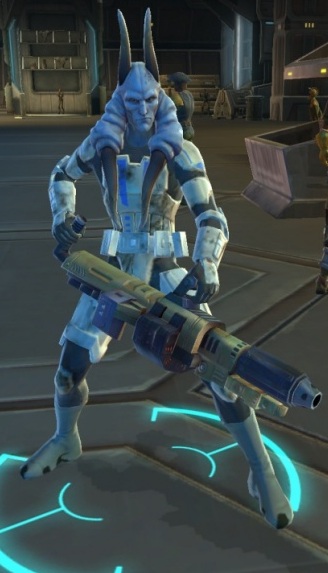
An official Game Update 7.6 patch note from December 10, 2024 confirms that Rusk's original character model is replaced with an updated version after the player completes the Alliance Alert to recruit him again. This detail matters when choosing pictures. Two valid screenshots can show different versions of the same character rather than a mislabeled person.
That cosmetic evolution should be documented separately from the original Holonet's blaster-cannon and crew-skill metadata. Old equipment bonuses and a new model are different kinds of evidence, and neither implies that the person's earlier career has been rewritten.
Their part in the Jedi Knight crew
Fideltin Rusk is a decorated Chagrian veteran whose official biography contrasts battlefield effectiveness with a damaging approach to the soldiers under his command. He repeatedly achieves assigned objectives, but the high casualties among his units limit the regard of his colleagues. His home colony's destruction during an Imperial incursion is an important part of his history without being sufficient to excuse every decision. Rusk's professional record highlights that the metric used to call a mission successful may differ from the welfare of the people ordered to carry it out.
In the Jedi Knight Origin Story, Rusk joins a crew concerned with threats extending well beyond normal military deployments. His presence brings a distinctly institutional language of objectives, obedience and sacrifice into conversations dominated by Jedi purpose. The Knight can question methods and respond to the human cost of conflict, but the plot is not a military disciplinary hearing and cannot establish an official judicial verdict on Rusk's actions.
Story chronology
Raised in a small Chagrian colony.
Becomes a decorated battlefield commander.
Home colony is destroyed.
Wins engagements with unusually heavy losses among squad members.
Travels with the Jedi Knight's crew.
Can be recruited through an Alliance Alert.
Official patch notes confirm a new model after Alliance Alert completion.
Connected people
Doc
Medical professional whose work centers on saving lives
RELATED CHARACTERKira Carsen
Knight ally with a distinct concept of duty and restraint
RELATED CHARACTERAric Jorgan
Havoc Squad officer who also considers risk and soldier welfare
RELATED CHARACTERLord Scourge
Strategist whose unusual experience complicates expectations of command
Anthropological assessment
Rusk's record highlights the distinction between a strategic objective and the welfare of the people ordered to accomplish it. Victory statistics can privilege a leader's reputation while concealing the distribution of injury and death among subordinates.
His willingness to obey formal command does not remove his responsibility for tactical judgment. A hierarchy may demand initiative and discipline at the same time, requiring officers to explain how and why they accept risks.
The loss of the colony helps contextualize his later decisions without assigning a diagnosis or treating Chagrian identity as their cause. Historical experiences and professional incentives provide a more defensible explanation than species stereotypes.
His later visual redesign also demonstrates a problem for online archives: character appearance changes over time, but those changes should be labeled as updates rather than presented as incompatible identities.
The most useful analytical distinction is between strategic success and ethical command. A hierarchy that rewards a captured objective without measuring avoidable losses encourages a particular kind of risk transfer: officers gain reputation while subordinates bear bodily danger. Rusk also demonstrates why cultural explanations require restraint. Being Chagrian does not cause his tactical choices; his professional formation, experiences and leadership decisions provide the more relevant evidence.
Interpretations are original IDS analysis of fictional institutions.
Analyze a dilemma
Choose an approach to examine the social consequences. These are editorial exercises, not actual SWTOR dialogue choices.
Select a response
Choose a position to see its consequences.
Evidence checks
What is Rusk's species?
Chagrian, per the official Holonet.
Does he always return from his engagements alone?
The Holonet describes high squad losses and Rusk repeatedly surviving; it does not establish a precise casualty count.
Was the colony destroyed before his enlistment?
No. The official biography places the Imperial attack years after he left.
Is an updated model documented in 2024?
Yes. BioWare's Game Update 7.6 notes confirm the change after his Alliance Alert.
Collecting this character
In-game costumes, armor or medical equipment provide useful visual references, but no numbered physical trading card or collectible is claimed without verification. Card photographs are shown only when supplied by the collection owner.
Sergeant Fideltin Rusk belongs to the original Jedi Knight crew. Follow that Origin Story's missions and companion conversations for the original recruitment context; a companion's presence in the broader Alliance roster or on another character's mission does not automatically establish the same recruitment conditions. The official Holonet profile is a source for launch-era biography, not a current guide to influence gifts, optimal gear, combat statistics, romance eligibility, or character unlocks. Check present-day in-game instructions and published patch notes for those systems.
Publisher evidence and image sources
- SWTOR Holonet: Sergeant Rusk ↗
- SWTOR Game Update 7.6, December 10, 2024 ↗
- Original image source, Almar's SWTOR archives ↗
- SWTOR Jedi Knight class overview ↗
The supplemental image is documented in its specific source. If a source is unavailable, the page retains an explanatory note rather than substituting an unrelated person.