
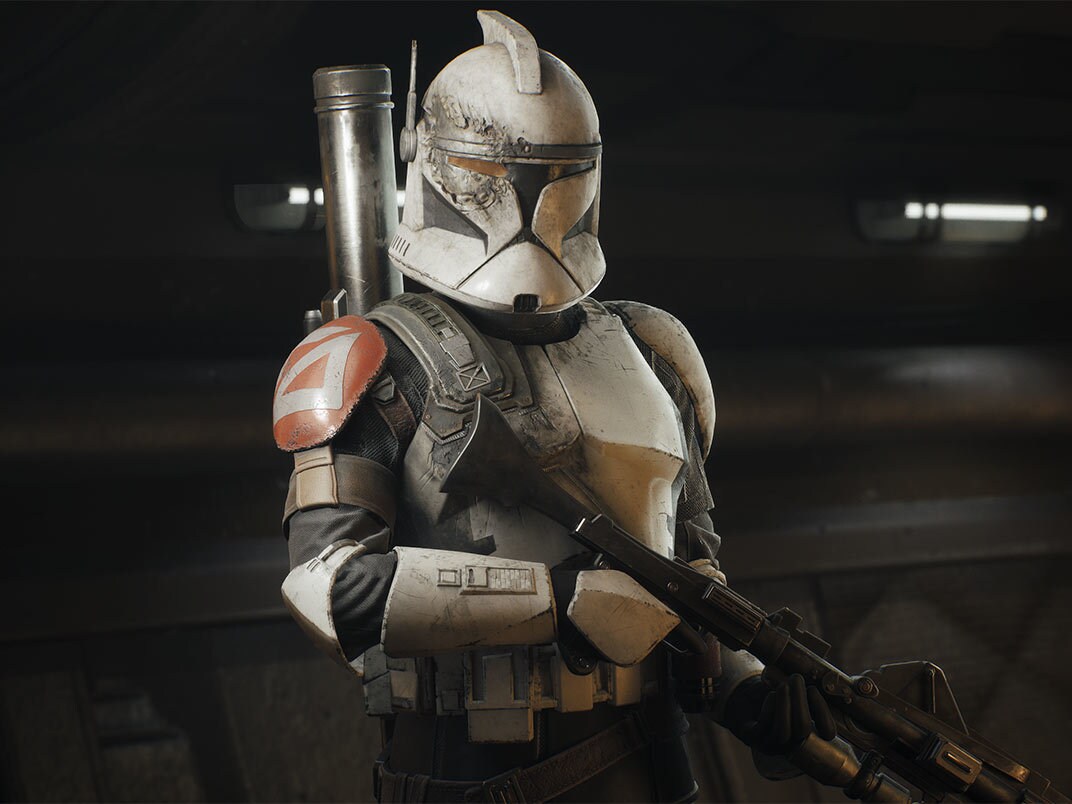
FIELD REPORT / WHO IS TRICK?
A life beyond the mission.
The Republic judged him unfit. His commander needed him anyway.
This dossier connects a verified biography to the larger questions of war, belonging, command and care. Read the official facts first, then try the interactive exercise to explore what those facts mean.
01 / FIELD BIOGRAPHY
The battle on Antine: saving a commander
The defining event in Trick's published biography is not a medal ceremony or an arena victory. During a Separatist attack on Antine, CT-3301 was wounded while saving Captain Hawks, the officer under whom he served. His injury emerged from the ordinary command relationship that made his service possible: a clone fought on behalf of a person with both greater rank and responsibility for the unit.
The battle had two different afterlives. Hawks was later dismissed from Republic service in connection with a disastrous defeat. Trick recovered from his own wounds but still faced an official decision that he was unfit to continue military service. The sources distinguish physical recovery from bureaucratic fitness; the reasons behind that decision have not been publicly explained in a way that would justify assigning a specific medical diagnosis.
Trick's continuation therefore begins at a sharp historical break. He had survived a war and regained his strength, yet the military institution that had defined his place said he could no longer belong. This unusual route into Zero Company is the story's doorway to questions about sacrifice, recognition, and who gets to judge a soldier's usefulness.
02 / FIELD BIOGRAPHY
Why Trick joined Zero Company
After leaving the Republic military, Trick chose to join Hawks as one of Zero Company's earliest operators. The decision preserves a personal loyalty while moving it into a formation that no longer derives its authority directly from the Grand Army of the Republic. His commitment to Hawks is therefore not simply a clone obeying a standing chain of command.
Zero Company operates as an independent intelligence and tactical organization, employing veterans and outsiders whose political histories do not necessarily align. Trick has to fight alongside people who could once have been his enemies. His loyalty to the Republic survives, but it now exists within a squad that cannot assume every operator shares the same trust in Republic institutions.
The distinction is useful when reading his relationship with Hawks. The captain can still draw on Trick's experience, but the former legal hierarchy has weakened. Friendship and choice carry more weight than the expired command structure; continued service becomes an expression of shared history.
03 / FIELD BIOGRAPHY
A clone identity beyond identical armor
Star Wars clone troopers are designed as a mass-produced military force, and their helmets and armor encode standardized equipment, ranks, and belonging. Trick illustrates a different layer of identity. His nickname, CT-3301 designation, remembered injury, and reputation as a gambler distinguish him from the abstraction of an interchangeable Republic soldier.
Lucasfilm describes him as someone who loves games of chance. That detail is small but important. Gambling involves judgment, play, risk and self-expression, not simply military efficiency. In a story that asks players to make choices under uncertainty, the trait gives Trick a recognizable personal style.
His official character portrait preserves the material history of the Republic in a different way. Armor can remain recognizable even after the institution stops granting its wearer a formal role. The gear communicates training and memory while the new company establishes a fresh social identity.
04 / FIELD BIOGRAPHY
The Republic, disability, and institutional exclusion
Trick recovered fully from his wounds yet was categorized as unfit for service. This contradiction illustrates an institutional problem: the category of fit or unfit is not identical to a simple measurement of personal ability. It is an administrative decision about who the organization will continue to employ and recognize.
The account should not be used to invent a diagnosis, speculate about a hidden medical defect, or imply that the clone was secretly incapable. The official material establishes the decision and its consequences, and the gap between those facts is precisely where critical interpretation belongs.
Clone soldiers bear a particular vulnerability because the Republic organizes their entire social life around military labor. Removal from service can mean losing not merely a job but the organizational world that structured daily routines, obligations, and status. Zero Company provides Trick a new place to exercise skill without requiring the Republic to reverse its judgment.
05 / FIELD BIOGRAPHY
Uneasy allies: Trick and the former enemies
Zero Company recruits widely, including people whose backgrounds make alliances uncomfortable. Lucasfilm has singled out Trick's initial tension with Luco Bronc, an Umbaran sharpshooter who resisted the Republic's occupation of his homeworld. The game treats those opposed memories as an opportunity for relationship development rather than a problem solved automatically by putting two characters on the same team.
Official previews describe how assigning two uneasy operators to missions together can improve their bond and potentially affect later outcomes. The feature gives a material form to a social claim: trust is practiced through cooperative work, not awarded simply because the mission begins.
An individual campaign might develop this relationship differently. The fixed facts are their different political histories and the game's bond mechanic. This dossier deliberately does not invent a canon friendship scene, unique dialogue, or guaranteed combat bonus that depends on a player's choices.
06 / FIELD BIOGRAPHY
Tactics and the meaning of teamwork
Zero Company uses tactical turns, action points, positioning, cover, and operator abilities. Trick's veteran experience matters in that shared combat context. He is a field operator rather than an armory clerk or distant narrator, and his links to Hawks make him a useful way to understand why squad relationships matter.
The game also distinguishes between completing an objective and simply defeating all nearby enemies. Protecting the operator, reaching the marked objective, and maintaining resources can be more important than producing the highest possible number of eliminations. That difference is central to a former Republic soldier whose most consequential act was saving someone.
The more detailed weapon builds, mission-by-mission advice, and current balance information belong on the Zero Company game guide. Those details may change with patches. The character dossier instead records the established role and asks what kind of soldier Trick becomes when the same skills are used for different institutional ends.
STORY / CONFIRMED SEQUENCE
How Trick arrived here.
These steps distinguish the official biographical sequence from assignments and choices that may differ between players.
CLONE SERVICE
CT-3301 serves under Captain Hawks in the Grand Army of the Republic.
ANTINE
He is wounded while saving Hawks from a Separatist assault.
AFTER RECOVERY
The Republic declares Trick unfit for continued service.
ZERO COMPANY
He chooses to join Hawks as one of the first operators.
PLAYER'S CAMPAIGN
Operational partnerships and developed squad bonds depend on play.
INTERACTIVE NETWORK / TRUST AND THREATS
Follow the relationships.
Switch between allies and opposition to examine different sources of loyalty and risk. Read every card for the context, not merely the name.
Captain Hawks
The officer Trick rescued and the independent company commander he later chooses to support.
Zero Company
The multi-background organization giving Trick new comrades and a role outside the Republic military.
Luco Bronc
An Umbaran veteran of Republic occupation. Their conflicting histories produce uneasy initial relations.
Kundri Fathom
The Infinite Coil leader whose spreading danger gives Zero Company its larger campaign mission.
INTERACTIVE ETHICAL FILE / ORIGINAL IDS ANALYSIS
One decision. Several costs.
Trick is ready for a mission, but a new operator remembers fighting the Republic on Umbara. As commander, what would you prioritize?
This is an IDS analytical scenario, not a documented in-game dialogue branch or a promise of battle rewards.
Choose an approach
Select an option to explore the power relationships and responsibilities behind the decision.
IDS ANTHROPOLOGICAL ASSESSMENT
Anthropological assessment: service beyond the uniform
Trick's biography exposes an asymmetry between sacrifice and recognition. He risked his body to save his commander, yet the organization receiving that service could later classify him as ineligible to remain. This does not prove that the Republic's decision was malicious, but it raises the question of who has authority to define recovery and belonging.
The clone's loyalty survives formal exclusion. It is redirected toward Hawks and a company composed of soldiers, Force users, and people from former enemy societies. Collective work cannot erase the past, but it creates opportunities for old opponents to reassess one another through shared danger.
The gameplay bond system makes these questions tangible. Whether the player sends a familiar ally or risks a difficult pairing, recruitment and deployment decisions help determine who becomes trusted. The interactive case below asks readers to examine that institutional tradeoff, not to predict an undocumented game ending.
COLLECTING THIS CHARACTER
Physical traces & provenance.
No verified Trick-specific licensed card or figurine is claimed here. Only documented Trick merchandise should be added to Collecting this Character; unrelated generic clone trooper items are not proof that the character was released as a collectible.
For a game-first collection, start by recording the edition you actually play and any verifiable official art. User-uploaded card images can be incorporated separately after verification.
SOURCE FILE / OFFICIAL REFERENCES
Verify the story.
Canon facts, player-dependent gameplay, and independent interpretation are separated throughout the dossier. No unsupported family names, medical diagnoses, secret allegiances, or guaranteed outcomes are asserted.
CONTINUE EXPLORING