
FIRST CONTACT / REPUBLIC AND UMBARA
He was an enemy before an ally.
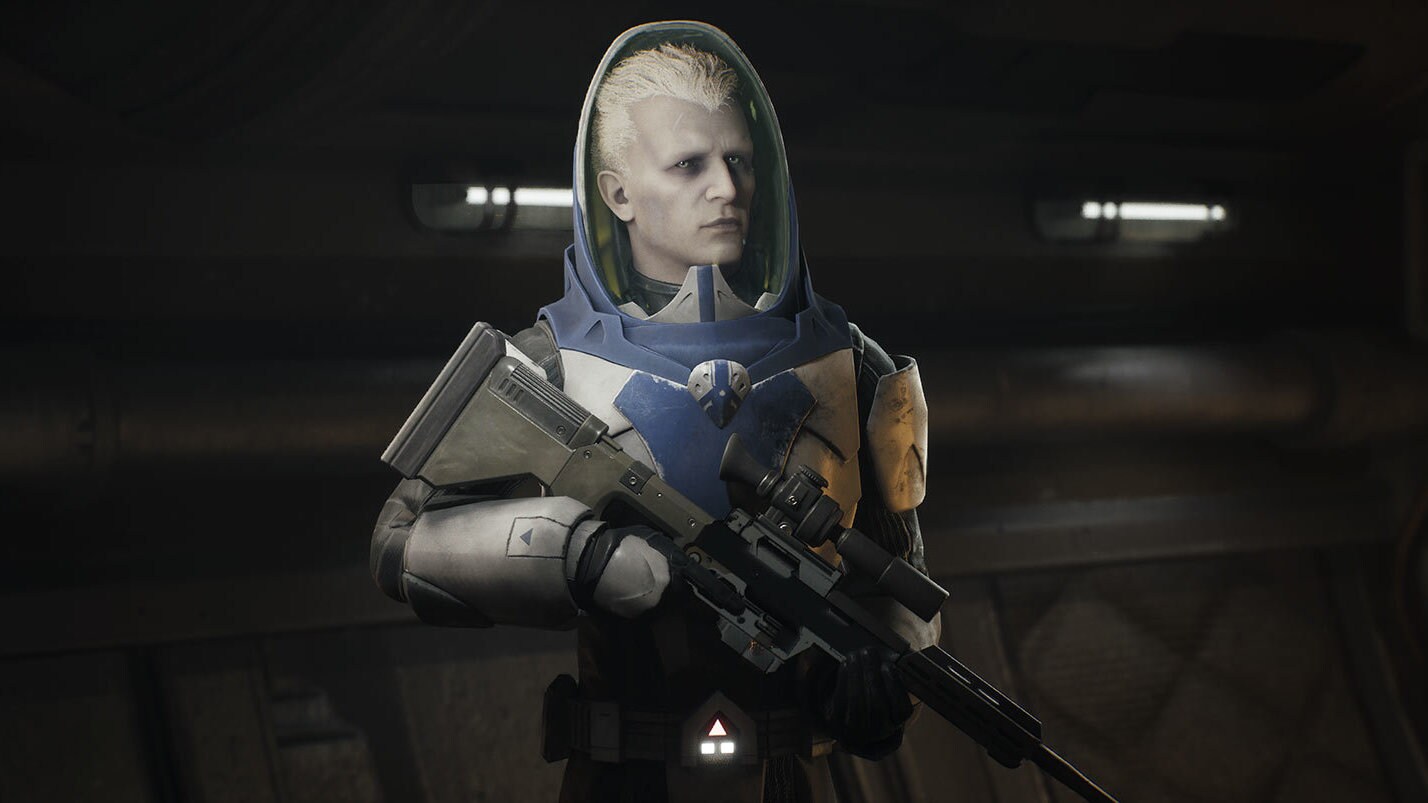
Luco Bronc is a sharply spoken Umbaran sniper who defended Umbara when Republic forces invaded his home. His decision to cooperate with Zero Company does not erase that history.
The Lucasfilm Databank offers a concise but politically significant biography. Luco served against the invasion of his planet. He dislikes the Republic precisely because it defeated and occupied Umbara. Nevertheless, he sets that antagonism aside to work with a squad whose leader once served as a Republic captain and whose founding members include clone veterans.
This history makes Luco more than a visual archetype of a pale, precise alien marksman. His presence requires a discussion of occupation, conflicting war memories and coalition-building after violence. A player can use him for ranged damage without pretending that tactical efficiency is the same as personal reconciliation.
The page connects his official story to Umbaran culture and to documented Zero Company missions. Separate interactive systems compare firing positions, filter his relationships and ask how a unit can treat the testimony of a former enemy as evidence. Numerical game statistics are sourced to recorded builds and labeled separately from Lucasfilm lore.
01 / IDENTITY
An Umbaran with a specific history.
Luco is an individual from Umbara, not an example of a biologically uniform attitude shared by all Umbarans. Lucasfilm describes his temperament as sharp-tongued and his role as a sniper. Neither attribute is presented as an innate property of the species. Both belong to the identifiable person who resisted a Republic invasion.
His official image shows a pale-haired person with a focused expression, a protective upper-body harness, and a scoped rifle. These visible objects support a reading of him as trained for ranged combat. They do not establish his birth date, family lineage, military rank, personal decorations or the manufacturer of every armor component. The weapon and uniform are relevant material evidence, but a portrait is not a full personnel record.
Luco's homeworld history is more concrete. The Republic attacked Umbara during the Clone Wars, and the resulting occupation shapes his judgment of Republic institutions. His later partnership with former Republic personnel introduces a public contradiction only if one assumes political loyalty never changes. A person can oppose an occupation and still recognize a new threat worth confronting.
Official sources do not identify an ancient Umbaran aristocratic family for Luco or document the details of his upbringing. This file instead follows the evidence: homeworld, occupation, sharpshooting identity, and recruitment into Zero Company. Additional game scenes can expand the history without justifying the invention of unshown events.
02 / WORLD AND WAR
Umbara was a home, not a level.
Umbara is the dark world whose surface receives little direct sunlight. Lucasfilm's Databank explains that its ecology and local technologies adapted to those conditions. During the Clone Wars its leaders turned away from the Republic and toward the Separatist cause, leading to an attack by Republic clone troops. The planet's inhabitants had their own institutions and expectations before it became a military objective.
Many viewers remember the Umbara campaign from The Clone Wars as a story about the suffering of Republic clones and the betrayal by General Pong Krell. Luco creates a different vantage point. For him the planet was not merely a dangerous battlefield entered by a foreign army. It was the place he defended. His resentment places the civilians and local forces who experienced invasion into the account.
The difference between a campaign seen from the attacker and one remembered by the defending population matters. A tactical map can render villages, fortified points and access routes as objectives. An inhabitant may connect those same places to memories of family, work, worship and political control. These are possible analytical perspectives, not claims that Luco's unrecorded relatives suffered particular events.
The word occupation describes the military and political relationship produced when outside forces take control of territory. It should not be used to infer a specific legal finding about every operation without examining the facts. The official biography directly says the Republic defeated and occupied Luco's planet. That is a stronger basis than inventing an atrocity to explain his anger.
Umbara's technology also resists a stereotype sometimes applied to societies seen as unfamiliar. Lucasfilm explicitly identifies Umbarans as technologically advanced, with unusual energy weapons and agile vehicles. The culture cannot be reduced to secrecy or alien appearance. Luco's military expertise belongs within a setting with its own developed technical and political history.
03 / PEOPLE AND INSTITUTIONS
Cooperation without forgiveness.
Zero Company is led by Hawks, a former Republic captain dismissed after accepting responsibility for a failed campaign. Trick is a clone veteran whose earlier identity is inseparable from the Republic's army. Joining such a team does not require Luco to celebrate the institution that conquered Umbara. It does require practical cooperation with people who once wore the uniforms he opposed.
The game's public presentation repeatedly emphasizes relationships among operators. Members bring their own histories and disagreements. The campaign develops bonds through deployments, creating mechanical consequences for sustained collaboration. Those systems should not be confused with an official announcement that every pair of characters reconciles or becomes friends on a particular mission.
Some community game references describe unusually difficult starting relations between Luco and Trick. That observation is useful for planning, but the exact numerical starting bond may depend on difficulty and game version. The official biography itself establishes the underlying tension without requiring a particular score.
Luco's willingness to cooperate against the Infinite Coil can be explained at the level the source permits: he is prepared to set aside a disagreement for the shared task. His political judgment about Umbara and the Republic remains intact. Coexistence under one commander is not equivalent to changing his account of what happened to his home.
This distinction matters during a war in which alliance labels conceal different motives. A squad of Mandalorians, Jedi, clone soldiers and former Republic enemies may agree that the Coil presents a danger while disagreeing about the Republic's right to rule. The organization survives through coordinated obligations rather than demanding one uniform historical memory.
04 / TACTICS AND MATERIAL LIFE
The sniper's weapon is only half the skill.
Game records identify Luco as a starting Sharpshooter, equipped with a longarm blaster. His signature Combat Gas talent and related ranged abilities are documented in community records of the released game. Those mechanics belong to a particular build and should be verified against the player's current version, difficulty and training choices.
For a practical deployment, the first question is whether the sniper has a meaningful line of sight. High range is of little use if a wall, corner or ally blocks the shot. Review cover, sightlines, nearby routes and whether the objective will move beyond the chosen position before committing Luco to a stationary firing lane.
A distant position may protect Luco from immediate return fire, but it also creates costs. He may become isolated, lose access to the mission objective or require another operator to extract him. Positioning is therefore a team question. It affects not only Luco's damage potential but the mobility and safety of the entire squad.
Overwatch can protect a corridor or force an opponent to reconsider movement. It is less attractive when the enemy is unlikely to pass through the firing arc or when the mission requires urgent relocation. Similarly, a powerful precision attack must be evaluated against the Advantage pool and other operators' needs, not chosen automatically because it looks impressive.
Luco's skills do not prove that he learned military doctrine in any particular Umbaran academy. The game demonstrates what the operator can do; it does not automatically disclose how every ability was taught. The gap between observed practice and narrated biography should remain visible.
TACTICAL / INSTITUTIONAL EXPLORER
Read the lane. Plan the withdrawal.
Try three ways of deploying a Sharpshooter. These are strategic interpretations rather than guaranteed AI behaviors.
A distant overwatch lane
A long firing lane may protect Luco and let him threaten exposed targets. Check line of sight and how quickly the next objective can move beyond the lane.
Key risk: Can the rest of the squad reach him if a flanker appears?
05 / CHRONOLOGY & MISSIONS
From occupation to a divided squad.
UMBARA'S POLITICAL TURN
The world aligns with the Separatist cause during the Clone Wars.
REPUBLIC INVASION
Republic forces attack, defeat and occupy Umbara. Luco defends his home.
CONTINUED ANTAGONISM
Luco holds a negative view of the Republic after the invasion.
ZERO COMPANY
He agrees to serve alongside Hawks and a mixed team against the Infinite Coil.
LORD OF BETRAYAL
His first named personal Hero Mission appears in the game's mission records.
NO KINGS, NO MASTERS
A later personal assignment requires Luco and Trick and additional campaign prerequisites.
To follow the real objectives and requirements, read Lord of Betrayal and No Kings, No Masters. Exact unlock timing depends on campaign decisions; this chronology does not promise a universal cycle.
06 / INTERACTIVE RELATIONSHIPS
One company. Different memories.
Umbara
Luco's homeworld, invaded and occupied by Republic forces during the Clone Wars.
Explore this connection →Trick / CT-3301
The clone veteran's Republic service makes cooperation politically difficult.
Explore this connection →Cly Kullervo
Mandalorian survivor with a separate personal grievance and a place in Hawks' squad.
Explore this connection →Tel-Rea Vokoss
Jedi Padawan whose training creates another view of loyalty and restraint.
Explore this connection →Republic occupation
The institution that conquered Umbara shapes Luco's established resentment.
Explore this connection →Infinite Coil
A threat that gives operators with rival backgrounds reason to cooperate.
Explore this connection →IDS INTERACTIVE ETHICS FILE / HYPOTHETICAL
Who gets to tell the war?
Select a response and compare its institutional and personal costs.
This is IDS interpretive analysis, not official story dialogue or a game-ending predictor.
Choose a response
A written analysis of that option appears here.
07 / ANTHROPOLOGICAL ASSESSMENT
Occupation, memory and tactical trust.
Luco's character challenges a familiar tendency in war narratives: to follow soldiers across an unfamiliar world while offering little sustained attention to the people who inhabit it. Umbara was never an empty testing ground. It had a political system, cultural practices, advanced technology and inhabitants capable of choosing sides in a galactic struggle.
An account of occupation must distinguish military victory from the consent of those who live under the victor's control. A state may hold territory without securing approval. The fact that Luco joins Zero Company later should not be retroactively interpreted as acceptance of the Republic's intervention. One tactical decision cannot settle every earlier political disagreement.
Work on collective memory shows why opposing participants may preserve different accounts of the same campaign. Republic clones remember orders, comrades and the conduct of their generals. An Umbaran defender can remember the arrival of outside forces and the consequences of defeat. Neither account should be dismissed solely because the speaker once fought on the other side.
Luco's sniper role can be studied through material culture. The blaster, protective gear and firing position are technologies that shape what a combatant can see and accomplish. They are also the visible signs by which teammates classify a person's expected contribution. A powerful rifle may secure a place within a squad even when trust is unsettled.
Mixed organizations do not require uniform ancestry or political biography. Zero Company recruits people who bring contradictory judgments about the war. Cooperation can emerge through shared tasks and new obligations. The cost is not always reconciliation; a team can function while important moral disagreements remain open.
Finally, the player's choices create a gap between authored character and mechanical control. Luco's recorded history belongs to him as a fictional person. His movement and firing positions belong partly to the player's encounter with the game's rules. One should not infer Luco's personal ethics from whichever action happens to win a difficult battle.
COLLECTING THIS CHARACTER
Evidence before merchandise.
Official Lucasfilm character art and the released Zero Company game are verifiable references. The cited sources do not identify a specific licensed Luco Bronc trading card, minifigure or action figure, and a generic clone trooper collectible must not be labeled as him.
Character-specific products can be listed after verifying the manufacturer, release and subject. Only user-supplied card photographs belong in this section. The main game page carries platform information and relevant sponsored shopping links.
SOURCE LOG / VERIFY THE STORY
Documented facts and limits.
The Umbara history and Luco's willingness to join Zero Company come directly from Lucasfilm. Weapon specialization and Hero Mission names are player-game records, not added Databank biography. The sniper exercise and war-memory case are IDS analysis.
KEEP EXPLORING