
01 / DOCUMENTED INSTITUTION
The professionals behind Sith power.
Imperial Intelligence is the original SWTOR-era Sith Empire's covert service. It conducts espionage, sabotage, counterintelligence, security investigations and politically directed operations through specialized non-Sith personnel.
The official SWTOR Imperial Agent Holonet emphasizes that the Empire cannot survive on Force power alone. Political control also requires informants, secret operations, covert identities and people able to influence enemies without open battle. The service supplies that capability and gives the Imperial Agent player a professional role in the state's hidden operations.
Imperial Intelligence is not the Galactic Empire's later intelligence agency under Palpatine. Although both use the word Imperial, they belong to different eras and state structures. This dossier covers the reconstituted Sith Empire of The Old Republic and its original Imperial Agent campaign, which is part of Legends continuity.
Its professional work includes identifying threats and taking covert action. The game also makes clear that Sith patrons can direct the organization against personal opponents or its own employees. A capable operative may possess extraordinary access to secrets while remaining politically subordinate to a single Dark Council member.
The original Imperial Agent plot moves from Hutta's political criminal economy to threats against the capital, a double-agent operation inside Republic intelligence and finally the discovery of the Star Cabal. Through these changes, the story asks whether professional service to the Empire can survive conflicts between secrecy, institutional loyalty and the interests of powerful Sith.
02 / HISTORY OF COVERT INFLUENCE
Intelligence before the Great War's end.
The service existed before the original playable class story. The official SWTOR Galactic History record describes Imperial operatives manipulating the Mandalorian arena system to create a political ally during the Great Galactic War. The narrative is presented by Jedi archivist Gnost-Dural, whose records represent an in-universe perspective rather than an all-knowing account.
In that record, Imperial operatives entered the world of gladiatorial contests as managers, sponsors and even competitors, then promoted a chosen fighter through manipulated victories. The resulting Mandalore helped rally Mandalorian fighters and put pressure on the Republic's trade routes. The operation demonstrates that the intelligence service targets social institutions, not merely military installations.
This kind of infiltration has a clear purpose: it changes who holds status and which political movements can mobilize support. The service acquires influence by altering competitive conditions rather than announcing that it is installing a client ruler. Its success depends on public audiences accepting a manipulated outcome as legitimate.
By the time the original game begins, the Empire's war with the Republic has produced a treaty and an unstable peace. The Sith Dark Council oversees government while covert conflicts continue. Intelligence specialists remain useful precisely because formal peace does not eliminate intelligence gathering, economic pressure or attempts to undermine rivals.
The official Holonet does not present a full chronology of every Keeper, Minister or covert operation. Individual campaign accounts are therefore used as evidence for specific periods, without inventing a comprehensive agency history between them.
03 / COMMAND, OVERSIGHT AND RISK
The Keeper, Minister and Dark Council.
The official Keeper biography identifies that title as the senior director of operations inside Imperial Intelligence. Keeper approves infiltrations into enemy territory and orders directed at enemies of the state. The role carries responsibility for personnel, secrecy and the consequences of field missions.
The chain of political accountability is not limited to Keeper. The same biography explains that the Minister of Intelligence and Sith councillors can remove an incumbent whose service fails their expectations. This places professional expertise beneath political oversight that is itself vulnerable to Sith rivalry.
A mission can therefore be operationally well planned while remaining politically unsafe. The officer carrying it out might have adequate resources and accurate information but no protection from a Sith who regards the operation as inconvenient. Keeper's survival requires judgment about when to obey and when to act independently.
The pre-release Holonet presents Keeper as a seasoned administrator who combines spycraft with knowledge of Imperial politics. That pairing is essential. An official in this setting cannot treat the technical design of missions as separate from the patrons who approve them.
Darth Jadus is another source of authority, described officially as controlling the Empire's vast intelligence service mainly through advisers and intermediaries. His influence demonstrates that the separation between a professional hierarchy and Sith political command is never complete.
Different periods of the Imperial Agent story place different people in the offices. The original game depicts promotion and reorganization; the name Keeper is a role rather than the permanent personal name of one unchanged individual.
04 / WORK, SPECIALTIES AND IDENTITY
Ciphers, Watchers, and the loss of private identity.
Cipher Nine is the best-known field operative because the Imperial Agent player receives that designation during the original campaign. The official class Holonet characterizes Ciphers as elite agents trusted with exceptionally sensitive operations. Such agents are not simply ordinary soldiers with disguises; their assignments require improvisation, judgment and unusual latitude.
Other personnel perform analysis, communications, planning and administrative support. The game uses professional titles such as Watcher, Keeper, Fixer and Minder. Their exact functions should be drawn from particular mission evidence rather than assuming that every occupational title is self-explanatory across the Empire.
Watcher Two, also known as Shara Jenn in later sources, is an important contact for Cipher Nine. Her work links field operations with intelligence headquarters. Keeper assigns missions through this network, while field agents return information that can change the next decision.
Cover identities allow an agent to interact with people who would refuse a known Imperial official. But keeping identities hidden has consequences for ordinary social life. It can conceal allegiance from colleagues, intimate partners and the people manipulated during a mission.
The Imperial Agent narrative repeatedly puts loyalty into conflict with job performance. An officer may defend the Empire's broader population while disobeying a dangerous Sith superior, or pursue a particular patron's interests while weakening professional independence.
An anthropological archive must therefore recognize the agency as a workplace. Its members are trained people with distinct tasks, careers and vulnerabilities, not a faceless emblem that acts with one unchanging intention.
05 / COUNTERTERRORISM COMPROMISED
When Jadus commands both sides of an investigation.
In the first chapter of the Imperial Agent story, Cipher Nine is sent to investigate a terrorist movement led by the Eagle. The agent disrupts operations on Dromund Kaas, but an Imperial dreadnought carrying important officials is destroyed. Darth Jadus is initially counted among those lost.
Further investigation reveals the Eradicators, orbital weapons placed above Imperial worlds. They could produce mass civilian casualties and a political crisis across the Empire. The player's assignment changes from dismantling independent terrorist cells to identifying a highly placed co-conspirator.
BioWare's official 2015 plot summary reveals Jadus as the hidden organizer. The professional service entrusted with Imperial safety has been manipulated by a Sith who seeks to benefit from the destruction of Imperial populations.
Cipher Nine's response can vary. The player can challenge, negotiate with or support the political plan, and different consequences follow. There is no single mandatory early-game ending to impose on every Agent character.
The episode demonstrates the difference between the institutional ideal of security and the preferences of a powerful person. Investigators need evidence and procedural independence; a Sith patron may demand obedience instead. The professional order and political hierarchy can therefore become competing sources of legitimacy.
06 / THE CONSPIRACY AGAINST BOTH FACTIONS
The Star Cabal and compromised institutions.
Later in the original Imperial Agent story, Cipher Nine infiltrates the Republic Strategic Information Service. The mission involves Ardun Kothe, false identities and evidence of a hidden project. The Agent story expands from conventional espionage into a question about who has secretly directed both galactic powers.
The final act identifies the Star Cabal as a conspiracy that has manipulated Republic and Imperial events for generations. Its stated aim is to weaken or eliminate the Jedi and Sith by encouraging the two states to destroy one another. These events should be attributed to the original Agent story, not treated as established real-world political history.
Cipher Nine and remaining intelligence allies follow clues to the Cabal's headquarters. Hunter is a central adversary, and the confrontation ends with the player obtaining the Black Codex, a repository of information about people and their covert activities.
The final decision concerns information itself: who should control a compiled record powerful enough to expose or blackmail numerous actors? The official class-story synopsis explicitly presents possible choices involving Imperial Intelligence, the Dark Council, the Republic or withholding the information.
The original agency undergoes severe disruption during the Cabal conflict. Later Sith Intelligence is a distinct successor arrangement rather than proof that the launch-era service kept precisely the same name, leadership and organizational structure indefinitely.
The ending makes intelligence work a political question of its own. The capacity to collect comprehensive records does not resolve who should use them, what purpose that use serves or how affected people can challenge misuse.
07 / TECHNOLOGY AND PHYSICAL SPACE
The Phantom, headquarters and classified archives.
The headquarters on Dromund Kaas is an important workplace in the original Agent storyline. The organization operates inside the Imperial Citadel's administrative environment, where missions, intelligence briefings and political interference are encountered directly by the player.
The X-70B Phantom is another distinctive piece of material culture. The official Holonet credits Imperial Intelligence with commissioning an unusually advanced low-profile starship with radar-resistant construction, advanced navigation and limited prototype production. It is assigned only to especially trusted agents.
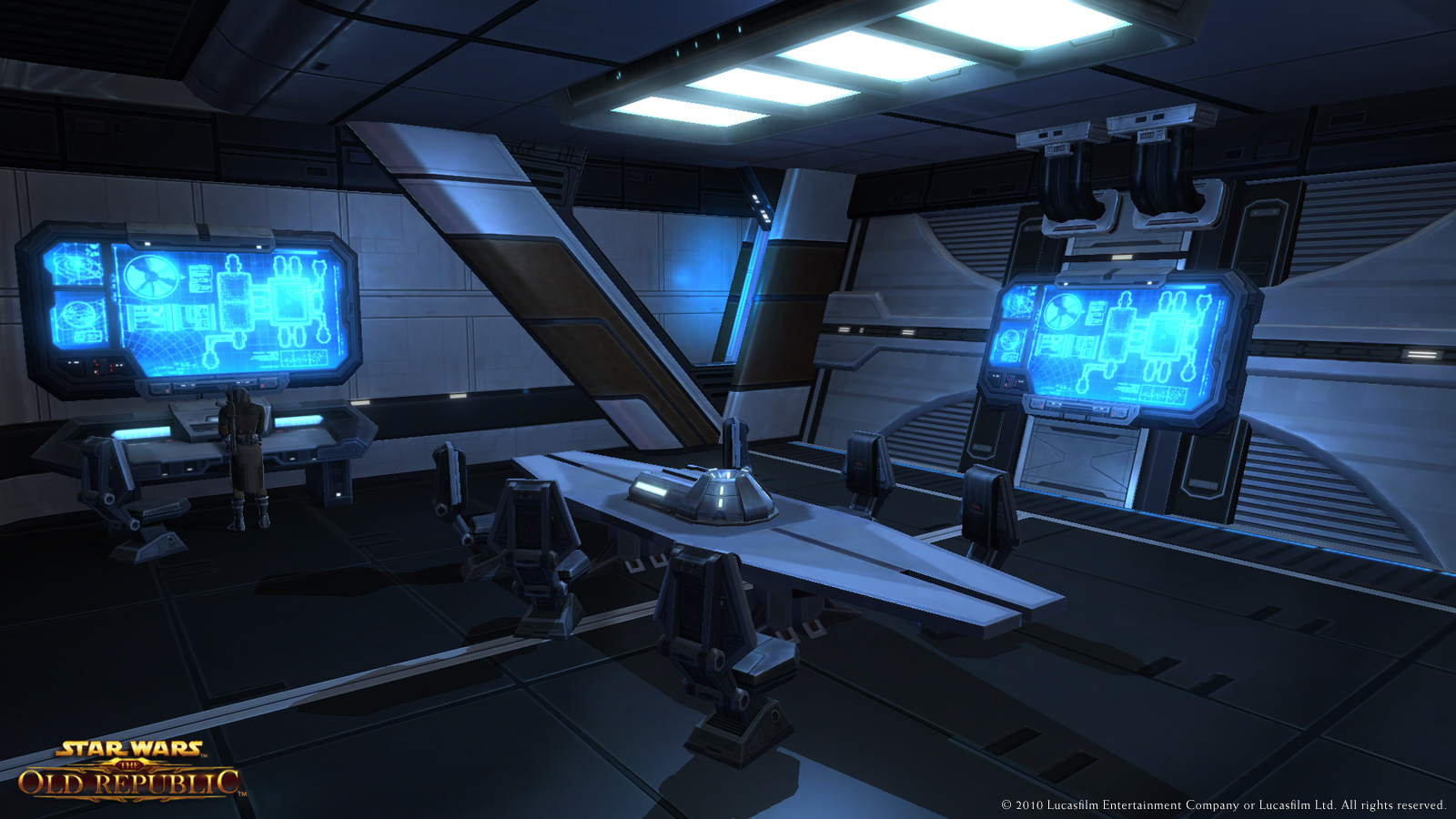
The hero image of this dossier shows the Phantom's internal command area. It is not a photographic group portrait of all the service's personnel and should not be confused with the later Galactic Empire's intelligence offices.
Ships and records make covert institutions practical. An undercover operative needs secure mobility, communications, access to databases and a plausible story that survives contact with outsiders. The high status of Sith supervisors does not remove those everyday technical requirements.
Archives can become a site of danger. A list of clandestine assets, sources or intercepted communications can compromise the people the organization recruited. The Black Codex is the game's clearest demonstration of how concentrated knowledge can create power even when no one has the Force.
The official X-70B account documents engineering features, but it does not establish every real-world-looking specification of a ship's sensor systems. Readers seeking current flight or combat mechanics should consult the game guide rather than interpret this as a contemporary gameplay build.
08 / RESEARCH CHRONOLOGY
The institution across the game.
Political operations beyond the battlefield
Gnost-Dural's history describes agents shaping Mandalorian politics through manipulated competitions.
Cipher recruited
The Agent succeeds on Hutta, makes contact with Keeper and attracts Darth Jadus's attention.
The Eagle / Jadus case
The Agent uncovers an internal terror conspiracy and the Eradicators. Choices affect Jadus's outcome.
SIS infiltration
Cipher Nine works undercover against a Republic intelligence operation.
The Star Cabal
An intelligence conspiracy threatens the profession itself, and the Black Codex is acquired.
Reorganization
The original agency's position changes during the campaign; later Sith Intelligence requires separate analysis.
These are narrative stages from published game accounts. The Imperial Agent origin-story guide provides quest navigation. A story synopsis does not guarantee fully tested mission directions.
09 / INTERACTIVE PERSONNEL MAP
Who serves whom?
Use the categories to separate professional staff from political sponsors and outside threats. The map identifies verified story relationships, not a total staffing register.
Cipher Nine
Elite operative and playable Imperial Agent whose loyalties and choices affect the story.
Watcher Two / Shara Jenn
Analyst and mission contact who later occupies senior Intelligence leadership.
Darth Jadus
A Dark Council member able to redirect Intelligence for a personal political plan.
The Dark Council
A governing institution whose members can impose demands on intelligence leadership.
The Eagle
Terrorist leader involved in Jadus's concealed Eradicator scheme.
Ardun Kothe
Republic SIS operative at the center of the original second chapter's infiltration.
The Star Cabal
Long-running conspiracy that exploits the conflict between both galactic superpowers.
10 / INTERACTIVE INTELLIGENCE REVIEW
Three risks. One compromised agency.
You are reviewing the discovery that a Sith sponsor of a security investigation may also be directing the terrorist threat. Which institutional safeguard would you investigate first? Outcomes are hypothetical IDS analysis, not SWTOR mission choices.
Select a response
Each choice reveals an institutional trade-off. This simulation cannot predict a game result.
11 / ANTHROPOLOGICAL LENS
Secrecy as work and political power.
Intelligence is an occupation and a political institution. It depends on specialized personnel whose labor may remain invisible precisely because success is defined as preventing a public crisis or quietly changing another group's behavior.
The Keeper's authority is bureaucratic rather than simply physical. Even while lacking the Sith status of Jadus, Keeper supervises employees, approves operations and understands an extensive network of files and sources. The professional role has real power but lacks secure independence from Sith patrons.
Cipher Nine reveals a tension between expertise and obedience. A person entrusted to make decisions under difficult conditions can discover that an official directive would endanger the population the service claims to protect. Loyalty to the state and loyalty to a particular leader become distinguishable concepts.
Workplace identity is altered by secrecy. Code names, covers and restricted files conceal the personal histories of agents. These practices may allow operations, but they also complicate accountability and ordinary human relationships.
The Star Cabal and Black Codex make information accumulation a problem of governance. Knowledge about political actors can be used for protection, blackmail, repression or public exposure. Collecting more information does not determine the ethical outcome.
Imperial Intelligence is fictional and belongs to a Sith authoritarian state. Its institutions can be studied for the way the story represents bureaucracy, ideological loyalty, political hierarchy and covert labor, but that analysis should not be treated as empirical evidence about real intelligence organizations.
12 / PRIMARY SOURCES
Where the claims come from.
- Official SWTOR Imperial Agent Holonet. Structure, missions and Cipher class duties.
- Official Keeper biography. Operations leadership and accountability to the Minister and Sith Council.
- Official Darth Jadus biography. Council patronage and Intelligence oversight.
- BioWare: Hidden Enemies (2015). The three-act original Imperial Agent plot and Black Codex decision.
- SWTOR Galactic History. In-universe historical explanation of Mandalorian infiltration by the intelligence service.
- Official X-70B Phantom record. Imperial Intelligence ship development and its distinctive low-profile technology.
- Game-screenshot source for the Phantom interior. Hero art represents the intelligence ship interior, not all the agency's members.
Continuity is Legends. Sources distinguish publisher statements and an in-universe Jedi historical narrative from IDS interpretation. The personnel network and hypothetical decision exercise are editorial tools, not playable quests. Reorganization into Sith Intelligence should not be mistaken for an unchanged institution through every later expansion.