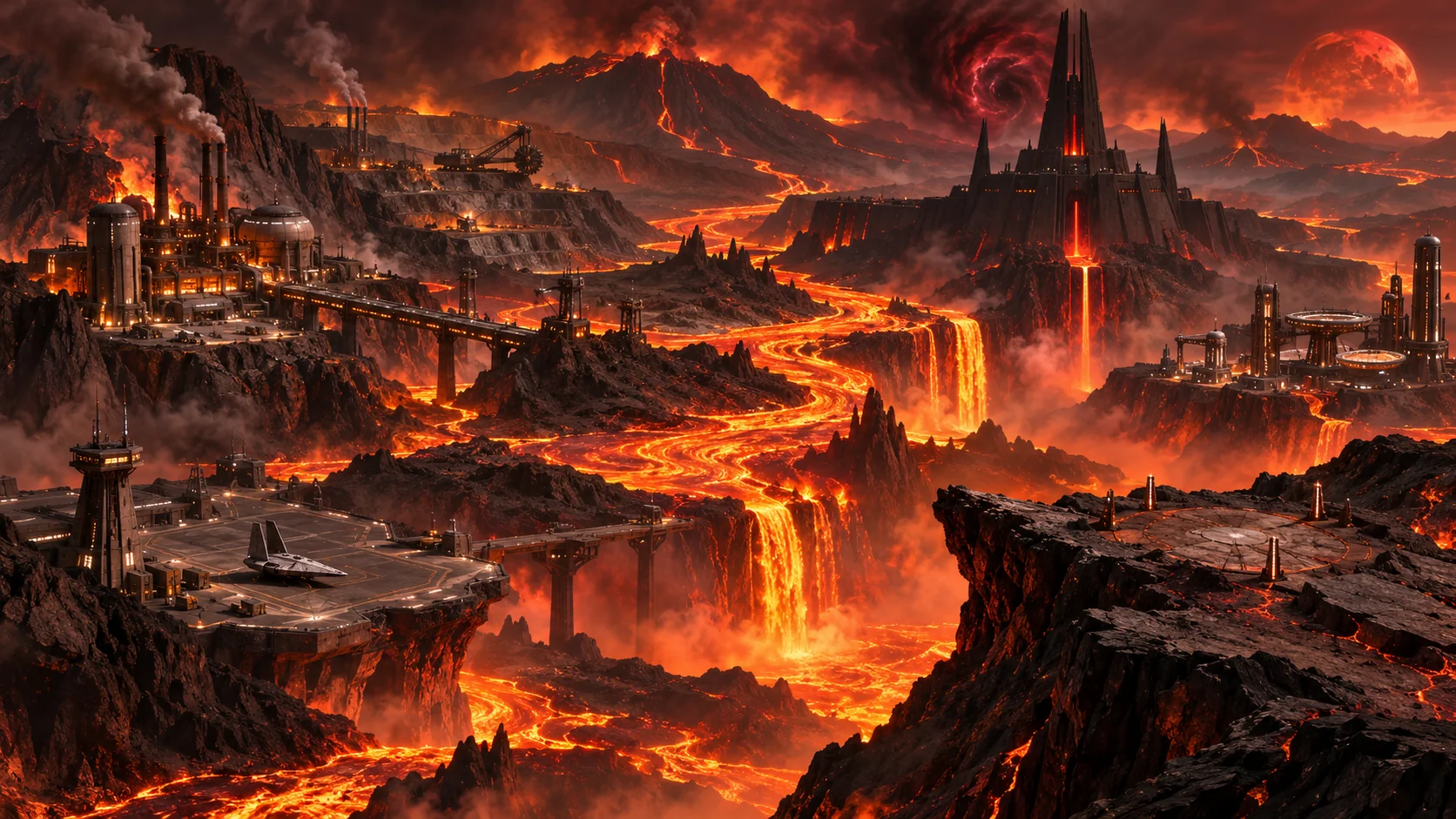
Original IDS conceptual illustration. Original Imperial-era panorama showing the fortress over lava and industrial terrain. The red celestial orb and atmospheric vortex are artistic additions, not established screen geography.
TypeVader's Imperial stronghold
Architectural linkLord Momin
Underlying siteAncient Sith cave / Force locus
Later conditionRuins and pilgrimage
INTERACTIVE ENVIRONMENT FILE
Explore Darth Vader's Castle
Select a photograph or illustration to examine the setting and its relationship to the source material.
Original IDS conceptual illustration
SCENE 01 / 04
Vader’s castle above the lava
Original Imperial-era panorama showing the fortress over lava and industrial terrain. The red celestial orb and atmospheric vortex are artistic additions, not established screen geography.
Darth Vader established an obsidian fortress on Mustafar, near the setting of his defeat by Obi-Wan Kenobi. The castle rises from lava fields and is constructed above an ancient Sith cave.
The architecture reinforces Vader's link to dark-side power and personal trauma. During the Imperial era the castle becomes a place for Vader to meditate, recover and receive high-ranking visitors, including Orson Krennic.
The post-Imperial setting is different. Official material describes the castle in ruins when cultists journey to Mustafar, which is why the main hub displays its intact form only in the Imperial scene.
Why this site matters
The castle is not simply a defensive building. Its architecture is linked to Vader's effort to manipulate a dark-side locus. The same site carries several layers of history: ancient power beneath the volcanic ground, Imperial occupation above it, and later devotion among the Alazmec.
Accuracy and interpretation
The fortress is documented as an Imperial-era structure. Its later ruined state is associated with post-Imperial Mustafar.