
01 · Central reading
What an anthropology lens changes
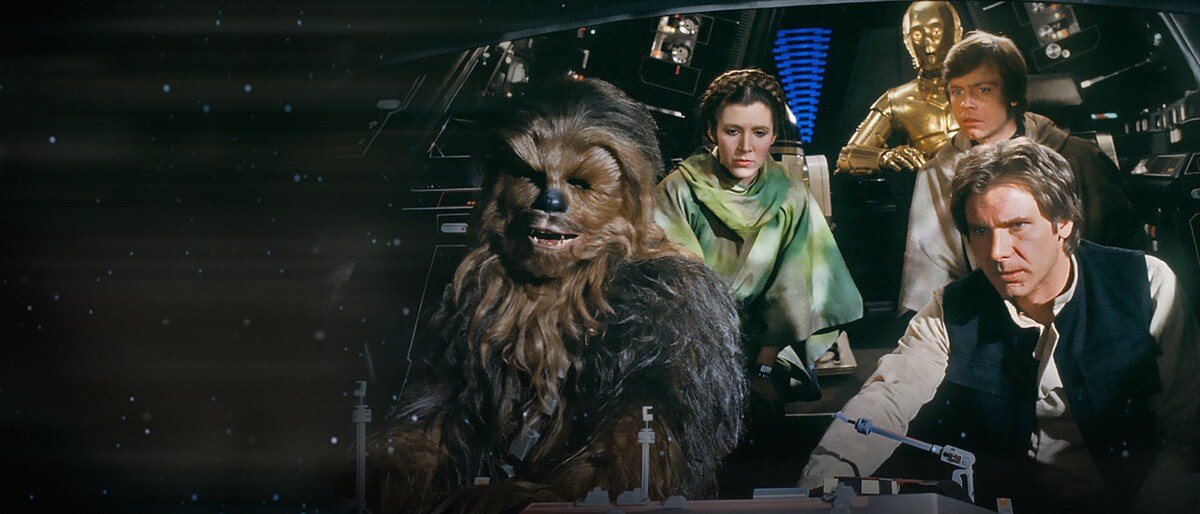
Return of the Jedi is built around alliances that the Empire consistently underestimates. Political victory depends on relationships across very different communities, while Luke's confrontation with Vader and Palpatine turns kinship into an alternative to Sith succession.
This review does not score the film. It asks what kinds of social relations the story makes visible: who has authority, how institutions reproduce themselves, what counts as family, how belief is organized, who performs necessary labor, how violence is justified, and how people attach meaning to places and objects.
02 · Anthropology lens
Jabba and patronage power
Jabba's palace is a political economy organized around personal rule. Access, entertainment, punishment, debt, and status all flow through the Hutt leader and his household. His authority is not bureaucratic in the Imperial sense. It is relational, theatrical, and enforced through retainers, fear, and control over bodies.
03 · Anthropology lens
Ewoks and coalition politics
The Rebels initially misunderstand the Ewoks, then depend on them. The alliance works because the local community possesses knowledge of terrain, mobility, and resources that the technologically superior Empire discounts. The film therefore places military success inside an intergroup coalition rather than attributing victory only to the central heroes.
04 · Anthropology lens
Kinship against succession
Palpatine imagines Luke as a replacement for Vader within a Sith structure of succession. Luke instead insists on his connection to his father and refuses the Emperor's terms. Vader's final action is therefore both political and familial. He breaks the chain of Sith reproduction by prioritizing a kin relationship over obedience to his master.
05 · Anthropology lens
Death, mourning, and funeral ritual
Vader's death is followed by Luke's private cremation of his body. The funeral separates Anakin from the Imperial identity represented by the armor while giving Luke a ritual act through which to mourn and reinterpret his father. The later communal celebration links private loss to public political transformation.
06 · Anthropology lens
Imperial spectacle and vulnerability
The second Death Star is designed as a demonstration of overwhelming Imperial capacity. Palpatine also stages Luke's encounter as a display of his own control. Yet both forms of spectacle depend on hidden assumptions about obedience, technological invulnerability, and the inability of weaker groups to coordinate.
07 · Anthropology lens
Celebration and political transition
The final celebrations show the fall of central Imperial authority as a social event experienced in multiple places. Political change becomes visible through crowds, symbols, music, and public emotion. The film does not explain the institutions that will follow, which makes the ending a moment of transition rather than a completed political settlement.
08 · Method
How IDS is reading this film
The analysis treats Star Wars as a fictional social world rather than evidence about any real population. Anthropological concepts are used as questions, not as claims that fictional societies map directly onto real cultures. The goal is to make institutions, relationships, practices, objects, and systems more visible without reducing the film to a single political or moral message.
Mentioned in this file