01 · Central reading
What long-form television makes visible
Visions is valuable because it loosens the expectation that every Star Wars story must fit one chronology. That freedom makes visible how strongly setting, visual language, social institutions, and genre conventions shape what Star Wars can mean.
This review treats the released series as a fictional social world. It does not rank seasons or assign a score. The focus is on recurring relationships, institutions, forms of authority, material systems, identities, and practices that become clearer because television can follow them across many episodes.
02 · Anthropology lens
Anthology and multiple social worlds
Each short can establish its own institutions, histories, and assumptions without maintaining continuity with every other story. The anthology form therefore allows comparison. Similar Star Wars elements take on different meanings when placed inside different social worlds.
03 · Anthropology lens
Cultural translation and artistic interpretation
The participating studios do not simply reproduce a single house style. They interpret Star Wars through distinct animation traditions, genres, visual conventions, and storytelling priorities. Analysis is most useful when it treats these works as creative interpretations rather than as direct stand-ins for entire real-world cultures.
04 · Anthropology lens
Alternative Force traditions
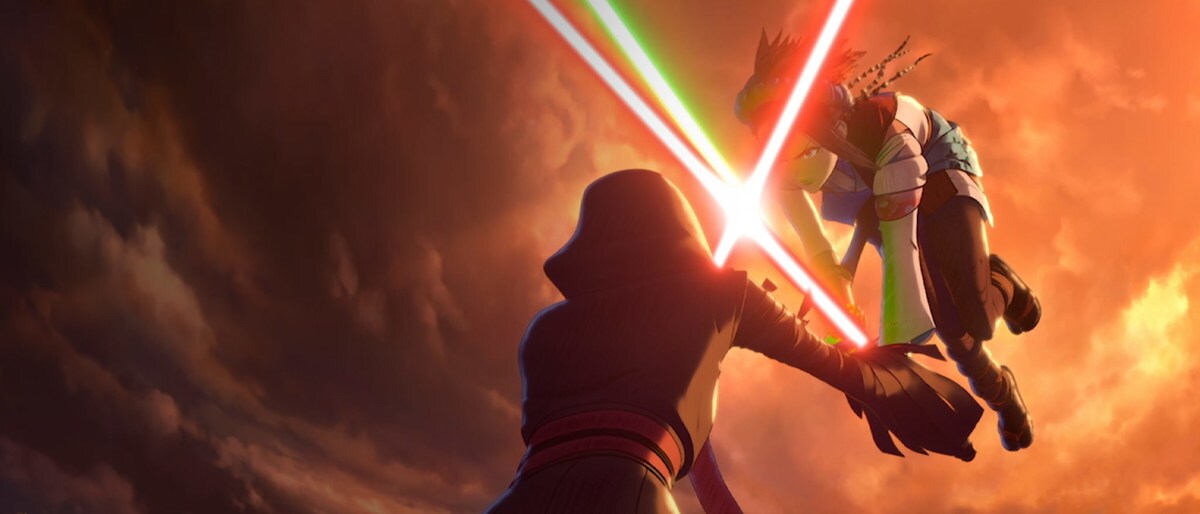
Visions repeatedly imagines Force use outside familiar Jedi and Sith institutions. This reveals how flexible the concept becomes when creators can invent new teachers, rituals, moral frameworks, and relationships to power.
05 · Anthropology lens
Family and inherited obligation
Many shorts use siblings, parents, ancestors, clans, or adoptive relationships to connect personal identity with larger obligations. Kinship often becomes the mechanism through which power, conflict, memory, or responsibility is transmitted.
06 · Anthropology lens
Material culture and visual meaning
Weapons, clothing, architecture, droids, ships, and landscapes are frequently redesigned in ways that immediately signal a different social environment. Objects carry narrative meaning before characters explain the institutions around them.
07 · Anthropology lens
Canon freedom and interpretive possibility
Because Visions is not required to resolve every story inside the main canon chronology, creators can test alternative political systems, histories, aesthetics, and outcomes. That freedom makes the anthology useful for understanding Star Wars as a flexible cultural form rather than a single fixed setting.
08 · Method
How IDS is reading this series
The analysis uses anthropology as an interpretive framework for fictional media. It does not claim that fictional peoples correspond directly to real populations. For ongoing or returning series, the discussion is limited to material already released rather than unreleased story details.
Mentioned in this file