01 · Central reading
What long-form television makes visible
Visions is valuable because it loosens the expectation that every Star Wars story must fit one chronology. That freedom makes visible how strongly setting, visual language, social institutions, and genre conventions shape what Star Wars can mean.
Television gives social institutions time to recur. A government office, household, prison, crew, religious community, workplace, or settlement can appear under different pressures across multiple episodes, which makes rules and exceptions easier to distinguish. This review does not rank seasons or assign a score. It asks how recurring relationships, institutions, forms of authority, material systems, identities, and practices change as characters continue living inside them.
The anthology format replaces long continuity with comparison across distinct social worlds. Repeated Star Wars motifs can therefore be examined as flexible cultural forms whose meanings change with artistic tradition, setting, family structure, political order, and visual language.
02 · Anthropology lens
Anthology and multiple social worlds
Each short can establish its own institutions, histories, and assumptions without maintaining continuity with every other story. The anthology form therefore allows comparison. Similar Star Wars elements take on different meanings when placed inside different social worlds.
This lens deepens Visions by connecting individual choices to recurring social structures. The same characters encounter rules, relationships, material constraints, and inherited expectations across multiple episodes, which makes it possible to distinguish a one-time plot event from an ongoing institution or practice. Variation inside groups also becomes easier to see. People who share a government, community, profession, religion, or political cause do not automatically interpret it in the same way. The series is therefore most useful when its social world is treated as negotiated and changing rather than as a collection of fixed categories.
The longer time scale matters here. The anthology format replaces long continuity with comparison across distinct social worlds. Repeated Star Wars motifs can therefore be examined as flexible cultural forms whose meanings change with artistic tradition, setting, family structure, political order, and visual language. Seen through the lens of anthology and multiple social worlds, recurring settings and relationships let consequences accumulate. An arrangement that first appears normal can later be exposed as fragile, coercive, privileged, or historically contingent. Characters also learn from earlier encounters, so institutions are not static backdrops: they adapt, fail, harden, fragment, or become newly meaningful as circumstances change.
03 · Anthropology lens
Cultural translation and artistic interpretation
The participating studios do not simply reproduce a single house style. They interpret Star Wars through distinct animation traditions, genres, visual conventions, and storytelling priorities. Analysis is most useful when it treats these works as creative interpretations rather than as direct stand-ins for entire real-world cultures.
Visions shows that memory is produced socially rather than stored perfectly inside individuals. Communities repeat stories, commemorate losses, preserve reputations, reinterpret earlier events, and decide which versions of the past deserve public authority. Material objects, recorded messages, names, ceremonies, visual styles, and inherited narratives can all carry memory between episodes and generations. Because people occupy different positions, they do not remember the same event in identical ways. That variation matters politically: a past understood as liberation by one group may be remembered as defeat, betrayal, occupation, or unfinished responsibility by another.
The longer time scale matters here. The anthology format replaces long continuity with comparison across distinct social worlds. Repeated Star Wars motifs can therefore be examined as flexible cultural forms whose meanings change with artistic tradition, setting, family structure, political order, and visual language. Seen through the lens of cultural translation and artistic interpretation, recurring settings and relationships let consequences accumulate. An arrangement that first appears normal can later be exposed as fragile, coercive, privileged, or historically contingent. Characters also learn from earlier encounters, so institutions are not static backdrops: they adapt, fail, harden, fragment, or become newly meaningful as circumstances change.
04 · Anthropology lens
Alternative Force traditions
Visions repeatedly imagines Force use outside familiar Jedi and Sith institutions. This reveals how flexible the concept becomes when creators can invent new teachers, rituals, moral frameworks, and relationships to power.
The recurring episodes of Visions make belief visible as organized social life rather than private spirituality. Traditions are carried by teachers, rules, sacred objects, remembered histories, ritual speech, places, and arguments about legitimate interpretation. Characters who claim the same identity may disagree over practice, which is important because it prevents a religion or culture from appearing internally uniform. Long-form storytelling also shows what happens when central institutions weaken: authority may move into small communities, personal mentorship, surviving texts, inherited objects, or competing reform movements.
The longer time scale matters here. The anthology format replaces long continuity with comparison across distinct social worlds. Repeated Star Wars motifs can therefore be examined as flexible cultural forms whose meanings change with artistic tradition, setting, family structure, political order, and visual language. Seen through the lens of alternative force traditions, recurring settings and relationships let consequences accumulate. An arrangement that first appears normal can later be exposed as fragile, coercive, privileged, or historically contingent. Characters also learn from earlier encounters, so institutions are not static backdrops: they adapt, fail, harden, fragment, or become newly meaningful as circumstances change.
05 · Anthropology lens
Family and inherited obligation
Many shorts use siblings, parents, ancestors, clans, or adoptive relationships to connect personal identity with larger obligations. Kinship often becomes the mechanism through which power, conflict, memory, or responsibility is transmitted.
Visions treats kinship as something people do through care, teaching, protection, obligation, co-residence, inheritance, and public recognition. Biology may matter, but it does not settle every relationship. Characters can acquire parents, children, siblings, mentors, crews, or household obligations through social practice, and those relationships can become more demanding than formal political roles. Across multiple episodes, the series can show kinship being tested rather than merely declared. Conflict, separation, danger, and return reveal which obligations endure and how family membership changes the decisions available to individual characters.
The longer time scale matters here. The anthology format replaces long continuity with comparison across distinct social worlds. Repeated Star Wars motifs can therefore be examined as flexible cultural forms whose meanings change with artistic tradition, setting, family structure, political order, and visual language. Seen through the lens of family and inherited obligation, recurring settings and relationships let consequences accumulate. An arrangement that first appears normal can later be exposed as fragile, coercive, privileged, or historically contingent. Characters also learn from earlier encounters, so institutions are not static backdrops: they adapt, fail, harden, fragment, or become newly meaningful as circumstances change.
06 · Anthropology lens
Material culture and visual meaning
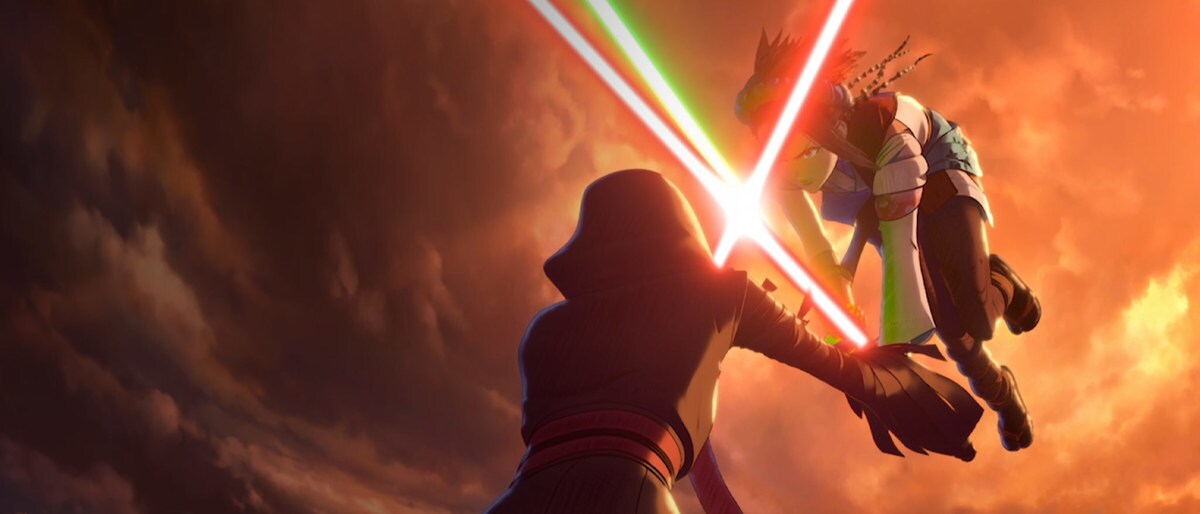
Weapons, clothing, architecture, droids, ships, and landscapes are frequently redesigned in ways that immediately signal a different social environment. Objects carry narrative meaning before characters explain the institutions around them.
Visions shows that memory is produced socially rather than stored perfectly inside individuals. Communities repeat stories, commemorate losses, preserve reputations, reinterpret earlier events, and decide which versions of the past deserve public authority. Material objects, recorded messages, names, ceremonies, visual styles, and inherited narratives can all carry memory between episodes and generations. Because people occupy different positions, they do not remember the same event in identical ways. That variation matters politically: a past understood as liberation by one group may be remembered as defeat, betrayal, occupation, or unfinished responsibility by another.
The longer time scale matters here. The anthology format replaces long continuity with comparison across distinct social worlds. Repeated Star Wars motifs can therefore be examined as flexible cultural forms whose meanings change with artistic tradition, setting, family structure, political order, and visual language. Seen through the lens of material culture and visual meaning, recurring settings and relationships let consequences accumulate. An arrangement that first appears normal can later be exposed as fragile, coercive, privileged, or historically contingent. Characters also learn from earlier encounters, so institutions are not static backdrops: they adapt, fail, harden, fragment, or become newly meaningful as circumstances change.
07 · Anthropology lens
Canon freedom and interpretive possibility
Because Visions is not required to resolve every story inside the main canon chronology, creators can test alternative political systems, histories, aesthetics, and outcomes. That freedom makes the anthology useful for understanding Star Wars as a flexible cultural form rather than a single fixed setting.
Visions shows that memory is produced socially rather than stored perfectly inside individuals. Communities repeat stories, commemorate losses, preserve reputations, reinterpret earlier events, and decide which versions of the past deserve public authority. Material objects, recorded messages, names, ceremonies, visual styles, and inherited narratives can all carry memory between episodes and generations. Because people occupy different positions, they do not remember the same event in identical ways. That variation matters politically: a past understood as liberation by one group may be remembered as defeat, betrayal, occupation, or unfinished responsibility by another.
The longer time scale matters here. The anthology format replaces long continuity with comparison across distinct social worlds. Repeated Star Wars motifs can therefore be examined as flexible cultural forms whose meanings change with artistic tradition, setting, family structure, political order, and visual language. Seen through the lens of canon freedom and interpretive possibility, recurring settings and relationships let consequences accumulate. An arrangement that first appears normal can later be exposed as fragile, coercive, privileged, or historically contingent. Characters also learn from earlier encounters, so institutions are not static backdrops: they adapt, fail, harden, fragment, or become newly meaningful as circumstances change.
08 · Synthesis
What changes when the lenses are connected
Taken together, the six major lenses in this review — Anthology and multiple social worlds, Cultural translation and artistic interpretation, Alternative Force traditions, Family and inherited obligation, Material culture and visual meaning, and Canon freedom and interpretive possibility — show why Visions benefits from anthropological reading. Visions is valuable because it loosens the expectation that every Star Wars story must fit one chronology. That freedom makes visible how strongly setting, visual language, social institutions, and genre conventions shape what Star Wars can mean. The anthology format replaces long continuity with comparison across distinct social worlds. Repeated Star Wars motifs can therefore be examined as flexible cultural forms whose meanings change with artistic tradition, setting, family structure, political order, and visual language. What television adds is duration. Repeated contact with the same institutions and relationships reveals maintenance, contradiction, adaptation, and unintended consequences that a single dramatic encounter may hide. Authority has to be renewed, families have to keep caring for one another, communities have to preserve memory, workers have to keep systems operating, and political projects have to survive ordinary problems. Those repeated processes make the social world legible without reducing the series to a single political lesson.
09 · Method
How IDS is reading this series
The analysis uses anthropology as an interpretive framework for fictional media. It does not claim that fictional peoples correspond directly to real populations. Descriptive statements about the story are separated from IDS interpretation about institutions, culture, kinship, religion, labor, identity, politics, place, material life, and historical change. For ongoing or returning series, the discussion is limited to material already released rather than unreleased story details or predictions.