

The bombing of a Jedi Temple hangar killed personnel on Coruscant. Ahsoka Tano was framed for the attack and subsequent crimes. The Council removed her from the Order so Republic authorities could put her on trial.
A bombing and an apparent suspect
The bombing of a Jedi Temple hangar killed personnel on Coruscant. Ahsoka Tano was framed for the attack and subsequent crimes. The Council removed her from the Order so Republic authorities could put her on trial.
Anakin uncovers the real culprit
Anakin Skywalker continued investigating and identified Barriss Offee as the perpetrator. Ahsoka was cleared. Her name was restored, and the Council offered to accept her again as a Jedi.
A refusal to return
Ahsoka declined the offer because the institution had failed to trust her when she needed it most. She left to determine her own future, separating from the formal Order without adopting the Sith cause.
Anthropological assessment
The event concerns institutional legitimacy and broken trust. Reversing a wrongful decision does not automatically restore the relationships damaged by that decision, particularly where loyalty has been demanded but not reciprocated.
Interactive evidence lab
Was Ahsoka expelled permanently after Barriss confessed?
No. She was cleared and invited back but chose to leave.
Choose a perspective
Canon evidence / institutions and ordinary lives
What the trial destroyed even after Ahsoka was cleared
The Jedi Temple hangar bombing was a criminal investigation conducted during a war in which the Jedi were also generals of the Republic. Ahsoka Tano was falsely implicated, and evidence appearing to connect her to later killings made her vulnerable to military and political pressure. The Council expelled her so that Republic authorities could put her on trial. This choice had consequences different from an ordinary disciplinary disagreement. The Order withdrew protection from someone who had depended on its teaching and relationships since childhood, while the state treated her as a security threat.
Anakin Skywalker continued his investigation and established that Barriss Offee was responsible. Ahsoka was exonerated and the Council offered readmission. She declined. The offer could reverse the formal ruling, but it could not require Ahsoka to resume trusting the people who had judged her so quickly. Leaving the Order did not mean agreeing with the Sith or rejecting every Jedi belief. It meant separating her own moral judgment from an institution that had failed to reciprocate the loyalty it expected. This distinction is important for later events: Ahsoka could defend others and work with Jedi again without pretending the rupture had not happened.
Institutional membership and moral identity are separate
An organization can recognize a person as one of its members yet fail to protect that person in a crisis. Restoring a membership record does not automatically restore personal trust. Ahsoka's refusal challenges the idea that loyalty is owed unconditionally to leaders rather than developed through their conduct.
The pressures of wartime authority
The Council's religious and educational duties had become intertwined with Republic military security. Treating suspected danger as a reason to act quickly could undermine the fairness that Jedi principles otherwise required. The incident is a case of authority being exercised under political fear.
Did Ahsoka leave after Barriss Offee was exposed and she was cleared?
Yes. Her departure was a voluntary decision after exoneration and an offer of reinstatement. It was not proof that she had committed the bombing.
Onscreen source: The Clone Wars season 5, 'The Wrong Jedi' (and preceding fugitive arc); StarWars.com Ahsoka Tano history.. IDS interpretation is distinguished from filmed facts. No fabricated dialogue, precise casualty numbers or unsupported time-order claims are included.
Sources and further reading
The Clone Wars, 'The Wrong Jedi'; Star Wars: Timelines. Read more about the event. Image captions clarify when the art is representative rather than an actual scene.
Canon · 19 BBY · Warfare, ecology and command
Ahsoka leaves the Jedi Order: source-grounded history
Historical event and chronology
After the Jedi Temple hangar bombing, Ahsoka was framed for murder and faced a Republic military tribunal. The Jedi Council expelled her, while Anakin investigated and exposed Barriss Offee as the culprit. Although the Order offered Ahsoka a return to her place, she declined, feeling that its leaders had abandoned trust in her at a critical moment.
Political and anthropological analysis
Institutional membership rests partly on credible procedures and social trust. Ahsoka's case shows the difference between acquittal and reconciliation: exposing the real bomber did not undo her treatment by the Council. The Republic's military tribunal, Jedi internal decisions and Anakin's personal loyalty operated through different rules.
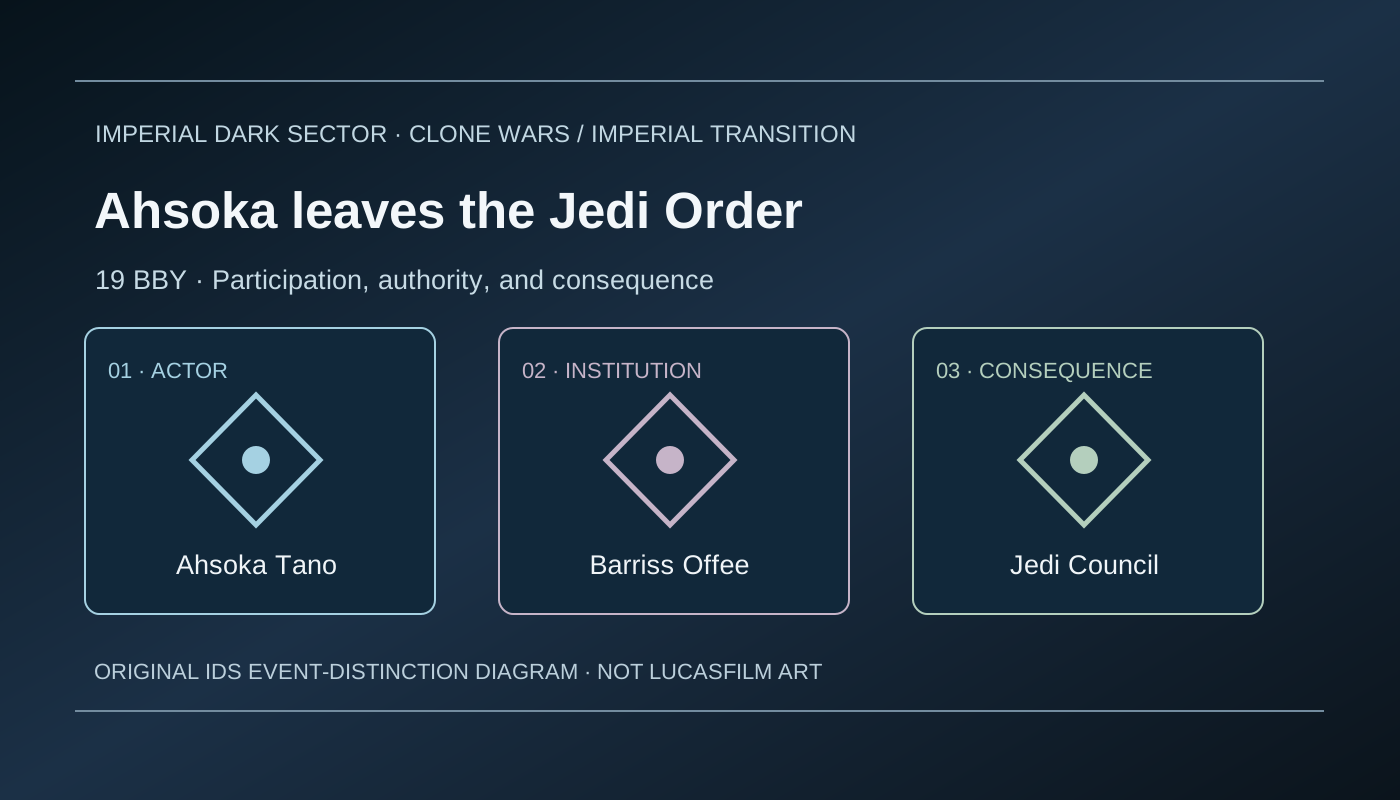
Original television context and visual accuracy
Official later-era portrait identifies Ahsoka, not her trial and departure. The date is the fictional BBY year; Clone Wars and Bad Batch episodes were published in other real-world years. Details not shown or verified in the episode should not be invented to complete the timeline.
Check your historical judgment
Answer two questions for source-based corrections, scoring and insight.