
script detected
memory modification
technical mediation and restricted knowledge
- Year
- 35 ABY
- Continuity
- Canon
- Setting
- Kijimi City, Thieves' Quarter
A town with older religious and economic layers
The travelers reached Kijimi, an icy world whose mountain settlements included structures originally associated with religious orders. Its modern city supported spice runners, trade guilds and people living beyond New Republic or First Order authority. During the war, however, occupying First Order forces imposed violent restrictions and monitored the movements of local residents.
A droidsmith with unusual skills
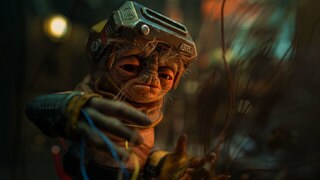
Zorii Bliss and the Spice Runners brought Rey's companions to Babu Frik, an Anzellan specialist able to modify a protocol droid's protected operating systems. C-3PO's programming prevented him from disclosing the Sith inscription on Ochi's dagger. Babu proposed a procedure that could unlock the language but erase the droid's other memory.
C-3PO risks his past
The droid agreed, losing his memories so the group could learn that the wayfinder was hidden in the wreckage of the second Death Star. The sacrifice was not permanent: R2-D2 later restored backed-up memories. Nevertheless, C-3PO understood the intervention as the possible loss of his personal history.
Anthropological assessment
Kijimi's droid workshop raises questions about personhood and informed consent in societies that often classify droids as equipment. The same technical intervention can be understood as maintenance by an owner or as a profound risk taken by a sentient companion.
Interactive evidence lab
Did Babu Frik give the group a completely new Sith wayfinder?
No. He modified C-3PO so the droid could translate instructions leading to the artifact.
Compare the source event, the institutions involved, and the anthropological interpretation.
A droidsmith enables the Sith-language translation
The travelers turn to Babu Frik on Kijimi because C-3PO can read Sith runes but cannot disclose their translation under his existing programming. Babu performs risky technical work on C-3PO's memory to let the group hear the translation, which points toward the Emperor's wayfinder.
Babu is a droidsmith who modifies C-3PO; he is not the ancient author of the inscription and should not be described as independently deciphering the dagger. This distinction matters when recording a chain of evidence: the dagger carries the writing, C-3PO recognizes the language, and Babu changes the conditions under which the translation can be accessed.
Source and date boundary: Lucasfilm's official Episode IX account. The year 35 ABY is the chronology label; the precise day and any postwar settlement are not asserted where unstated. Anthropological interpretations are editorial analysis.
Test your historical judgment
Answer both questions for a score, detailed corrections and an educational takeaway.
Canon · 35 ABY · Source analysis
A translation requires consent, programming access and memory loss
By the time Rey's group arrives on Kijimi, C-3PO has already inspected Ochi's blade. He does not need Babu Frik to teach him the language. The problem is a prohibition in his programming against speaking the translation. Poe Dameron's knowledge of the city's underworld helps the travelers find a droidsmith capable of bypassing the restriction. Lucasfilm's C-3PO biography specifies the cost: unlocking the stored information requires erasure of the protocol droid's memory, an outcome he understands before the procedure.
Babu Frik's technical work therefore supplies access to prohibited information rather than creating new coordinates. The translation directs the party toward a Sith wayfinder in wreckage of the second Death Star. The memory loss produces a separate consequence for C-3PO, who afterward no longer recognizes his companions. A later backup made by R2-D2 permits restoration of most of that memory. A page that calls the loss necessarily permanent would misrepresent the story, while a page that omits the loss would erase the personal cost the film places on the procedure.
IDS analyzes this as a problem of agency and technical maintenance in a society that often treats droids as property. The narrative presents C-3PO making a costly choice; that is distinct from a general philosophical claim about all droids. The Pasaana discovery explains the source of the text. The subsequent destruction of Kijimi shows why the workshop also belongs to the history of a vulnerable civilian community.
Lucasfilm reference: Lucasfilm Databank: C-3PO. Narrative events are from Star Wars: The Rise of Skywalker. Official Databank pages provide corroborating context; interpretive arguments are original IDS analysis. Publication year is not the 35 ABY story date.
Sources and method
The Rise of Skywalker, official story gallery; Kijimi City Databank. Read original or official story background →. Film events and interpretive commentary are distinguished in separate sections.