
PLANET DOSSIER 01
A city built for people who could not go home
Kijimi was a frigid Mid Rim planet whose densely built mountain city sheltered former religious institutions, artisans, fugitives and rival criminal organizations. In Outlaws the Ashiga Clan contested control of local production; decades later the First Order occupied the world, and a Sith Eternal Star Destroyer destroyed it in 35 ABY.
The planet’s most important settlement is neither a purpose-built military capital nor an empty outlaw camp. Its streets accumulated different political and social uses over centuries: sacred buildings became occupied strongholds, industrial workshops took over old properties, and the districts between rival syndicates remained places where ordinary residents negotiated safety. A visitor who sees only the smuggling economy misses the repair workers, traders, migrants and other people whose lives sustained the city.
Imperial Dark Sector therefore approaches Kijimi as a changing social landscape. The timeline matters: Queen Ashiga’s dispute with Krisk belongs to the Galactic Civil War; Babu Frik’s work for Poe and Rey belongs to the First Order era; the world’s destruction is a subsequent fixed event, not a branch of the video game.
PLANET DOSSIER 02
Mountains, snow and a settlement above the clouds
Cold climate, snow and steep mountain slopes shaped settlement on Kijimi. Elevated buildings and narrow passages were built to cope with the exposed terrain. The primary official Databank calls the planet frigid, remote and mountainous. Warm interiors and protected passageways gave the city practical appeal even to people arriving for clandestine trade rather than permanent residence. The landscape was a refuge because entering and governing it required more than simply asserting authority from another world.
Lucasfilm describes Kijimi as inhospitable, remote and lacking the cosmopolitan public life found on more connected worlds. Those observations help explain why people avoiding central authorities might regard it as useful. A hostile climate can limit the reach of outsiders, but it can also impose costs on residents who have no intention of committing a crime. Shelter and a reliable supply of heat are practical forms of wealth.
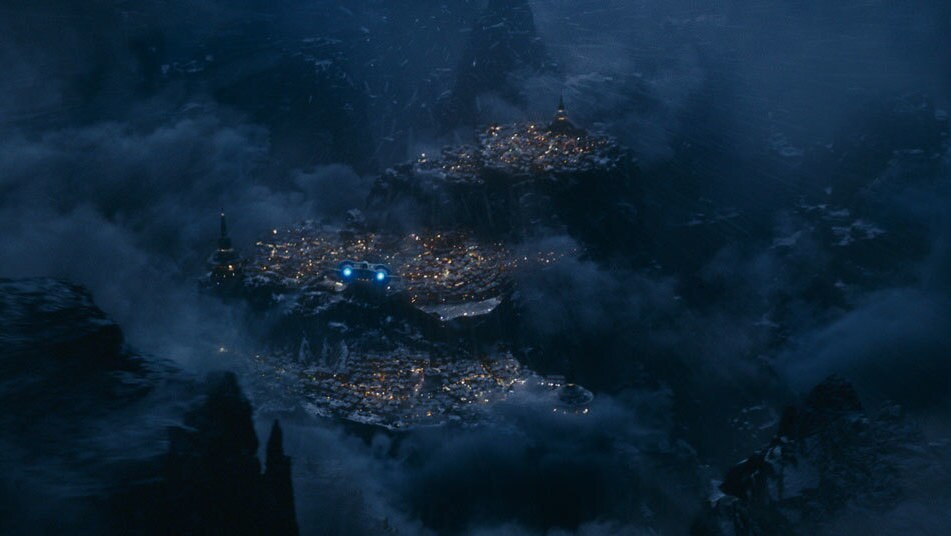
In the film, city lights gleam above a field of dark cliffs and cloud. In Outlaws, players move among snow-covered terraces and winding walkways rather than a broad open countryside. The difference between what the sky view suggests and what someone can cross on foot is important to understanding the city’s social geography.
PLANET DOSSIER 03
The city preserves older religious foundations
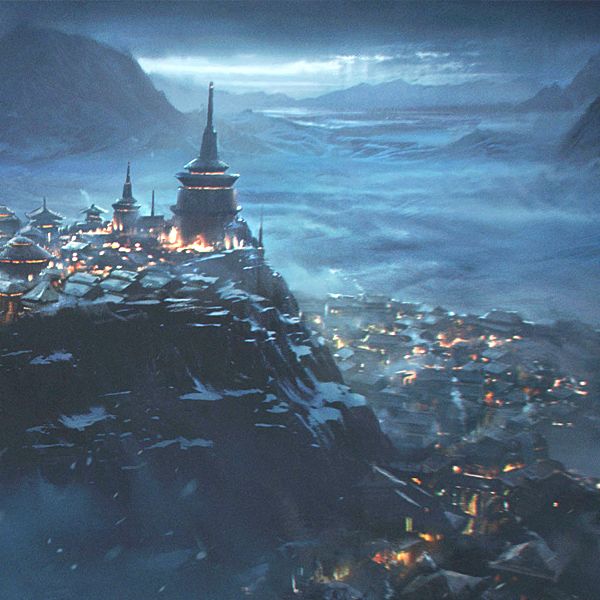
Kijimi City grew on a mountain around monasteries and sites associated with several religious orders. Prayer halls, dwellings and refectories were adapted into commercial and criminal spaces long after the monks departed. By Outlaws, the Ashiga occupied a former Dai Bendu monastery as a stronghold, while other districts had brokers, workshops, cantinas and guarded entrances. The scene in The Rise of Skywalker shows tightly packed rooftops and warm windows among steep snowy streets. Buildings matter as reused infrastructure, not evidence that new occupants shared earlier religious beliefs.
The mountain setting is not merely visual atmosphere. Access routes create chokepoints, commercial passages and differentiated territories. The same doorway can act as an ordinary public route under one political arrangement and a guarded boundary under another. The Ashiga stronghold makes that distinction especially clear: the building is older than the criminal institution occupying it.
Kijimi City's built form offers evidence of continuity without implying unchanged beliefs. A former monastic refectory can become a profitable social venue. A monastery can support a new leader’s headquarters. Occupation changes function, while surviving walls and names preserve an incomplete record of earlier life.

PLANET DOSSIER 04
Residents are more than underworld stereotypes
Kijimi is not one uniform criminal population. The city sheltered artisans, droid mechanics, ordinary residents, religious institutions in earlier eras, migrants, people wanted elsewhere and multiple rival criminal networks. The Melitto Ashiga Clan had a historically specific hive identity, while the Spice Runners under Zorii Bliss represented another network in the later period. Babu Frik, an Anzellan droidsmith, illustrates skilled labor serving patrons who valued discretion. These groups held different positions in the same city, and the planet's reputation as lawless does not mean everyone living there was a criminal.
A single stereotype cannot account for Kijimi’s named inhabitants. Queen Ashiga exercises authority over a Melitto hive. Krisk disagrees with her mother about whether working with the Empire protects the clan. Zorii Bliss commands Spice Runners in a later era and must decide whether to remain on a heavily occupied planet. Babu Frik is a highly skilled Anzellan who makes technical decisions that affect Resistance survival.
The same city can therefore be experienced as a birthplace, a refuge, a job market or a controlled jurisdiction. The interests of a resident who repairs droids, a traveler who needs a covert contact and a guard protecting a district are not identical.
PLANET DOSSIER 05
Weapons, repairs, spice and the labor behind power
Weapons manufacture and the trade in valuable or restricted goods were visible parts of the local economy in the Imperial period. The Ashiga factory employed Ank Parako and became important to Kay Vess's effort to recruit a heist specialist. Queen Ashiga negotiated weapons contracts in exchange for giving Imperial authorities access to rhydonium mines, a bargain with economic and political consequences. Repair businesses and the Spice Runners continued to operate in the later era. The published sources do not supply a reliable complete economic census or a single share of income attributable to each activity.
The Ashiga weapons factory illustrates the link between political decisions and ordinary work. In the game's Kijimi missions, Ank Parako's professional competence makes her useful both to the factory and to Kay Vess’s crew. Getting her out requires negotiating territorial and employment restrictions. The problem is not simply locating a famous specialist on a map.
By the time of The Rise of Skywalker, the underworld repair economy is also visible through Babu Frik. His workshop can bypass safeguards that official military systems treat as significant. Technical expertise becomes valuable where legal or bureaucratic access is unavailable. Neither weapons nor droid repair represents every job Kijimi residents held.
PLANET DOSSIER 06
Dai Bendu and the afterlife of sacred buildings
Official Lucasfilm history describes Kijimi City's origins around monasteries of multiple religious orders, including the Dai Bendu. Their halls and residences remained after the monks vanished and were reused by later occupants. Monk's Gate and the Domak Refectory preserve the memory of earlier religious movement and communal eating. The physical survival of a sacred building does not imply that the Ashiga Clan practiced the order's beliefs. Religion on Kijimi is therefore most securely documented through architecture, historical land use and memory rather than claims about a universal present-day faith.
Lucasfilm’s Databank calls Kijimi City a settlement that originally developed around several religious orders. It does not describe a single homogeneous faith that every contemporary criminal later inherited. The historical city belongs to a succession of different communities using the same difficult landscape.
The traces of the Dai Bendu invite an archaeological reading. Buildings survive because they can be adapted. A trade venue may retain a monastic name, and a route between sanctuaries may become part of ordinary pedestrian circulation. Reading architecture as evidence is more careful than inventing a liturgy for a clan that now holds the space.
PLANET DOSSIER 07
Criminal districts as competing governments
Kijimi lacked a single effective planetwide government in the periods emphasized by official sources. Different gangs, guilds and clans exercised influence over parts of Kijimi City. In Star Wars Outlaws, Queen Ashiga ruled the Melitto clan's territory while her daughter Krisk and Crimson Dawn challenged that authority, and the Empire sought resource access. By 35 ABY, First Order occupation constrained the autonomy of the city's criminal groups and residents. The titles, interests and jurisdictions of these powers changed over time; political control should not be projected backward or forward unchanged.
The Ashiga Clan and Crimson Dawn differ in the way they occupy space. Ashiga power is associated with an established residential district and a fortified older building, while Crimson Dawn relies more heavily on intelligence contacts and its newly acquired foothold. Trade relationships with the Empire create a further layer of influence that does not erase either group’s independent organization.
A territorial map in Outlaws is therefore also a map of competing claims. It describes who can question travelers, deny access, hire protection and operate production sites. A uniform label like “lawless” hides the practical rules residents still face.
PLANET DOSSIER 08
The city’s streets are political boundaries
Kijimi's isolation offered concealment but made arriving, leaving and moving through the city socially consequential. Transporters approached a mountain settlement with controlled landing zones, while people on foot navigated steep streets, gates and territorial boundaries. Star Wars Outlaws presents the explorable planet primarily as Kijimi City rather than a speeder-accessible open countryside. Guides identify restricted Ashiga and Crimson Dawn areas, neutral zones and fast travel sites. During the later First Order occupation, a ship's access and a droidsmith's location mattered to the Resistance mission as much as formal spaceport authority.
For players, Kijimi is primarily a city-sized playable environment rather than the open speeder landscape of Toshara. That design difference reflects a densely packed settlement where the route between objectives is often controlled by entrances, patrols and reputation with a particular faction. Some locked pathways open only after relevant missions begin.
In the later film, mobility is an even more immediate question. Poe and his companions need access to a black-market droidsmith, while a First Order warship controls dangerous space above the city. Zorii’s assistance matters precisely because knowing the right person and having a usable clearance object can make movement possible where force cannot.
PLANET DOSSIER 09
The Empire, the First Order and competing coercion
In Outlaws, the Ashiga succession conflict links Queen Ashiga's Imperial mining arrangement to Krisk's Crimson Dawn-supported coup. Kay Vess can deliver the origin strand to either claimant; the story records different, mutually exclusive leadership outcomes. Later, the First Order occupies Kijimi and the Resistance reaches the city in search of Babu Frik. The film Star Wars: The Rise of Skywalker explicitly depicts the Sith Eternal destroying the entire planet with a superlaser-equipped Star Destroyer, on Palpatine's order. The 35 ABY destruction is a fixed Canon event and must not be confused with the optional outcomes of the earlier game.
The queen’s bargaining with Imperial authorities is an Outlaws-era problem about economic concessions and political survival. The First Order’s occupation belongs to a different period and significantly restricts residents’ independence. These are not one continuous policy under one unchanged state; the names and command structures of galactic authorities changed.
The fate of Kijimi in 35 ABY is not ambiguous. The official film synopsis states that Palpatine orders the planet destroyed by a Sith Star Destroyer. Showing this alongside earlier stories emphasizes what is lost: not merely a visually striking location but an inhabited city, workplaces, personal histories and long-reused religious buildings.
PLANET DOSSIER 10
Places that reveal life inside the city
A travel guide gives directions; this archive connects landmarks to history. The Domak Refectory remembers communal religious dining, the old monastery becomes an armed stronghold, the weapons factory reveals the labor supporting a criminal monarchy, and Babu Frik’s later workshop reveals the value of independent technical skill. The same city holds both monumental symbols and small practical workspaces.
The cards below identify the source context and show why each location matters. Some names are important only in the Outlaws-era city, while others appear in The Rise of Skywalker. They should not be treated as automatically contemporaneous.
Kijimi City — Urban centre · Mountain settlement — Religious foundation, trade districts, steep streets and later occupation of the same landscape.. Ashiga Clan Stronghold — Institution · Reused monastery — Former Dai Bendu monastery occupied by the Melitto hive, with guards, a throne and a cryochamber..
Kijimi City
Mountain settlement born from the religious precincts; later the heart of informal trading networks
Ashiga stronghold
A former Dai Bendu monastery occupied by the Melitto hive
Ashiga weapons factory
Ank Parako's workplace and a source of the queen's commercial leverage
Domak Refectory
Former monastic hall turned into a place of food, warmth and meetings
Thieves' Quarter
District with links to former religious property and later covert commerce
Babu Frik's workshop
Droidsmith's workroom, vital to C-3PO's Sith inscription translation
Queen Ashiga statue
A monumental claim to clan leadership near the guarded Ashiga district
The Wellspring
A former bathhouse used as a Crimson Dawn base in the Outlaws era
Kijimiko Caverns
The route used during the mission The Hive to enter guarded Ashiga spaces
Spice Runners' Den
Underworld venue of Zorii Bliss's later faction
PLANET DOSSIER 11
Four different political eras, one planet
The city began around mountain monasteries; Melitto settlers later established the Ashiga Clan in the High Republic era. The city developed into a refuge for smugglers, fugitives, repair specialists and criminal organizations. During the Galactic Civil War, Kay Vess negotiated rival faction interests and recruited Ank Parako amid the Ashiga succession crisis. The later New Republic period did not turn Kijimi into a fully integrated central state, and the First Order eventually occupied it. In 35 ABY Poe Dameron returned to the Spice Runners, Rey's group sought Babu Frik's help, and the Sith Eternal destroyed the planet shortly before the Battle of Exegol.
The chronological jump between Outlaws and The Rise of Skywalker is substantial. When Kay visits, the Ashiga Clan’s succession crisis makes control of local production a contested question; when Rey and Poe arrive decades later, other groups hold local leverage under First Order occupation. The earlier branching quest does not supply an officially fixed answer about every resident’s future.
The final transition, however, is documented as a single devastating event. The destruction of Kijimi in 35 ABY is a canonical part of the film narrative. The timeline in the interactive panel keeps that certainty separate from the playable choices in the game.
PLANET DOSSIER 12
IDS anthropology: reuse, migration and precarious sovereignty
Kijimi offers a clear case of religious and political reuse: monasteries became strongholds, working halls and underworld institutions without losing all traces of their earlier purpose. Its cold mountain geography shaped migration and boundaries, but did not mechanically determine criminal behavior. Political authority was fragmented among groups, while offworld states tried to use coercion and resource contracts to change local arrangements. Comparing Outlaws with The Rise of Skywalker also shows how worldbuilding distributes attention unequally: a short visit by heroes intersects with a much longer lived history of residents, workers and displaced communities. The destruction of the planet is therefore the loss of an inhabited social world, not merely scenery.
The first useful comparison is between authority and territory. Ruling a district does not mean administering every person or institution on the planet. The second is between historical identity and present use: a name, doorway or prayer hall can survive when the group that created it disappears. Both patterns are visible in Kijimi City.
The third concerns migrants and refuge. Calling a place lawless can serve the interests of an external authority because it makes every inhabitant appear undeserving of protection. Kijimi’s skilled workers and neighborhoods resist that reduction. Finally, the planet's destruction shows the disproportionate consequences of galactic coercion for people who were never central participants in the war.
PLANET DOSSIER 13
Sources, canon and what remains unknown
The sources separate three kinds of evidence. Lucasfilm’s Kijimi and Kijimi City Databank entries provide broad setting descriptions. The Ashiga Clan entry and Star Wars Outlaws give a closer view of the Melitto hive, its production economy and the struggle for local power. The official Rise of Skywalker film record establishes the visit by Rey’s party and the planet’s eventual destruction.
Independent game maps are useful for locating the Domak Refectory, Kijimiko Square, the Ashiga stronghold and the city’s other accessible districts. Their marker lists do not provide a comprehensive census of residents or every event in the planet’s long history. The same caution applies to player-dependent ending choices.
This dossier treats the geographic and narrative descriptions as Canon where indicated and the sections on political anthropology as interpretation. It does not invent a definitive Ashiga succession winner, an exhaustive Melitto religious practice, total planetwide income or a comprehensive record of everyone who lived on Kijimi.
INTERACTIVE 01 · FOUR HISTORICAL MOMENTS
Choose an era of Kijimi
Travel through the planet's documented political history without mixing centuries together. These selections change the archive explanation below, not the game or its Canon outcome.
Sacred foundations
The city grows around mountain religious orders; the Dai Bendu built a monastery. The High Republic-era Ashiga Clan later claims the old complex. These are institutional changes over centuries, not one event performed by a single monarch.
Explore the linked Outlaws-era timeline and the later 35 ABY destruction article for separate event dossiers.
INTERACTIVE 02 · ANTHROPOLOGY WORKBENCH
Investigate a city clue
Choose an evidence type to test which institution or relationship the physical world reveals. A saved building can conceal new rulers; a guarded factory can expose the dependence of commerce on coercion.
Who owns a sacred site after the monks disappear?
An old monastery becomes an armed headquarters. The building's survival carries traces of earlier religion while its new owners enforce a different political order.
This is an IDS research exercise. It does not invent an extra quest or replace the documented story branches in the Ashiga Clan dossier.