

By Imperial Dark Sector
DOSSIER MAP / STORY ORDER
The throne, the mines and the origin strand
Read the fixed history first. The two simulations below explore competing interpretations of the queen’s rule and reveal the mutually exclusive endings to The Hive. They do not modify the game.
01 / ASHIGA DYNASTY
A queen whose authority was never absolute
Queen Ashiga leads the Ashiga Clan, the Melitto hive that dominates Kijimi’s criminal economy in Star Wars Outlaws. Her title suggests absolute rule, but the story reveals a ruler balancing collective welfare, industrial income, hostile outside powers and an ambitious heir. The queen stands at the center of a political crisis rather than at the end of a simple criminal hierarchy.
Her authority is visible from the moment Kay Vess enters the Ashiga district. The clan’s guarded territory, distinctive clothing, insignia and monumental statue identify a social order that predates the events of the game. People can tell where the hive exercises power without meeting the monarch herself. Yet the same material displays of continuity do not prevent discontent among clan members who believe her strategy has endangered their future.
Lucasfilm’s Databank identifies the Ashiga as a Melitto syndicate whose ancestors arrived on Kijimi during the High Republic era. It is important to distinguish the clan’s long history from the queen’s personal chronology. The site’s source record does not establish that this particular queen personally founded the settlement or built the stronghold generations earlier.
02 / ASHIGA DYNASTY
The Ashiga Clan’s long presence on Kijimi
The Ashiga built their local position around a former Dai Bendu monastery. Converting a religious complex into a guarded clan headquarters tells readers that institutional buildings can acquire new political meanings. The present-day criminal stronghold occupies older architecture; its current function does not establish that the Dai Bendu once participated in the syndicate.
Over generations, the hive gained control of an entire city district, with a statue of Queen Ashiga serving as a visible landmark. What matters is the relation between a named ruler and collective history. The statue presents leadership as part of an enduring social landscape. It cannot tell readers whether every member of the hive privately agrees with the queen’s decisions.
The planet’s cold climate and remoteness are part of that history. Kijimi draws refugees, smugglers and communities wary of outside authorities. The Ashiga are not simply another visiting pirate gang; their residence, neighborhood and institutions have material permanence. Kay’s arrival introduces her to an existing order with its own economic interests and conflicts.
03 / ASHIGA DYNASTY
The Imperial bargain and the rhydonium mines
For much of her rule the queen is remembered for resisting Imperial encroachment. That legacy makes her later concession especially controversial. Under mounting pressure, she gives the Galactic Empire access to Kijimi’s rhydonium mines in return for weapons contracts. The arrangement is described in the game’s character background and in published character guides.
That bargain is not merely an exchange of credits. Rhydonium is a strategic resource, and access to its extraction allows an outside government to influence local production. Weapons deals may enrich the clan and expand its reach, but they create dependence on an imperial customer with greater military power.
The queen appears to see accommodation as a way to preserve Ashiga power under conditions she cannot fully control. Her opponents interpret the same decision as a surrender of the autonomy she was supposed to defend. This distinction matters because neither side is simply arguing over whether the Empire is good. They disagree about the costs of survival and the meaning of loyalty to the hive.
Calling the queen an Imperial officer would be inaccurate. She heads a local Melitto criminal institution that does business with Imperial authorities. A commercial alliance can be politically consequential without changing a character’s species, native culture or formal chain of command.
04 / ASHIGA DYNASTY
Krisk Ashiga and the conflict over succession
The heir, Krisk Ashiga, believes that her mother’s grip on Kijimi is weakening. She is impatient with a succession system that promises power in the future while the hive’s position deteriorates in the present. Their disagreement is simultaneously a political dispute and a familial rupture.
Krisk does not claim to reject the hive’s importance. She instead presents her challenge as a better way to preserve it. This is one reason the conflict is more complicated than a daughter rebelling against a parent. Both figures use the language of collective survival, but favor incompatible methods and outside partners.
Queen Ashiga seeks leverage through the Empire and existing contracts. Krisk conspires with Qi’ra’s Crimson Dawn to overthrow her mother. The new ally offers resources for a coup but has its own interest in Kijimi’s production and the Ashiga’s secure position. Replacing an Imperial partnership with Dawn patronage might exchange one dependency for another.
Neither kinship nor the title of heir automatically settles whose interpretation of the collective interest is valid. The story makes succession a contested political process in which family obligation, material resources and outside intervention intersect.
05 / ASHIGA DYNASTY
Why Kay Vess needs the queen
Kay comes to Kijimi to recruit Ank Parako, the explosives specialist Jaylen Vrax wants for the planned Canto Bight heist. Ank is working at an Ashiga weapons factory and is not free to depart on Kay’s timetable. This turns a crew-recruitment errand into a negotiation with local authority.
The queen has the power to offer an agreement connected to Ank’s release. Her influence reaches beyond the throne room into employment and security arrangements at the factory. Kay discovers that solving her own problem requires dealing with institutions that do not treat individuals as independent of their obligations.
Krisk contacts Kay and offers an alternative route, using an access card and the chance to help the heir’s political project. Kay must decide which relationship will make Ank accessible. The game’s Breakout mission shows how a small mercenary agreement can put an outsider inside a succession struggle she did not originally seek.
The queen’s response to Kay is not presented as a universal friendship or a requirement that the player endorse Ashiga rule. She acts according to the interests of her office; Kay acts to assemble a crew. Their interests overlap only for part of the story.
06 / ASHIGA DYNASTY
The origin strand: material control of succession
The climax centers on the origin strand, a guarded object stored inside the Ashiga stronghold’s cryochamber. The game treats the strand as a genetic resource essential to the hive’s reproduction and continuity. It also functions as a political object because securing it enables one claimant to assume authority over the clan.
Unlike a decorative crown, the origin strand has direct implications for biological continuity. That does not mean a single object can explain every aspect of Melitto society. It means the game joins control of a reproductive resource to control of political legitimacy. An outsider who retrieves it becomes unusually important to the competing claimants.
Crimson Dawn pursues the strand in the hope of gaining influence over the hive through Krisk. Kay’s mission shifts from helping an employer to stopping Dawn agents from taking the object for themselves. This conflict forces a distinction between assisting the heir and allowing her ally to seize what the clan regards as foundational.
Behind the palace’s ceremonial language is a material question: who controls the resource on which the group depends? The queen can command guards, but possession of the strand gives Kay the deciding role at the moment of confrontation.
07 / ASHIGA DYNASTY
The Hive: Queen Ashiga’s possible fate
During The Hive, Kay enters the stronghold through the Kijimiko caverns, reaches its control systems and disables turrets as fighting breaks out. She moves toward the cryochamber and retrieves the strand. Her path back leads to the throne room, where Queen Ashiga and Krisk confront each other.
Giving the strand to Queen Ashiga preserves her position in that playthrough. Her guards kill Krisk during the confrontation. The choice increases Kay’s reputation with the Ashiga Clan and substantially reduces her standing with Crimson Dawn. The queen’s victory is therefore also the death of her daughter.
Giving the strand to Krisk produces the opposite succession outcome. Krisk kills her mother, claims the symbols of office and assumes leadership with Crimson Dawn backing. Kay’s reputation with Crimson Dawn increases. The queen does not survive that version of the story.
The game leaves this final choice to the player. This dossier does not treat both deaths as one fixed history, or invent an official canonical survivor. It describes the shared political crisis and distinguishes two mutually exclusive outcomes.
08 / ASHIGA DYNASTY
Ceremonial dress, the throne and an older monastery
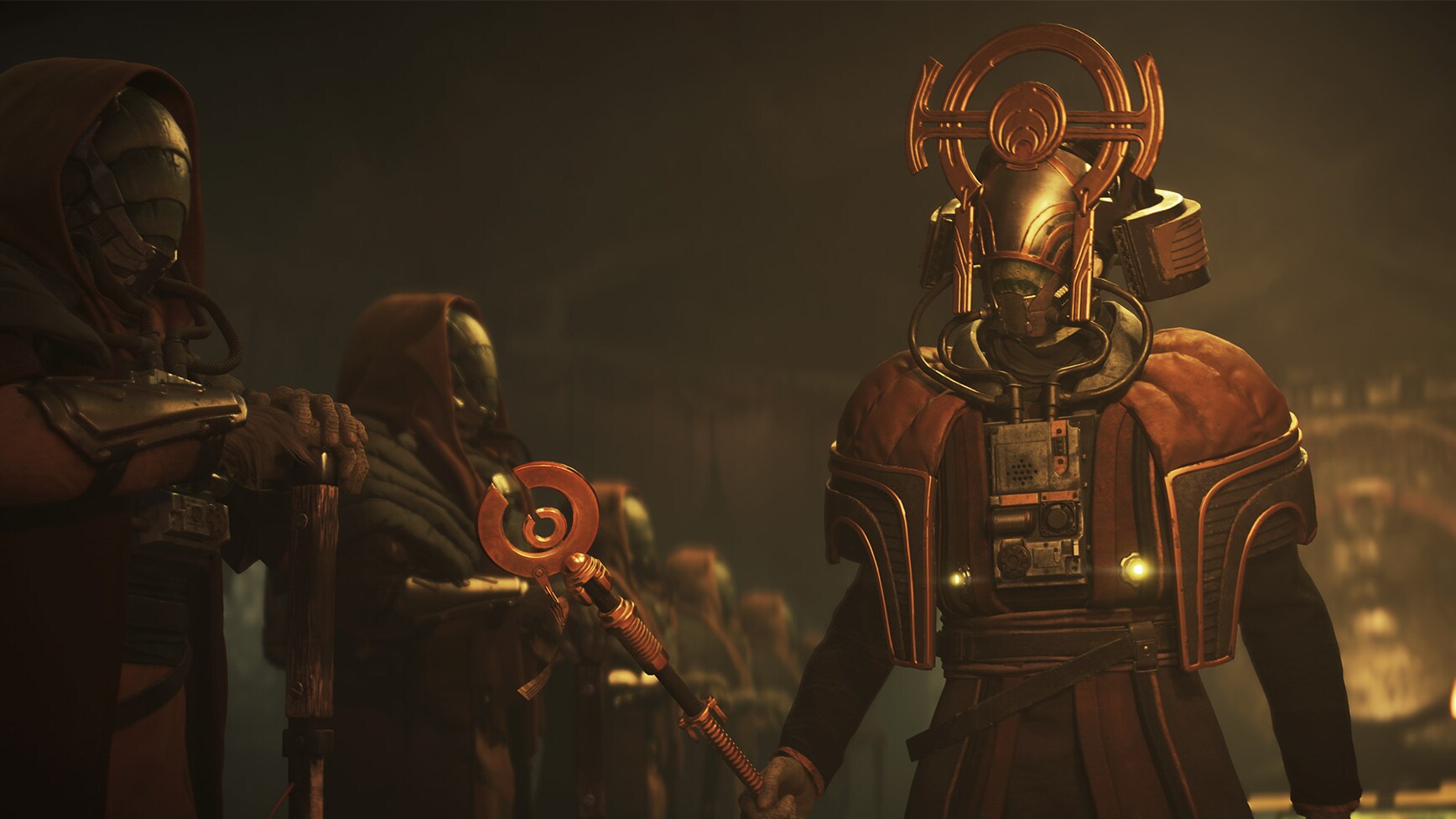
The queen’s visible appearance sets her apart from guards and ordinary clan agents. She wears a tall metallic headdress, layered robes, a chest-mounted breathing assembly and carries a staff marked with circular ornament. The clothing and staff function as public signs of leadership in the scene. They should not be presented as proof of an undocumented universal Melitto coronation ritual.
The guards share elements of the broader Ashiga aesthetic, including warm metallic details and practical equipment. Their resemblance underlines membership in a single institution, while the queen’s more elaborate design communicates hierarchy. The game lets readers see how status is worn before it is formally announced.
The fortress is also an artifact of the clan’s political history. Its older Dai Bendu foundations, controlled approaches, cryochamber and throne room have different purposes, and the queen’s authority depends on access to all of them. Occupying a spectacular throne does not prevent a sabotage operation directed at the systems that protect it.
The accompanying official Lucasfilm group image shows Ashiga clan agents, not an additional private portrait of the queen. It illustrates the institution whose ceremonial language the queen embodies.
09 / ASHIGA DYNASTY
Anthropology: kinship, extraction and political legitimacy
Political anthropology asks what makes a ruler’s commands authoritative to others. Queen Ashiga can order guards and make commercial bargains, but her security depends on the belief that those actions protect the hive. When Krisk contests that premise, authority has to be defended through alliances, material control and violence.
Kinship ties appear in the mother–daughter conflict, yet family continuity is not identical to political continuity. The proposed transfer of rule is a dispute over how the group will survive, not evidence that every daughter in a Melitto hive has the same legal path to the throne. The game’s specific succession crisis should not become an unsupported ethnographic rule for the species.
Political economy directs attention to rhydonium and weapons manufacture. Mining access, factory output and procurement relationships shape the queen’s options. Her autonomy is constrained by trade with a far larger state. A decision described as practical by the ruler can be experienced as subordination by other members of the collective.
The origin strand connects biological reproduction to the exercise of power. It is tempting to call the hive a mindless collective, but Krisk and the queen openly disagree, negotiate, threaten and choose different partners. A careful reading separates the narrative’s hive terminology from assumptions that Melitto individuals lack agency.
Finally, the branching finale exposes a limit of historical interpretation in choice-based games. The mechanics assign faction reputation consequences to different actions while allowing two incompatible reigns. IDS records both as possible versions of the game rather than claiming an unverified canonical outcome.
INTERACTIVE 01 / THE HIVE
Who holds the origin strand?
Choose an outcome from the two alternatives in The Hive. Both choices resolve the same crisis differently, and the reputation effect changes.
The queen keeps the throne
Kay sides with the reigning queen. Krisk is killed by Ashiga guards, Ashiga Clan reputation rises and Crimson Dawn reputation falls. This branch preserves the Imperial bargain but ends the heir’s claim.
INTERACTIVE 02 / POLITICAL ANTHROPOLOGY
What makes the reign vulnerable?
Inspect one pressure on the throne. The exercise distinguishes observations from interpretation rather than inventing extra dialogue or missions.
Trade brings dependence
The queen gains access to weapons contracts but gives the Empire mining access. An alliance that might preserve the hive’s wealth also gives opponents evidence that its autonomy is slipping.
Does the game establish one canonical winner?
No. The last choice remains branch-dependent. The mission guides document both Queen Ashiga and Krisk becoming or remaining ruler under different player choices.
Was the Dai Bendu monastery built by this queen?
Not established. Lucasfilm dates the Ashiga settlement’s history to the High Republic era; that does not identify the individual who first converted the monastery.
Does a hive mean every Melitto has the same opinions?
No. The succession conflict shows meaningful individual disagreement. IDS does not infer a total loss of individual agency from the word hive.
COLLECTING / EVIDENCE-LED
Collecting this Character
No licensed Queen Ashiga standalone figure, LEGO minifigure or Topps card is independently verified in the sources used for this dossier. This section avoids invented products and unrelated card pictures. The original game provides the confirmed appearance; visit the Star Wars Outlaws game hub for relevant sponsored retail links.
SOURCE REGISTER / PUBLIC RECORD
Sources and continuity notes
Lucasfilm Databank, Ashiga Clan verifies the hive’s High Republic arrival, Dai Bendu stronghold, queen’s statue and location. Ubisoft, Star Wars Outlaws verifies the faction, its Melitto makeup, commerce and Kijimi setting. Game-Maps, Queen Ashiga documents the queen’s Imperial mining bargain. Breakout walkthrough and The Hive mission guide describe her role and the branching succession outcome.
All story details are from the 2024 Canon game and the identified records. The descriptions of patronage, political economy and material culture are IDS anthropological interpretation. When endings diverge, this page documents both instead of pretending there is one confirmed biography.