The Melitto hive that built its Kijimi power from an old monastery and then fought over whether its future belonged to a queen, her daughter, the Empire or Crimson Dawn.
This is an organization dossier, not a duplicate of Queen Ashiga’s character page. It follows the institution across generations, compares internal factions, and shows how the game’s reputation system makes shifting political alliances visible.
ARCHIVE 01 / KIJIMI
A city district, a hive and a criminal government
The Ashiga Clan is a Melitto organization based in the frozen city of Kijimi. In Star Wars Outlaws it is one of the four major syndicates with which the player must negotiate. The clan is an underworld institution with a visible territory, an entrenched workforce, armed security and a hereditary political conflict. It is not an interchangeable label for every Melitto in the galaxy.
Lucasfilm describes the clan as a reclusive criminal syndicate whose influence expanded across generations. Its ancestors arrived on Kijimi in the High Republic era and claimed a Dai Bendu monastery. In the period shown in Outlaws, the stronghold and its surrounding district are controlled by the clan. A statue of Queen Ashiga advertises that control to people who may never enter the headquarters.
Ubisoft describes an organization devoted to its queen and hive, distrustful of outsiders and wealthy from weapons dealing. This is a summary of institutional positioning, not proof that every individual member has the same beliefs. The story deliberately contradicts any assumption of total consensus: the queen’s daughter Krisk seeks to depose her.
The player encounters the clan as an employer, an obstacle, a source of guarded territory and eventually a divided polity. For Kay Vess, gaining access to an important contact can mean assisting people whose disputes concern the future of an entire community. The organization’s political and economic interests remain distinct from Kay’s personal heist.
ARCHIVE 02 / KIJIMI
From religious precinct to syndicate district
The stronghold’s earliest known setting is a Dai Bendu monastery. A religious building can outlive the community that constructed or occupied it, acquiring a different use after political control changes. The Ashiga presence is established long after the site’s earlier use; no primary source cited here says the Dai Bendu endorsed the later weapons trade.
Kijimi City contains steep streets, enclosed passages and an older collection of buildings developed around religious institutions. The clan’s contemporary district is part of that larger setting. Its territorial control is more specific than claiming to rule every settlement on Kijimi or every period of the planet’s history.
Occupation of the former monastery confers practical advantages. A substantial structure can house leaders, secure resources and restrict access. The game’s infiltration route through caves, service corridors, security controls and an inner cryochamber emphasizes how material barriers and architectural depth support the governing group.
The surrounding queen’s statue is a political object. It marks the district as Ashiga territory and presents the ruler as a public symbol of institutional continuity. Its presence alone does not identify when the statue was erected, how it was financed or whether individual residents approve of the present queen.
ARCHIVE 03 / KIJIMI
Who belongs to the hive?
Ubisoft specifies that the Ashiga Clan consists entirely of Melitto. That membership condition is important because the organization is presented as a hive, not merely a business venture open to any mercenary with the right skills. Kay can work for it and improve her standing without becoming Melitto or receiving membership through a contract.
Members perform distinguishable tasks. Royal figures negotiate political agreements and direct the stronghold. Security personnel guard entrances and enforce decisions. Workers produce goods and maintain sites that finance the organization. The game does not provide a complete census, formal rank chart or exhaustive list of occupational groups, so this dossier does not invent one.
The queen and Krisk show that collective membership does not erase different interests or judgment. Both portray themselves as protecting the hive and both seek outside arrangements to do it. A group whose members share species and history can still have disagreement over leadership, trade and political risk.
A useful question for visitors is what collective obligation means when the collective has divided. Supporting the reigning queen can be framed as loyalty to continuity. Supporting the heir can be framed as loyalty to future independence. The two arguments rely on the same vocabulary of hive survival yet propose different actions.
ARCHIVE 04 / KIJIMI
Weapons production and the cost of survival
Ubisoft identifies weapons dealing as the basis for Ashiga wealth. In the game, the weapons factory provides direct evidence of how economic activity connects to political authority. Ank Parako, an explosives specialist Kay wants to recruit, cannot simply walk away from the factory without confronting local obligations and security.
Queen Ashiga agrees to give the Galactic Empire access to Kijimi’s rhydonium deposits in exchange for weapons contracts. The deal promises a material return, but it gives an outside state leverage over an important resource. The queen may interpret it as an effort to preserve capacity under unequal power. Krisk regards the same agreement as a surrender of independence.
At an institutional level, contracts can redistribute both income and risk. Weapons output brings payment and influence. Mine access can strengthen the Empire’s supply chain. Guards enforce the terms, while ordinary workers may experience the consequences of policy choices they did not negotiate.
There is no verified ledger in the cited game material showing the exact price of these contracts, mine production totals or the percentage of clan income from a single deal. Describing the exchange as a major political issue is supported. Assigning invented credits or an exact share of the syndicate’s budget would not be.
ARCHIVE 05 / KIJIMI
How a queen exercises power
Queen Ashiga directs the group during the period of Outlaws. Her throne, ornate headdress, staff, guarded approach and public statue create a recognizable pattern of authority. These objects communicate hierarchy, but they do not establish a documented universal coronation law for all Melitto societies.
The queen’s formal standing relies on more than ceremony. She controls access to the stronghold, the workers and the origin strand. She can negotiate with outsiders and instruct armed clan personnel. At the same time, practical command depends on guards continuing to obey her and important resources remaining in her custody.
Krisk Ashiga is the queen’s daughter and expected successor. Their relationship makes the leadership crisis a family dispute, but it also reveals that kinship can create competing claims rather than resolve them. A ruler’s child can support the institution while challenging the person who currently heads it.
An organization can present a continuous monarchy while functioning through negotiation among relatives, officers and economic partners. The game illustrates that tension without explaining every procedure of succession. The branch chosen during The Hive establishes the fate of this particular succession, not a complete constitution for every future reign.
Queen Ashiga, character image from Game-Maps.Krisk Ashiga, character image from Game-Maps.
ARCHIVE 06 / KIJIMI
Empire, Crimson Dawn and competing dependencies
The Empire seeks strategic resources on Kijimi and has greater military reach than the clan. Trading rhydonium mine access for weapons contracts lets the queen work with that power rather than confront it directly. This is not evidence that she becomes an Imperial governor or that all clan personnel enlist in the Imperial military.
Crimson Dawn intervenes from another direction. Qi’ra supports Krisk’s challenge and helps plan the infiltration of the Ashiga stronghold. The arrangement promises a new ruler but also creates a chance for Dawn to take control of what gives the hive its material security.
Krisk’s critique of the Imperial partnership is not contradicted by her stated desire to help the hive. Yet her dependence on Dawn complicates the promise of independence. She could replace a relationship she regards as exploitative with another whose terms she cannot fully control.
The two external powers are different institutions with different capacities. Empire contracts and law-enforcement pressure are not identical to Crimson Dawn espionage and patronage. Treating both as simple foreign manipulation would miss how clan members make decisions within genuine constraints.
ARCHIVE 07 / KIJIMI
How the Kijimi story pulls Kay into clan politics
Kay Vess arrives in search of Ank Parako, a skilled explosives expert needed for a separate heist. A local factory ties Ank to the Ashiga organization. Kay’s need for a crew member becomes the reason she enters an older political conflict.
In Breakout, Krisk offers access to the factory in exchange for assistance. The queen offers a different route to an agreement. Kay must move through security and negotiate whose terms will let Ank leave. These are not ordinary recruitment mechanics; they show that the clan controls labor access and the movement of valuable specialists.
The following mission, The Hive, expands the stakes. Ank works with Qi’ra in support of Krisk’s attempted coup. Kay enters the stronghold through a concealed route, avoids guards, disables defenses and reaches the cryochamber that houses the origin strand.
That mission path is important because it reveals the layers of control protecting the institution. Outer guards, internal cameras, turrets, the cryochamber and the throne room are different boundaries. Penetrating one does not automatically grant access to another. The sequence makes political security visible through level design.
ARCHIVE 08 / KIJIMI
The origin strand as a political and reproductive resource
The origin strand is treated in the story as central to the biological continuity of the hive. It is secured in an inner cryochamber and becomes the focus of the coup. Its precise biological mechanism is not fully explained in the verified sources used here, so this dossier does not invent a genetic process.
Possession of the strand carries political force because it bears on the hive’s future. In The Hive, Kay’s decision about who receives it determines which claimant will continue to rule. A valuable object therefore mediates an argument about succession, family and the right to govern.
The sequence also demonstrates the limits of spectacle. A queen can appear secure in a ceremonial throne room while rebels breach the machinery and guards that protect her. Likewise, an heir can claim the throne without controlling the resource needed to make the claim effective.
The strand is not just a decorative token. The story explicitly treats its importance to the hive as greater than a throne ornament or currency. That distinction gives the material object anthropological significance without requiring an invented ritual or laboratory description.
ARCHIVE 09 / KIJIMI
Two mutually exclusive endings to The Hive
After Kay retrieves the origin strand, she returns to the throne room, where Queen Ashiga and Krisk confront one another. The game presents a decision, not a single unalterable ending. The same conflict can produce a different surviving leader depending on which claimant receives the strand.
Returning the strand to Queen Ashiga preserves her reign. A clan guard kills Krisk during the confrontation. This path increases Kay’s reputation with the Ashiga Clan while reducing her standing with Crimson Dawn. It does not mean Krisk becomes queen later in that same branch.
Giving the strand to Krisk leads to the daughter killing Queen Ashiga and taking the throne. Kay receives a substantial Crimson Dawn reputation increase, while her Ashiga Clan standing remains unchanged by that particular choice according to the cited mission guide. This outcome does not simultaneously preserve the mother’s rule.
Neither branch should be presented as a confirmed official postgame succession without further canon evidence. Each is a documented player-selected version of a mission. The distinction matters for the character biographies and for an institutional page that covers the clan beyond one possible ruler.
The Hive, player choice screen. Image: Gamepressure walkthrough. The interface displays a selected reputation status, not a universal canonical outcome.
ARCHIVE 10 / KIJIMI
Costumes, signs and the sound of a Kijimi institution
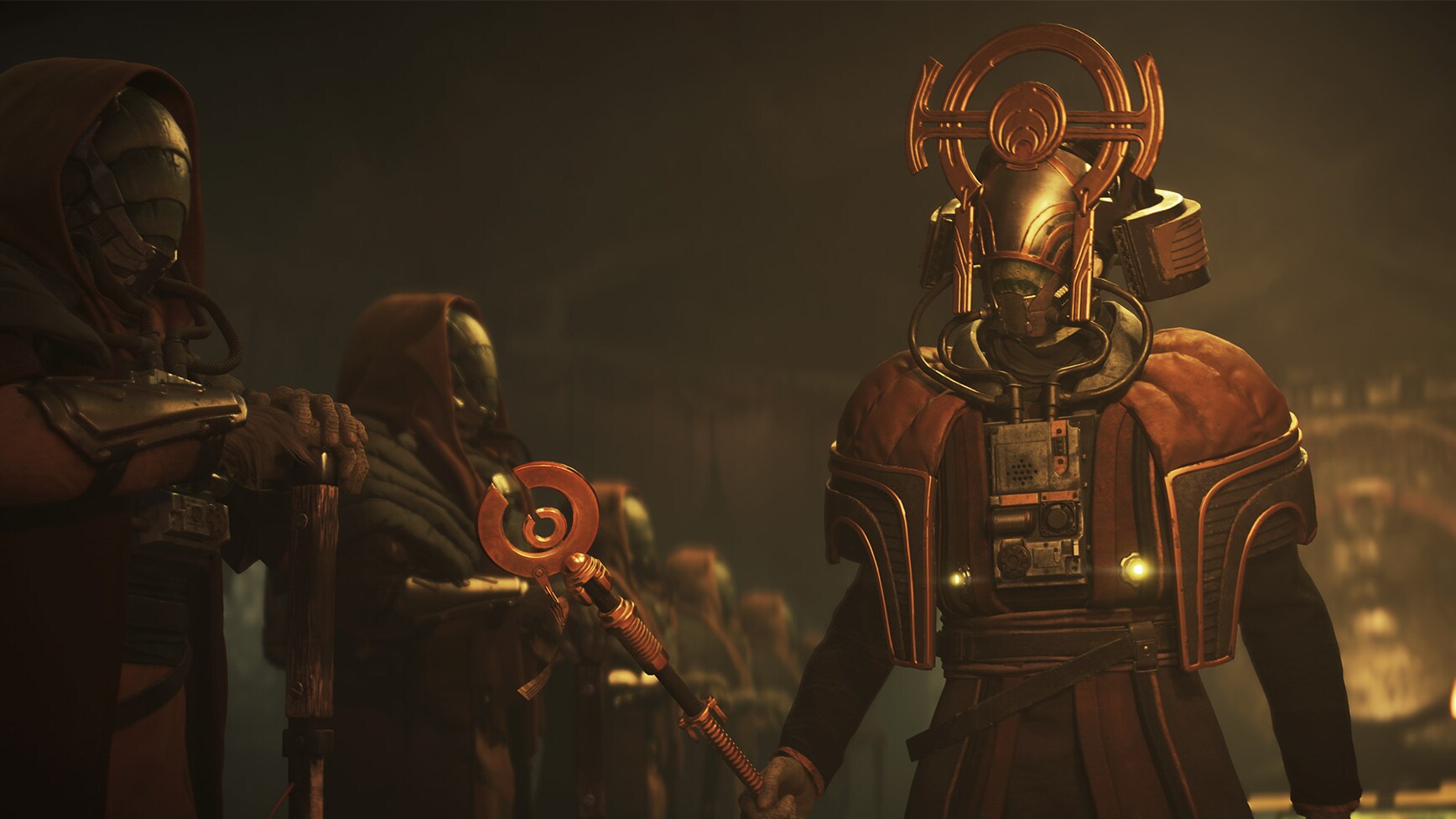
The visual design gives the Ashiga Clan a distinctive material identity: face coverings and breathing equipment, elaborate layered clothing, metallic ornaments, ritual-looking headgear for the queen, and a recognizable insignia. The game uses these visible features to distinguish the clan from the Pykes, Crimson Dawn and Hutts.
The royal staff and headpiece denote status in the specific scenes shown. They are not proof of a newly invented species-wide rite, caste system or religion. More ordinary members wear related clothing and equipment that makes the guards legible as part of one organization, while retaining the practical tools of their assigned roles.
The game's music also contributes to the institution’s identity. Ubisoft composer Wilbert Roget II credits Kazuma Jinnouchi with writing the Ashiga Clan material, using Japanese instruments including shakuhachi and shinobue. Those are documented real-world production choices, not evidence that the fictional Melitto literally practice Japanese religion or speak Japanese.
Architectural continuity, distinctive dress, industrial production and a soundtrack all help represent a social world. A careful archive keeps the production influences separate from the in-universe claims it can actually support.
ARCHIVE 11 / KIJIMI
IDS anthropological assessment: clan, coercion and legitimacy
The Ashiga present an opportunity to compare kinship and corporate organization without treating them as opposites. Family succession is important, but labor, trade, armed guards and property also sustain the institution. The queen's blood relationship with Krisk matters politically because both can claim to speak for a wider group.
Political anthropology distinguishes formal office from practical authority. The queen occupies a recognized position and controls a palace, but she cannot guarantee obedience or prevent a coup. Krisk has a legitimate claim to future succession but still needs help from outsiders to seize the present office.
Political economy asks who controls production and extraction. Rhydonium mining, weapons manufacture, factory obligations and commercial contracts shape the options available to the clan. The Empire’s access to mines may bring payments while simultaneously limiting the queen’s freedom of action.
Material culture provides another perspective. The reused monastery, queen’s statue, entrance guards, cryochamber and origin strand each establish different boundaries around the institution. They are not merely decorative scenery. They help explain which kinds of power characters can exercise in particular places.
The game uses a single reputation interface to make political outcomes visible. That is a useful game design convention but not a literal census of every Ashiga member’s private position. Support for Krisk may differ among guards, workers and elders, even when the interface supplies only one faction label.
Finally, the story resists a simplistic idea of a perfectly unified hive. Krisk opposes the queen. Both defend a claimed collective interest, and their choices affect people who do not themselves take part in Kay’s final decision. The clan is best studied as a changing institution whose history exceeds either possible ruler.
NETWORK / PEOPLE AND RIVAL POWERS
The Ashiga political network
Each link opens a separate researched dossier. Family ties, external partners and hired specialists should not be conflated with permanent membership in the Melitto hive.
Choose one of the actual quest branches, or compare both. The analysis view is editorial interpretation, not a third game ending. The results describe Kay’s reputation changes without suggesting that the page controls the game.
Queen Ashiga retains power
Returning the strand preserves the queen’s reign. Krisk is killed, Kay’s Ashiga reputation improves, and Crimson Dawn reputation falls. This branch excludes Krisk becoming queen in the same playthrough.
Select a dimension of authority. Each result identifies a documented resource and a specific limitation on the clan’s power.
Visible territorial control
The former monastery, the guarded district and the royal statue make Ashiga authority recognizable. Hidden routes and sabotage show that guarded territory is not invulnerable.
Are all Melitto members of the Ashiga Clan?
Not established. Ubisoft says the Ashiga Clan consists entirely of Melitto, not that every Melitto in the galaxy belongs to the clan. Species and organization are different classifications.
Does the game establish a single canonical winner?
No. In The Hive, Kay can return the strand to Queen Ashiga or give it to Krisk. The documented outcomes are mutually exclusive.
Was the old monastery built by Queen Ashiga?
That claim is not supported. The documented High Republic settlement history does not identify the founder as the queen active during the game.
Is the Japanese musical influence a literal Melitto cultural fact?
No. Composer interviews discuss real-world influences on soundtrack creation. That is production history rather than a statement of in-universe Melitto religious or musical practice.
Continuity: Canon. Publication focus: Star Wars Outlaws (2024). Origin period: High Republic-era Melitto settlement; precise dates of individual Ashiga reigns are not established here. Mission options are recorded as possible player outcomes. The political and anthropological assessment is independent IDS interpretation rather than invented species biology or unverified canon.