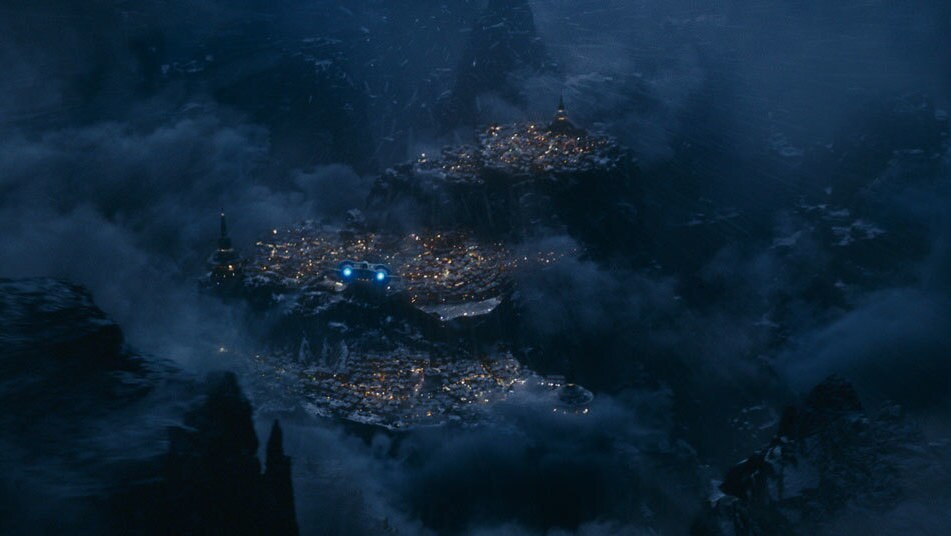
Official Lucasfilm view of Kijimi City, the Spice Runners' home base. Databank photograph ↗.
By Imperial Dark Sector
INSTITUTIONAL ARCHIVE · TABLE OF CONTENTS
From a freighter crew to Kijimi's last days
This page traces the social and economic organization across two very different periods: the younger Poe Dameron's life with Zeva and Zorii and the later First Order occupation of Kijimi. Interactive files below explore how goods, reputation, relationships and credentials sustain a clandestine network.
INSTITUTION 01 / SPICE RUNNERS
A syndicate made from ships, contacts and obligation
The Spice Runners of Kijimi are a criminal smuggling organization whose members work across the galaxy but maintain an important home base on the cold mountain world Kijimi. They transport contraband, protect valuable routes, recruit pilots and cultivate specialists capable of bypassing barriers established by larger governments. Their documented history reaches back to Republic-era spice-runner Zarah Bliss, before continuing through the criminal syndicate led by her daughter Zeva and later by her granddaughter Zorii. That chronology connects a pre-Phantom Menace trafficking episode, the New Republic, Poe Dameron’s youth, and the final confrontation with the First Order.
The name describes an institution rather than a species. Members in the novel Poe Dameron: Free Fall come from different backgrounds and have different jobs; the group is not an Anzellan or Melitto clan. Zorii Bliss is its later leader, while Babu Frik is an honorary member whose technical skills are available for particular jobs. Membership, employment and patronage are not identical social relationships.
Lucasfilm’s Kijimi City reference describes a settlement governed by an unstable mixture of guilds, gangs and clans. The Spice Runners are one important participant in that system, not a sovereign planetwide government. The group’s ability to enforce rules among its own people does not give it undisputed authority over every street.
Seen anthropologically, the organization turns movement, knowledge and obligation into power. Its power lies in who can move cargo, repair machines, connect traders, recognize a trusted visitor and decide when an outside state’s demands are no longer tolerable.
INSTITUTION 02 / SPICE RUNNERS
The organization before Zorii’s command
The network’s earliest known Bliss-family leader, Zarah Bliss, appears indirectly in Alex Segura’s Republic-era short story “Resolve.” A runaway Jedi Padawan named Lizel Liit describes Zarah offering passage to the Outer Rim, then taking her to Desinta and selling her to a local faction. This episode demonstrates that the syndicate’s history includes exploitation and coercive trade well before the Empire’s collapse. Later references identify Zeva as Zarah’s daughter and successor by 4 ABY, with Bib Fortuna assisting her political rise. These earlier events should not be confused with the network’s later Kijimi operations under Zeva.
Free Fall reveals a Spice Runner organization that already predates Poe Dameron’s involvement. Zeva Bliss commands the larger syndicate during the novel’s central events, and Zorii, who initially introduces herself under the surname Wynn, is her daughter. That distinction prevents the group from being described as something Zorii founded after the film’s heroes had already met her.
Within Zeva’s organization, members are expected to prove their value through hazardous assignments and obedience to immediate leaders. The structure contains competing ranks and claims to authority, although the novel does not provide a complete formal constitution. Zeva’s command is exercised through trusted intermediaries, threats, the use of ships and her ability to call members together.
The syndicate’s influence also depends on reputation among rival organizations. A smuggler who advertises a reliable route can attract work; the same reputation can attract enforcement officers or competitors seeking the cargo. Those pressures help explain the group’s combination of secrecy and public underworld prestige.
Earlier activities mentioned in supporting Canon stories do not mean the same exact individuals commanded every crew through every period. The secure storyline for this dossier follows the documented Free Fall crew and the later Kijimi organization, rather than imposing an unsupported uninterrupted roster across decades.
INSTITUTION 03 / SPICE RUNNERS
The Ragged Claw and Poe Dameron’s recruitment
The official Lucasfilm excerpt from Alex Segura’s Free Fall shows Poe Dameron joining a Spice Runner crew aboard the Ragged Claw after the ship becomes stranded on Yavin 4. Vigilch issues immediate orders. Marinda Gan, Gen Tri and Zorii Wynn are among the members involved, and the danger intensifies when New Republic Security Bureau forces attempt to apprehend them.
Poe is a talented pilot, but talent alone does not make him socially trusted. He must navigate the crew’s command structure, protect its passengers and demonstrate that his improvisation serves the group’s survival. In the escape, Poe suggests presenting himself as a hostage to negotiate with pursuing security forces. Zorii carries out the verbal deception convincingly.
The same encounter demonstrates that members do not all make identical moral decisions. Poe asks Zorii to disable pursuing craft rather than kill their pilots. Her response fulfills that instruction, even as the broader group remains committed to smuggling. The moment establishes an early relationship between the two rather than proving the gang had a codified nonlethal policy.
On a larger scale, the Ragged Claw is a workplace. Pilot, gunner, leader and crew perform different functions, and an attack requires them to coordinate. A ship’s engines, access to communications and knowledge of local security protocols become resources as consequential as any individual’s weapon.
INSTITUTION 04 / SPICE RUNNERS
Zeva Bliss, Tomasso, Vigilch and Zorii
Zeva Bliss holds the central leadership role during the younger Poe’s story. Her daughter Zorii begins as a crew member, not as the undisputed head of the entire organization. Vigilch commands the Ragged Claw contingent during the escape from Yavin 4, while Tomasso functions as an experienced figure in the wider network. Those different jobs demonstrate how a syndicate can separate everyday command from final organizational power.
Free Fall includes a Kijimi gathering framed as criminal diplomacy. Poe discovers that Zeva plans to use it to eliminate competitors rather than reach the agreement advertised to guests. His opposition becomes a fracture inside the group. Zorii intervenes on Poe’s behalf, but the two ultimately disagree about whether they should seize control and continue the syndicate’s work.
By the time of The Rise of Skywalker, Zorii Bliss is the leader of the Spice Runners. The official Lucasfilm biography confirms her later status without setting out a detailed, uninterrupted account of every succession step. A responsible dossier reports that transition and its known conflict without inventing a formal coronation or precise day on which command changed hands.
These relationships raise a useful question about organizational continuity: when a leader changes, do personal rivalries become factional disputes? The evidence shows competing approaches to work, violence and loyalty, but does not license an invented list of permanent party blocs within the Spice Runners.
Zorii Bliss as later leader, Lucasfilm Databank. This portrait identifies a member, not the entire organization.
INSTITUTION 05 / SPICE RUNNERS
Smuggling, protection and routes through the galaxy
The organization earns its reputation as a spice-running gang, but its operations involve more than carrying one illegal cargo. The network also trades in access to ships, routes, technical support and information, sometimes through direct transactions and sometimes through pressure placed on other traders.
Canon reference material on Kijimi describes the criminal activity emerging as protection over legitimate space lanes weakened after Imperial defeat. Spice Runners could exploit uncertainty around cargo leaving Kessel and the surrounding region. Such operations explain why a small crew might challenge official policing yet remain vulnerable to organized competitors.
Protection arrangements create a contradiction: a group can sell security while also threatening people who refuse its terms. That dynamic should not be treated as proof that every Spice Runner mission involved extortion or that all Kijimi merchants paid the group. The available narrative focuses on a set of identifiable crews, not a complete financial archive.
Labor makes the network function. Pilots operate ships, navigators identify routes, mechanics preserve equipment, intermediaries negotiate, and trusted people communicate with clients. Money may pay for a shipment, but credibility determines whether the group can keep operating after a failed run or a change of leadership.
INSTITUTION 06 / SPICE RUNNERS
Kijimi City, the Thieves’ Quarter and the den
Kijimi is both a base of operations and a social landscape. The city sits above snowy mountain slopes and contains religious buildings reused by smugglers, traders and fugitives. It is not a purpose-built Spice Runner colony; the organization occupies a city whose older history is visible in the architecture.
The Spice Runners’ Den in the Thieves’ Quarter provides a meeting place and a symbol of underworld belonging. Lucasfilm identifies Oma Tres as a bartender there during First Order occupation. His position illustrates that people who keep a criminal organization running need not all be combatants. Bars and gathering places provide employment, exchange information and sustain social familiarity.
Nearby, Babu Frik’s workshop occupies a crowded blockhouse. The official Databank says ordinary residents throughout Kijimi seek his repair services, while special modifications are reserved for his Spice Runner patrons. This division makes the workshop both a local business and a resource selectively available to people inside a network of trust.
Territory is not the same as complete sovereignty. Other factions historically occupy Kijimi, including the Ashiga Clan earlier in the Galactic Civil War. The Spice Runners do not have a documented claim to control the Ashiga stronghold at the time of Star Wars Outlaws.
Babu Frik is one of the clearest examples of a specialist who makes the Spice Runners more capable without simply becoming an armed field operative. Lucasfilm describes the Anzellan as an honorary member and confirms that he reserves certain modifications for his patrons. The distinction links his professional reputation to the group's trust relationships.
The criminal value of a droidsmith can extend from keeping navigational machines operational to working around software restrictions that governments or manufacturers expect to hold. Such capabilities are especially valuable to people who cannot ask an ordinary public repair shop to modify forbidden systems.
In The Rise of Skywalker, Poe brings a Resistance party into this world through Zorii. Their objective is not a spice shipment but the translation of a Sith inscription that C-3PO can understand but is forbidden to disclose. Babu can attempt the bypass, with a memory wipe as its understood cost. Access depends on a personal introduction before it depends on technical skill.
This scene is evidence of brokerage. Zorii connects the mission to a specialist, Babu performs the work, and C-3PO consents to a sacrifice. The group’s importance lies in the network through which knowledge and expertise become available, not in falsely crediting every decision to Zorii personally.
INSTITUTION 08 / SPICE RUNNERS
Occupation and the limits of neutrality
During The Rise of Skywalker, the First Order has established an occupation of Kijimi. Its patrols and security systems restrict movement, while Kijimi’s criminal groups try to continue their work without becoming open targets. Lucasfilm’s Zorii Databank explicitly frames her situation as a difficult choice between neutrality and the Resistance.
The Spice Runners' ability to act independently is tested when Poe returns with Rey, Finn and C-3PO. Zorii remembers Poe’s abandonment of their shared crew. Her willingness to help after initially challenging him should not be mistaken for an assumption that old trust was instantly restored across the entire organization.
A First Order captain’s data-medallion supplies another important resource. The device carries authentication information that can pass checks imposed by the military. Zorii has reason to keep it for escape but gives it to Poe so that he and his companions can attempt to rescue Chewbacca from a Star Destroyer.
From an institutional perspective, the object converts formal authority into something portable. Someone outside the command chain can use a credential in ways that confuse the checkpoint’s classification of friend and enemy. The group can therefore help the Resistance without becoming an official Resistance regiment.
INSTITUTION 09 / SPICE RUNNERS
Kijimi destroyed and a dispersed network
Palpatine orders a Sith Eternal Star Destroyer to destroy Kijimi in 35 ABY. The planet’s destruction is a fixed event in The Rise of Skywalker. It ends the physical setting of the Spice Runners’ Den, Babu’s workshop and many other workplaces and dwellings. No action chosen in Star Wars Outlaws changes this later film event.
Zorii Bliss and Babu Frik survive and subsequently appear in connection with the civilian fleet supporting the Resistance at Exegol. Their survival shows that at least two people from the Kijimi network escape. It is not evidence that every member fled or that the organization retained its earlier structure after the loss of its world.
An institution can be disrupted without every individual member dying. Losing ships, bases, reliable contacts and an established customer population can be enough to prevent the old organization from continuing in its former form. The game and film sources available for this dossier do not establish a complete post-destruction membership register.
The destruction matters anthropologically because a city is also an archive of ordinary labor and relationships. Its loss erases gathering places, streets, repair shops and memories carried by objects that could not leave in time. Zorii’s participation in the final battle marks survival amid that wider loss.
INSTITUTION 10 / SPICE RUNNERS
Helmets, ships, encrypted identity and a working bar
Zorii’s burgundy armor and bronzium helmet make the Spice Runners recognizable through a leader whose face is hidden. The film uses the contrast between anonymity and reputation to show that a person can be socially known without presenting an uncovered face.
Free Fall emphasizes the Ragged Claw as a working freighter. It is a mobile place of employment, danger and negotiation. Its value lies not just in hull specifications but in the coordinated abilities of crew members. Navigation, weapon control, communications and access to hyperspace are practical capacities that shape a criminal organization’s opportunities.
The First Order captain’s medallion is a different kind of object. It is important because official systems treat it as an authenticated token. It makes a connection between Zorii’s local network and the larger bureaucracy of the occupying military, without implying that she has been legitimately commissioned as an officer.
The den’s bar is material culture too. Oma Tres’s place of work is a site for passing news, making deals and preserving continuity during a tense occupation. A crowded workshop and a functioning bar can matter more to institutional survival than a grand public monument.
INSTITUTION 11 / SPICE RUNNERS
Anthropology: patronage, reputation and changing coalition
The Spice Runners present a model of non-state organization built from repeated transactions and personal obligations. A customer trusts a pilot because past runs succeeded; a technician reserves sensitive work for patrons because the relationship offers protection, referrals and other benefits. These connections can persist even when the central government of the galaxy changes.
Recruitment is not purely voluntary friendship. Poe’s entry is shaped by his desire to escape home and by the risk posed by the crew’s work. Members face pressure from experienced leaders who control access to future jobs. That is a different relationship from the formal rights and procedures of a representative government.
The history of Zeva and Zorii suggests that kinship and organizational succession can interact without being identical. Their family connection matters, but the narrative also shows skill, internal rivalry and differing judgments about force. It would be inaccurate to invent a hereditary rule applying to every role in the syndicate.
The organization also illustrates the moral ambiguity of coercive exchange. The same network can move illegal cargo, protect routes, preserve community space and later assist people opposing authoritarian occupation. A group's work is not made harmless by one later generous act, nor are its members incapable of meaningful choices because it began as a criminal operation.
Finally, an organization’s institutional life does not have to end at the moment its members scatter, but continuity requires evidence. The destruction of Kijimi is confirmed. A universal claim about the subsequent fortunes of every surviving Spice Runner is not. The file preserves that distinction rather than manufacturing a final organizational census.
INTERACTIVE REFERENCE · NETWORK
Nine connections across the syndicate’s history
Each entry is a person, workplace, tool or territorial location. A connection does not automatically imply full membership or equal authority. Zarah, Zeva and Zorii each have separate IDS character dossiers, making it possible to distinguish their leadership eras rather than treating the family as a single ruler.
Explore two documented uses for the captain's data-medallion and compare their political meaning. The choices are historical interpretations, not extra film endings or a modification of any game.
A scarce route out of Kijimi
Zorii treats the First Order credential as an escape resource. It offers a way through certain military checks, but is not proof she has become a legitimate military officer. Its scarcity matters under occupation.
INTERACTIVE 02 · ANTHROPOLOGICAL LENS
What keeps a criminal organization together?
Choose one mechanism. The findings distinguish events in the novel and film from IDS analysis, without inventing a complete membership registry or accounting ledger.
Coordination is a form of power
The Ragged Claw relies on pilots, gunners, navigators and someone authorized to negotiate. Each role gives crew members practical leverage even when an officer gives the immediate order.
Were Zorii and Zeva co-commanders throughout Free Fall?
No. Zeva is the earlier organizational leader and Zorii works within that structure. Zorii is identified as the later leader by Lucasfilm's film-era account.
Is Babu Frik a captain or ordinary paying customer?
Neither description fits the complete record. Lucasfilm specifically describes him as an honorary member who reserves certain modifications for the Spice Runner patrons of his business.
Did every Spice Runner die with Kijimi?
No. Zorii and Babu survive, but the sources used here do not establish that the complete organization continued unchanged after the planet's destruction.
SOURCES · CANON AND EVIDENCE LIMITS
Primary records and editorial boundaries
Lucasfilm’s excerpt from Poe Dameron: Free Fall documents the Ragged Claw, Vigilch, Marinda Gan, Gen Tri, young Zorii Wynn, Poe Dameron and a confrontation with New Republic security. The complete 2020 novel by Alex Segura supplies the larger Zeva Bliss story and the Kijimi summit. Lucasfilm's publishing-panel recap confirms that the novel develops the young Zorii and Babu Frik connections.
Canon, not Legends. The described events are drawn from the identified novel and film, while judgments about patronage, decentralized authority, reputation and material politics are IDS interpretation. This dossier does not invent a complete bank record, initiation ritual, universal nonlethal policy, full post-35 ABY roster or an official statement that every surviving member joined the Resistance.