
By Imperial Dark Sector
DOSSIER MAP / A SUCCESSION CRISIS
What Krisk believes she can change
Read the conflict in story order, from the Empire bargain to The Hive. The two interactive case files examine the competing endings and the patronage behind the coup.
01 / SUCCESSION FILE
The heir who could not wait
Krisk Ashiga is the daughter and presumed successor of Queen Ashiga, leader of the Melitto hive controlling much of Kijimi’s underworld. In Star Wars Outlaws, she is one of the central political actors in the Kijimi story. Her claim to the throne is not founded on a foreign invasion. She believes her mother has weakened the clan so seriously that waiting for succession would make her future office worthless.
This gives Krisk an apparently collective justification for a deeply personal act. She describes her coup as a means of protecting the hive. Her mother sees the same conspiracy as an invitation for Crimson Dawn to seize everything the Ashiga possess. Both claims are tied to recognizable dangers, so the story’s conflict cannot be reduced to whether a young heir is simply impatient.
Krisk is a Melitto, not a Pyke or a member of a separate species. Her clothing, equipment and position are embedded in Ashiga institutions. Her alliance with Crimson Dawn is a political arrangement, not a change of biological identity or automatic membership in Qi’ra’s syndicate.
02 / SUCCESSION FILE
The clan she expects to inherit
The Ashiga Clan is older than Krisk’s dispute with her mother. Lucasfilm places the Melitto group’s arrival on Kijimi in the High Republic era, when they took over a Dai Bendu monastery that became their stronghold. Over generations their organization grew into a criminal power with control over a nearby city district.
Krisk grows into a claim shaped by that collective past. She expects to succeed a queen whose public symbols already occupy the streets. The queen’s statue and guarded district suggest stability to outsiders, but the heir believes the strength they proclaim has declined. In a political succession crisis, inherited legitimacy can become a liability when the heir argues that the incumbent no longer protects the institution.
Published character material describes Krisk as pragmatic, dutiful and convinced that the hive must come first. These words do not prove that all Melitto agree with her. They describe how Krisk understands and justifies her own course of action, which soon puts her directly against another Melitto who claims to act for the same collective.
03 / SUCCESSION FILE
Opposition to the Imperial bargain
Queen Ashiga held back Imperial encroachment for much of her reign, then agreed to let the Empire use Kijimi’s rhydonium mines in exchange for weapons contracts. Krisk interprets this shift as evidence that her mother is surrendering the hive’s future. The objection concerns trade, political sovereignty and the older image of a queen who once refused outside interference.
Rhydonium extraction provides the Empire with a strategic material asset. Weapons contracts offer the queen income and military capacity. The exchange can be defended as adaptation to unequal power. Krisk instead treats it as a reason to replace the ruler who authorized it.
Her alternative is not to isolate Kijimi from the wider galaxy. It is to cooperate with another powerful outsider. This contradiction is significant: Krisk rejects one dependency while inviting help from Crimson Dawn, a syndicate with its own ambitions for Ashiga resources.
The central question is therefore not whether the clan should be entirely untouched by external actors. It is who chooses its partners, who receives the benefit and how the collective could hold a ruler accountable for the arrangement.
04 / SUCCESSION FILE
Qi’ra and the price of a coup
Krisk joins forces with Qi’ra, leader of Crimson Dawn. Dawn’s operatives know how to profit from a political rupture. If the incumbent queen falls, a replacement who owes her throne to Dawn may give the syndicate privileged access to commerce, information and infrastructure in Kijimi City.
Krisk can regard the agreement as a temporary partnership necessary to free her people from the Empire. Qi’ra can regard the same arrangement as a means to control the Ashiga through an indebted client ruler. Nothing requires those perspectives to be identical. This is the familiar problem of a local faction relying on a larger patron to win a domestic dispute.
Ank Parako, an explosives expert whom Kay Vess needs for another job, becomes entangled in the operation. Krisk and Dawn use Ank’s access to support the planned breach of the Ashiga stronghold. The plan involves not only political promises but engineering, infiltration and access to a guarded physical location.
Under those conditions a promise of independence is inseparable from the cost of victory. Krisk cannot overthrow the queen without risking the clan’s military defenses and giving outsiders a role in the mechanism of succession.
05 / SUCCESSION FILE
Breakout: recruiting Kay Vess
Kay Vess reaches Kijimi because her planned heist needs the technical skills of Ank Parako. Ank cannot simply board the Trailblazer. Her duties and debts at the Ashiga weapons factory prevent her from leaving freely, and Kay has to engage with local power to reach her.
The queen offers one route to an arrangement. Krisk contacts Kay with another. The heir promises access to the factory in return for assisting the coup. The Breakout mission begins with a meeting at the Domak Refectory, where Krisk supplies the access needed to reach the facility.
Kay then infiltrates the weapons factory, locates Ank, recovers belongings and helps her escape the site’s controlled spaces. The mission illustrates how a struggle for the throne can create an opportunity for a contractor who has no longstanding allegiance to either claimant.
Krisk does not become a universally loyal companion merely because her offer assists Kay. The apparent generosity serves her political objective: she needs skilled outsiders whose freedom of movement can bypass security loyal to the queen. Kay has to decide whether the immediate benefit is worth becoming part of an internal Ashiga conflict.
06 / SUCCESSION FILE
The Hive: a revolt inside the stronghold
After Breakout, Qi’ra and Ank prepare an explosive entry into the Ashiga stronghold. Kay approaches through the Kijimiko caverns. Once inside, she must survive security systems and armed resistance to reach the origin strand, a resource central to the hive’s continuity.
The operation is not an open election or a public appeal to all clan members. It is a covert seizure of strategic access. Krisk’s position depends on outsiders disabling protective systems and taking custody of an object normally controlled inside the ruling institution.
As Kay moves through the stronghold, the operation becomes more complicated. Crimson Dawn agents seek the strand for their own purposes. That pursuit supports the queen’s fear that outside assistance may turn into external ownership. It does not erase Krisk’s stated concern about Imperial dependence.
The game places the decisive material object in Kay’s hands. Krisk’s claim, the queen’s present office and Dawn’s plans all converge on what a third party chooses to do with the strand. This outcome is why the quest’s final scene matters beyond a simple reputation reward.
07 / SUCCESSION FILE
Why the origin strand changes the succession
The origin strand is connected to the genetic basis of the Ashiga hive. In the story it helps sustain the collective’s reproduction and is guarded in a cryochamber inside the stronghold. Control of that object therefore concerns future generations as well as symbolic ownership.
A typical succession story might revolve around a crown, ceremonial seat or written decree. The origin strand makes custody of biological continuity itself part of the political contest. The object’s importance is established by the game, while the broader implications for material culture and authority are IDS interpretation.
Krisk’s desire to possess it does not mean she can create a fully independent future just by holding it. A reigning queen also needs guards, contracts, workers, secure territory and working relations with other powers. Dawn’s attempt to control the strand reveals precisely how vulnerable the hive becomes when the object can be taken by an outside actor.
The tension between material and political legitimacy helps explain the ending. Krisk’s claim does not succeed merely because she speaks convincingly. Kay must decide whether to entrust her with the clan’s most important resource.
08 / SUCCESSION FILE
Two deaths, never one universal ending
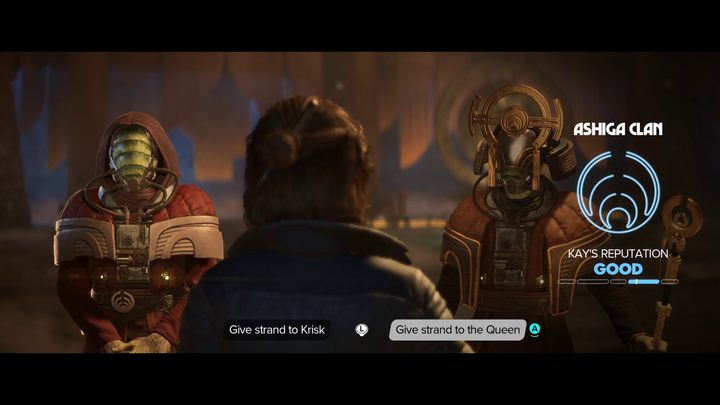
When Kay returns to the throne room, Krisk confronts her mother. The queen warns that Dawn is using the heir, while Krisk maintains that the Empire partnership threatens their future. Kay chooses who receives the origin strand.
If Kay gives Krisk the strand, Krisk kills Queen Ashiga, takes her place and becomes the new ruler. Crimson Dawn gains access to a favorable leadership arrangement, and Kay’s reputation with Dawn increases significantly. This is the path in which Krisk survives and takes the throne.
If Kay returns the strand to Queen Ashiga, the queen remains in power. Krisk is killed by a clan guard during the confrontation. Kay gains substantial Ashiga Clan reputation but loses Crimson Dawn standing. This is a different branch, not an event that occurs after Krisk has become queen.
Both outcomes are supported by published playthrough guides. They should be represented as player-dependent alternatives. The game does not require a writer to claim that Krisk simultaneously becomes monarch and dies before ruling.
09 / SUCCESSION FILE
The clothes of an heir and the technology of command
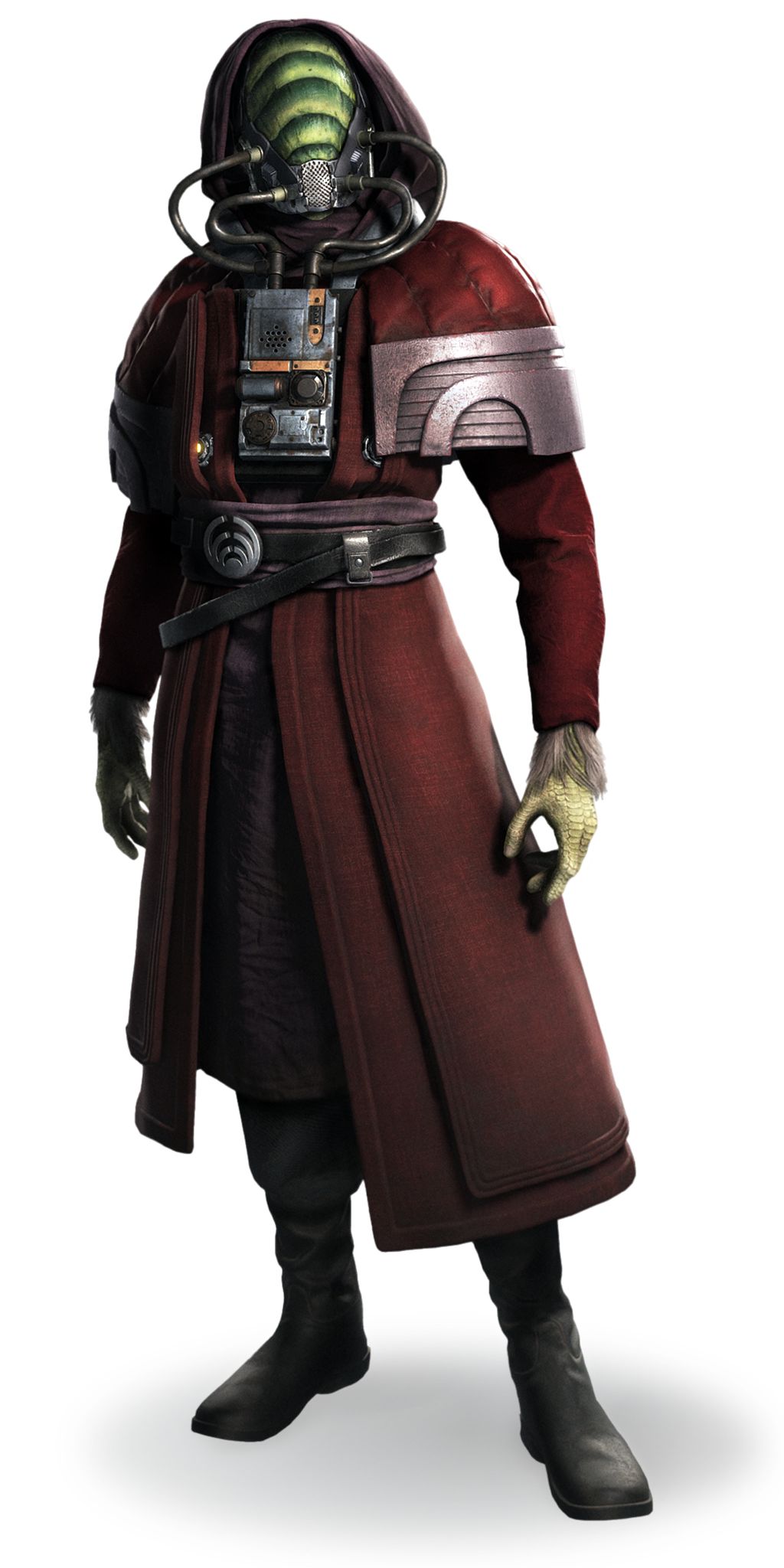
Krisk appears in dark red layered robes, protective shoulder equipment and a breathing assembly over her face. The silhouette resembles broader Ashiga dress, but lacks the queen’s elaborate headdress and staff. The contrast distinguishes an heir from a reigning monarch without requiring an invented ritual explanation.
Her equipment is also evidence of what the setting makes materially possible. Security cards, factory doors, explosive charges, consoles and the cryochamber affect the balance of power more directly than any speech. Krisk’s strategy succeeds or fails in part because objects and spaces are controlled by different actors.
The accompanying gameplay image depicts the choice interface that determines whether Krisk or the queen controls the strand. It is not a second portrait and should not be mistaken for a detailed reconstruction of Melitto reproductive science. It documents the player’s point of decision.
Her depiction presents a politically ambitious individual within a hive. The visual similarity between members should not be used to erase individual motives, family relationships or differences over policy.
10 / SUCCESSION FILE
IDS anthropology: succession, factionalism and dependent sovereignty
Kinship structures the conflict because Krisk is the queen’s daughter and expected successor. Yet heredity does not resolve disagreement. Krisk’s revolt shows that a political family can become divided over policy, resource allocation and the meaning of duty to a wider group.
Factionalism is the formation of competing groups inside a larger institution. Here the disputed issue is not membership in the Ashiga Clan but who should direct it. Crimson Dawn can help one faction without becoming identical to it. The Empire’s role in the queen’s trading arrangements likewise does not convert every Ashiga member into an Imperial employee.
Patron–client relations are unequal arrangements in which a powerful actor offers resources, backing or access and expects reciprocal service. Krisk’s alliance with Qi’ra raises a central question: can the heir gain power through an outside patron without surrendering the autonomy she says she is restoring?
The origin strand links reproductive continuity to the allocation of political authority. Its custody is not just treasure ownership. It changes who can rule and who may benefit from an entire community’s future. This gives the quest a material dimension beyond the immediate bloodshed.
Finally, the game uses reputation as a simplified model of institutional response. Helping Krisk brings Dawn favor; siding with the queen brings Ashiga favor. Such measures help players understand consequences, but they are not evidence that every clan member unanimously approves of the chosen ruler. IDS separates gameplay abstraction from the more complicated social processes it represents.
INTERACTIVE 01 / THE HIVE
Choose who receives the strand
These are alternative mission results. The comparison view is IDS analysis, not a third selectable ending in Star Wars Outlaws.
Krisk becomes queen
Krisk kills her mother and assumes the throne with Crimson Dawn backing. Kay gains significant Crimson Dawn reputation. The victory raises the question of whether a new ruler can escape her patron’s influence.
INTERACTIVE 02 / POWER MAP
Where does Krisk get her leverage?
Select a resource to see how the coup turns inherited status, outside support and access to physical infrastructure into a political challenge.
Outside support has a price
Qi’ra provides expertise and force to help the heir. Dawn also wants control over what makes the Ashiga wealthy and powerful. Krisk gains a path to office but risks dependence on her new backer.
Does Krisk rule in every playthrough?
No. If Kay gives the strand to Queen Ashiga, Krisk is killed instead. Both outcomes are clearly documented by The Hive quest guides.
Does opposition to the Empire make her independent?
Not necessarily. Her plan depends on cooperation with Crimson Dawn, which has interests in the hive’s material resources.
Does the game define a complete Melitto succession law?
No. It establishes this queen, her heir and the significance of the strand. IDS avoids generalizing that every Melitto society follows identical rules.
COLLECTING / SOURCE-VERIFIED
Collecting this Character
The research for this page did not verify a dedicated Krisk Ashiga figure, LEGO minifigure or Topps card. No unrelated merchandise or speculative listings are displayed as confirmed items. Her verified media appearance is Star Wars Outlaws, which has its own disclosed sponsored shopping links.
RESEARCH / CANON AND GAMEPLAY
Sources and evidence boundaries
Lucasfilm’s Ashiga Clan Databank establishes the hive’s Kijimi history and institutional setting. Ubisoft’s Outlaws page verifies the Melitto clan, weapons dealings and faction dynamics. Game-Maps’ Krisk character record covers her position and motivation. Breakout walkthrough and The Hive mission guide identify the mission sequence and reputation outcomes. Gamepressure’s choice guide corroborates both alternatives.
Continuity: modern Star Wars Canon, 2024 game. Krisk’s final political position and survival depend on player choice. Statements about inheritance, patronage and reproductive resources are presented as IDS anthropology, not invented game lore.