
By Imperial Dark Sector
FIELD GUIDE / READ IN STORY ORDER
Eleera's two eras
Follow Eleera from Qi’ra’s early years under Dryden Vos to the Toshara power struggle. Select one of the two interactive intelligence exercises below to compare factions, information, and institutional obligations.
DOSSIER 01 / CRIMSON DAWN
A quiet threat on Toshara
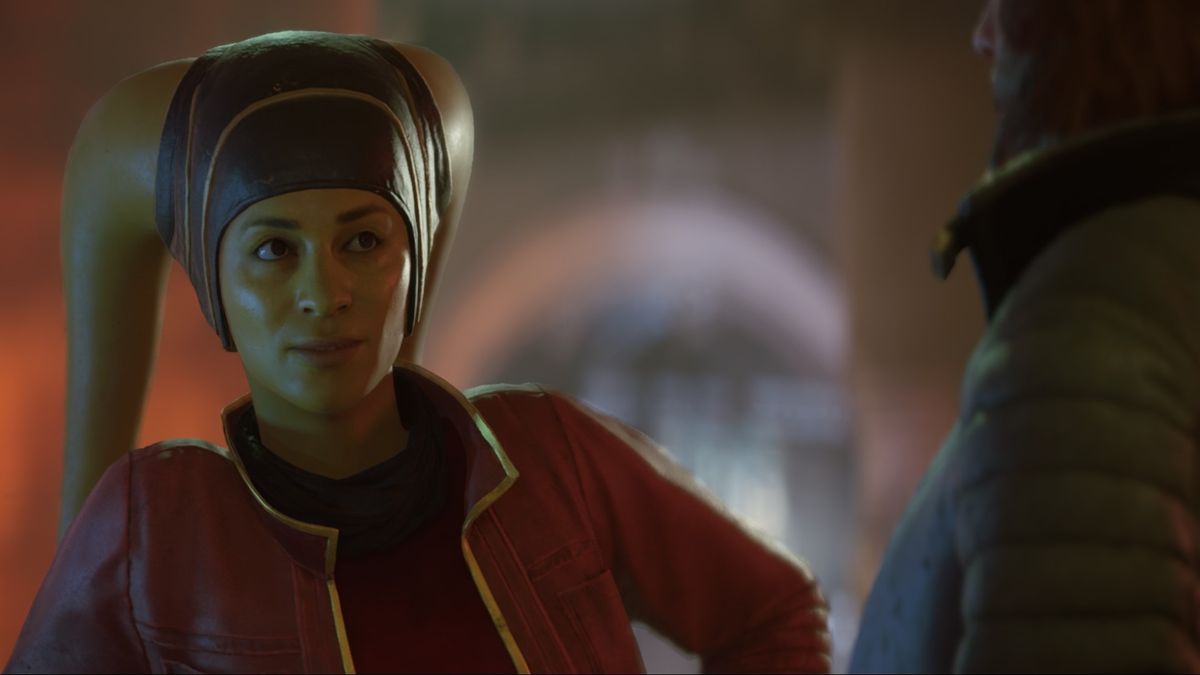
Eleera Soi is the Crimson Dawn operative who turns Kay Vess’s first major underworld assignment into a political problem. Kay has infiltrated a Pyke facility to extract information, but she does not initially know that the mysterious employer behind the contract serves a competing syndicate. When Eleera finally introduces herself, the information Kay carries already threatens the most powerful criminal organization on Toshara.
That is Eleera’s method. She does not need to challenge the Pyke boss Gorak Palas in his own fortified office. She hires someone who can pass through his defenses, gathers information the Pykes would rather conceal, and offers the contractor access to Crimson Dawn’s resources. Her power is exercised through secrecy, carefully chosen intermediaries and an understanding of what other people need.
An official syndicate briefing published by Ubisoft on Xbox Wire calls Eleera a senior member of Crimson Dawn and a key contact for Kay. Its stated objective is to secure the Dawn foothold on Toshara and displace Pyke dominance there. Eleera is therefore an important story contact, not merely an optional merchant or incidental quest marker.
DOSSIER 02 / CRIMSON DAWN
Before Outlaws: the recruit on Thorum
Eleera’s life connects the 2024 game to an earlier Canon novel. In E. K. Johnston’s Crimson Climb (2023), she appears as a Crimson Dawn operative before the organization is controlled by Lady Qi’ra. The novel follows Qi’ra after her separation from Han Solo on Corellia and her entry into Dryden Vos’s organization. Eleera is already familiar with violent work when the new recruit arrives.
Eleera entered Dawn through a world of competitive fighting. Accounts of the novel describe her attracting attention while competing in manipulated matches. The detail is important because it places her skills in a labor market that could be exploited by criminals. An ability to survive violence became an asset a larger syndicate could purchase and redirect.
On Thorum, Eleera works alongside Qi’ra and other operatives on collection jobs. Their orders involve recovering payments and reminding reluctant businesses that Dawn has coercive power. The mission is not an abstract exercise in loyalty. Threats to people and property enforce a stream of money upward through the organization.
Eleera’s exact birthplace, full childhood history and private beliefs are not established in the cited record. Her early recruitment explains how Dawn came to employ her, but it does not justify inventing a homeworld, named family or a complete psychological explanation for her later actions.
DOSSIER 03 / CRIMSON DAWN
The fighter who trained Qi’ra
During their time together, Eleera recognizes that Qi’ra has acquired useful street skills but needs a more systematic command of close combat. Eleera provides instruction with vibroblades. In exchange, she wants information about the criminal world Qi’ra knew on Corellia. This trade makes knowledge and bodily skill comparable resources within the syndicate.
The relationship is neither a conventional school nor a purely affectionate mentorship. Both women are trying to remain valuable to an employer who can punish weakness. Training becomes a way to demonstrate competence while negotiating how much each woman knows. Eleera acquires intelligence about Corellian gangs; Qi’ra learns techniques that may keep her alive.
Eleera’s role in Crimson Climb also extends beyond fighting. She takes part in intimidation, reconnaissance, and the syndicate’s wider social activity. These different jobs place her in contact with traders, workers and people higher in the hierarchy. She understands how to shift from a visible threat to an observer who does not disclose her full purpose.
The novel gives the older history. Outlaws shows what that experience can look like after years inside Crimson Dawn: an operative who sends a thief into another faction’s headquarters and then uses the result to negotiate a new relationship.
DOSSIER 04 / CRIMSON DAWN
The dangerous lessons of Dawn service
Crimson Climb includes an expedition to recover a Force-related artifact from a remote temple. Eleera is part of the wider team, and the mission reveals how dangerous it can be to obey instructions whose full stakes are withheld. The object’s religious importance is not the same as the agents’ reasons for pursuing it. They are sent to collect something valuable to their patrons.
Lucasfilm’s published interview with Johnston confirms the novel’s focus on a Jedi-made artifact with potentially catastrophic effects. The team’s exposure to deadly dangers makes the syndicate’s working conditions visible. A subordinate can be expected to accept danger in pursuit of an object whose wider political meaning is largely concealed from them.
Eleera survives into the later Outlaws story, where her experience appears as practical caution. This does not mean she can predict every betrayal or escape every danger. It means her biography gives readers a reason to distinguish polished criminal prestige from the injury, risk and coercive work needed to maintain it.
DOSSIER 05 / CRIMSON DAWN
The Dawn contact in Mirogana
By the events of Star Wars Outlaws, Eleera operates on Toshara as a field contact and handler. Kay Vess encounters the underworld through Danka Orsato, an independent broker. Eleera initially works behind that introduction rather than arriving as a formally announced envoy with her full affiliations displayed.
The location matters. Mirogana is a city where the Pyke Syndicate has substantial territorial authority, yet information can still flow to a smaller competitor. Dawn does not need to occupy every street to compete. It can recruit intermediaries, cultivate knowledge of Pyke operations and make a contractor’s private debt or ambition serve its cause.
Eleera’s approach to Kay is calculated. The thief needs help repairing her ship and protection from the much larger Zerek Besh threat. The Dawn operative offers assistance but also makes clear that continued cooperation is expected. Support is conditional. Kay receives something materially useful while being invited into a relationship she may later regret.
The contrast with Gorak is deliberate. He performs status through an imposing private suite and guarded access. Eleera can exert influence from a conversation, a concealed assignment, and a promise. These are different styles of organized criminal authority, not evidence that Dawn is morally less coercive than the Pykes.
DOSSIER 06 / CRIMSON DAWN
Underworld: deciding who receives the secret
At the end of the main quest Underworld, Kay returns from the Pyke base with evidence of a plot against Gorak. Eleera reveals that she is the Dawn contact connected to the assignment. The player must decide whether to share the information with her or reserve it for Gorak.
Giving the information to Eleera improves Kay’s standing with Crimson Dawn. Keeping the evidence for Gorak improves her standing with the Pykes after she delivers it. The distinction matters for immediate access to syndicate areas and resources. It is not a permanently binding affiliation or a fixed canonical ending for Kay’s biography.
The same piece of intelligence serves two incompatible uses. For Gorak it helps expose a traitor and defend an incumbent hierarchy. For Eleera it can undermine the organization she wants to displace. Neither can make the evidence valuable without its connection to local politics.
Guides documenting the actual mission confirm that Kay can receive the ship parts regardless of which side receives the information. That detail prevents the dossier from inventing a plot consequence: accepting Gorak’s route does not erase Eleera from the wider story.
DOSSIER 07 / CRIMSON DAWN
False Flag: assigning blame to the enemy
Eleera later directs Kay toward an Imperial-controlled installation in Toshara’s orbit. The objective is to manipulate records and have the resulting incident appear to be the work of the Pyke Syndicate. This is an operation against a rival’s reputation as much as an attempt to gain a material advantage.
False Flag develops the theme introduced in Underworld. If information can be sold, it can also be altered, withheld, or attached to a misleading attribution. The scheme seeks to influence how the Empire understands a criminal event. Officials act on reports, not on omniscient knowledge of what Kay actually did.
The game allows a player to follow Eleera’s framing plan or switch the blame toward Crimson Dawn. This branch changes faction reputation and should be described as an available game outcome rather than as an event that inevitably happens in every continuity.
The sequence shows why a handler is powerful. Eleera does not need to board every vessel or personally slice every terminal. She can select a target, provide motive and instructions, and recruit someone with the mobility to act. The same separation gives her plausible distance if the plan fails.
DOSSIER 08 / CRIMSON DAWN
Who trusts Eleera and who does not
Lady Qi’ra stands at the top of Crimson Dawn during Outlaws. Eleera has known her since an earlier, harsher stage in the organization’s history. This makes Eleera different from a newly recruited contact on Toshara. She has first-hand knowledge of the leader’s early career, although that fact alone does not grant her an established ceremonial rank.
Dryden Vos was a powerful figure in the Dawn organization during the novel’s earlier period. His leadership structure helps explain the world in which Eleera learned the danger of both obedience and internal competition. It does not follow that every later Dawn decision must have originated with him.
Danka Orsato connects people with jobs without belonging to every syndicate she serves. Kay Vess is an independent contractor whose loyalties can shift. Gorak Palas represents the Pyke hierarchy Eleera wants to weaken. Governor Thorden represents local Imperial political power, whose relationships with criminal employers can make a single leak or fabricated record consequential.
These ties form a network rather than a simple chain of command. Eleera can know Qi’ra personally, deal with Danka, bargain with Kay and attack Pyke interests without holding a public territorial title. Her independence is a feature of the role, but the organization still gives her money, access and a political objective.
DOSSIER 09 / CRIMSON DAWN
Red clothing, knives and information
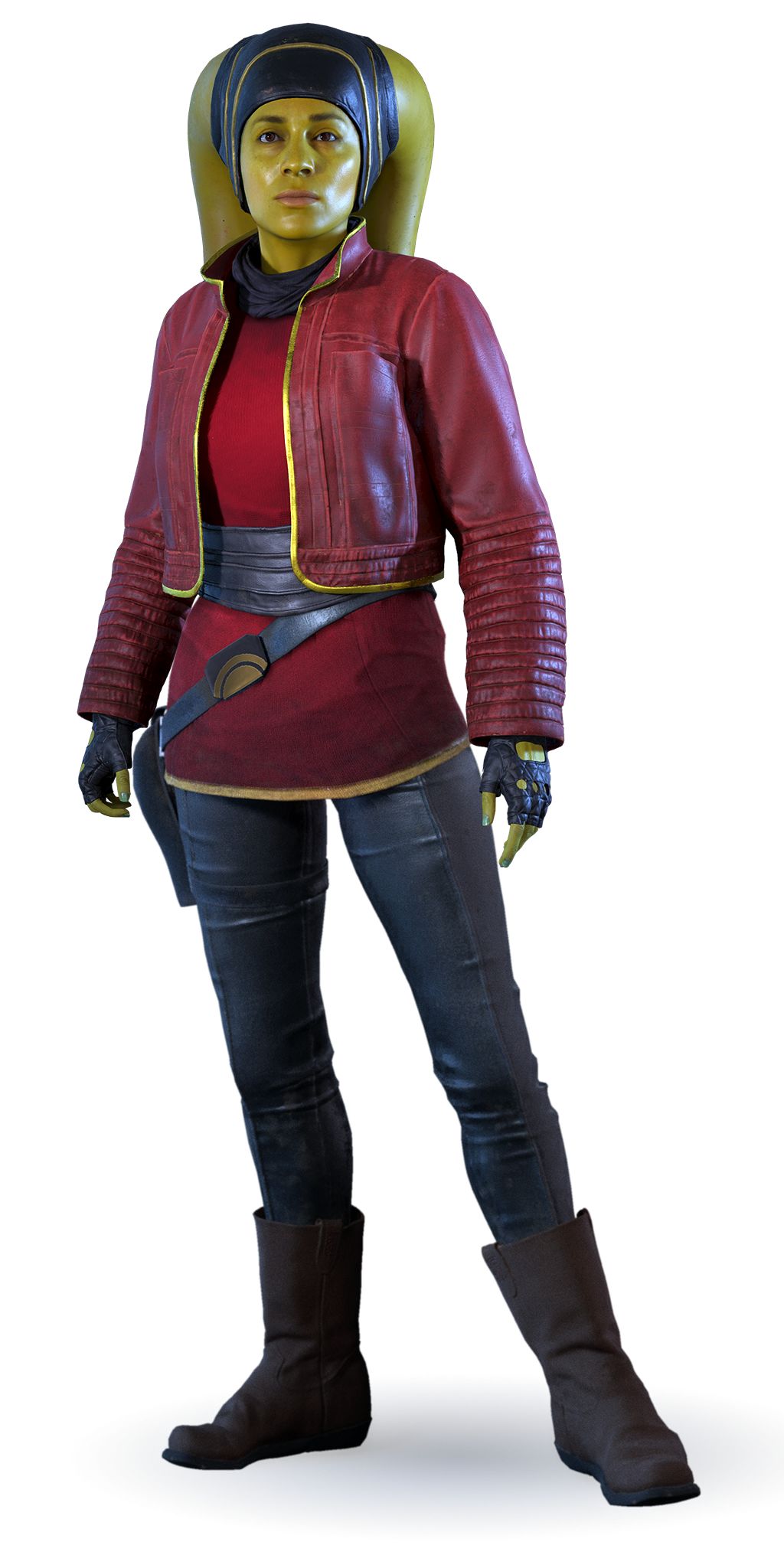
Eleera’s Outlaws appearance is easy to recognize. She wears a red jacket with contrasting trim, a matching upper garment, dark utility clothing, gloves and headwear that accommodates her Twi’lek lekku. The clothing communicates membership and confidence, but a visible costume should not be mistaken for a universal Crimson Dawn uniform imposed on every operative.
The novel describes her carrying concealed knives and using a compact flamethrower in intimidation work. That material record differs from her appearance in the game, where information brokerage and directed sabotage matter more than a showcased boss fight. Both sets of objects express the same professional world through different scenes.
The image below is a game-sourced full-body character render archived by a walkthrough site. It complements the separate conversation screenshot above and is used only to identify the same named character. The source of the render does not establish additional biographical facts.
Documents also matter. An Imperial case file about Eleera appears as a retrievable information item in Outlaws. A criminal operative can be watched and classified by an opposing institution even while acting covertly. The file’s existence is evidence of surveillance, not proof that the player can reconstruct all of her hidden operations.
DOSSIER 10 / CRIMSON DAWN
IDS anthropology: dark capital and the price of trust
Political anthropology examines how authority is created and maintained through personal obligations, institutions and control of resources. Eleera illustrates a style of power in which access to information matters more than occupying a public office. She can offer Kay shelter and work because she speaks for a larger criminal network, while that network benefits from the thief’s relative independence.
Patronage is not equivalent to friendship. An influential actor provides protection, employment or a valuable introduction in exchange for expected service. Eleera’s relationship with Kay fits this pattern, but its terms are unstable. Kay can later assist other syndicates, and Eleera’s promises remain shaped by Crimson Dawn’s strategic interests.
Secrecy is likewise a social practice, not a mystical personality trait. A handler decides what a contractor knows, when a name is disclosed and which facts should appear in an official record. The asymmetry creates power because the other party must make decisions without the same information.
Colin Atkinson’s 2026 peer-reviewed article on Outlaws describes reputation as part of a broader exchange of criminal and street capital. The game converts shifting perceptions into access, contracts and risk. Eleera’s opening choice is a useful example: information becomes an asset that Kay can spend, but exchanging it also changes her relationship to every other possible buyer.
Players should not mistake the reputation bar for a literal sociological measure. Real communities do not all agree on one score, and an institution’s formal reputation is not its members’ private judgment. Outlaws compresses those complexities to make player choices legible. IDS uses the mechanic as a starting point for analysis rather than claiming the game is a precise model of organized crime.
Eleera’s history also shows how training can reproduce an institution. Her lessons to Qi’ra transmitted physical techniques and situated knowledge about the criminal underworld. Years later, she recruits Kay for covert work. These relationships do not create a blood family; they show how skills, contacts and obligations can be passed among successive members of a syndicate.
INTERACTIVE 01 / UNDERWORLD
Who benefits from the Pyke traitor file?
The Underworld mission lets Kay decide who receives information about a Pyke conspiracy. Select a recipient to compare the documented reputation effect with the social stakes. The third option is analysis, not an additional quest ending.
Crimson Dawn gains a source
Giving Eleera the file significantly improves Kay’s Crimson Dawn reputation. Eleera can use evidence against a competitor; the reward is access and patronage rather than proof of moral trustworthiness.
Mission basis: Underworld walkthrough and PC Gamer decision guide.
INTERACTIVE 02 / COVERT POWER
What does Eleera actually control?
Choose a relationship to trace the difference between Eleera’s operational discretion and the authority she borrows from Crimson Dawn.
Trust is not a public title
Eleera’s history with Qi’ra helps explain why she is trusted to work independently. Her discretion does not make her the leader of all Crimson Dawn; she is a senior operative acting toward the syndicate’s interests.
Evidence check: Did Eleera first appear in the game?
No. The character named Eleera was published in the 2023 novel Crimson Climb. Star Wars Outlaws (2024) supplied her surname and first visual depiction.
Evidence check: Does choosing Gorak remove Eleera from the story?
No. The early choice primarily changes syndicate reputation and accompanying dialogue. The larger storyline continues.
Evidence check: Is this a combat-boss guide?
No. Eleera is a major handler and quest contact, not presented in the cited material as a boss encounter with a verified health bar or attack pattern.
COLLECTING / STORY CONNECTION
Collecting this Character
No specific Eleera Soi Topps card, LEGO minifigure, or licensed action figure has been independently confirmed for this file. This section therefore contains no invented collectible listings, prices or borrowed trading-card art.
Her story appears in the verified 2023 Canon novel Crimson Climb by E. K. Johnston, and she is a character in Star Wars Outlaws. Follow those IDS media pages for the related books and game, including any clearly disclosed sponsored retail links.
RESEARCH RECORD / PRIMARY AND SECONDARY
Sources and evidence boundaries
Ubisoft via Xbox Wire: Breaking Down the Syndicates identifies Eleera as a senior Toshara contact seeking to undermine the Pykes. Ubisoft: Star Wars Outlaws confirms Crimson Dawn’s emphasis on intelligence and faction competition. Lucasfilm: E. K. Johnston on Crimson Climb and the novel publisher's record establish the publication and central narrative. The character-specific novel details are corroborated by Wookieepedia’s cited account of Crimson Climb; the original novel remains the controlling source.
Underworld mission guide documents the two reputation branches, while PC Gamer corroborates the mechanics. Atkinson (2026), Crime, Media, Culture provides peer-reviewed analysis of criminal reputation and game systems. IDS anthropology is interpretation, not a claim of additional canonical beliefs, ranks, missions, combat statistics or mandatory player outcomes.
Continuity: Canon. In-universe setting: Eleera’s earlier Crimson Dawn service before the events of Solo, and Star Wars Outlaws during the Galactic Civil War. Story branches are documented as player choices rather than fixed biography. Hero is an attributed game screenshot, not a studio portrait invented for this archive.