
By Imperial Dark Sector
FIELD GUIDE / INTERNAL NAVIGATION
Inside Gorak's power structure
Read his encounters in story order, inspect the threats to his position, then test how information changes syndicate relationships. The interactive exercises below analyze narrative choices and are not a live game-state calculator.
FILE 01 / TOSHARA
The criminal court of Toshara
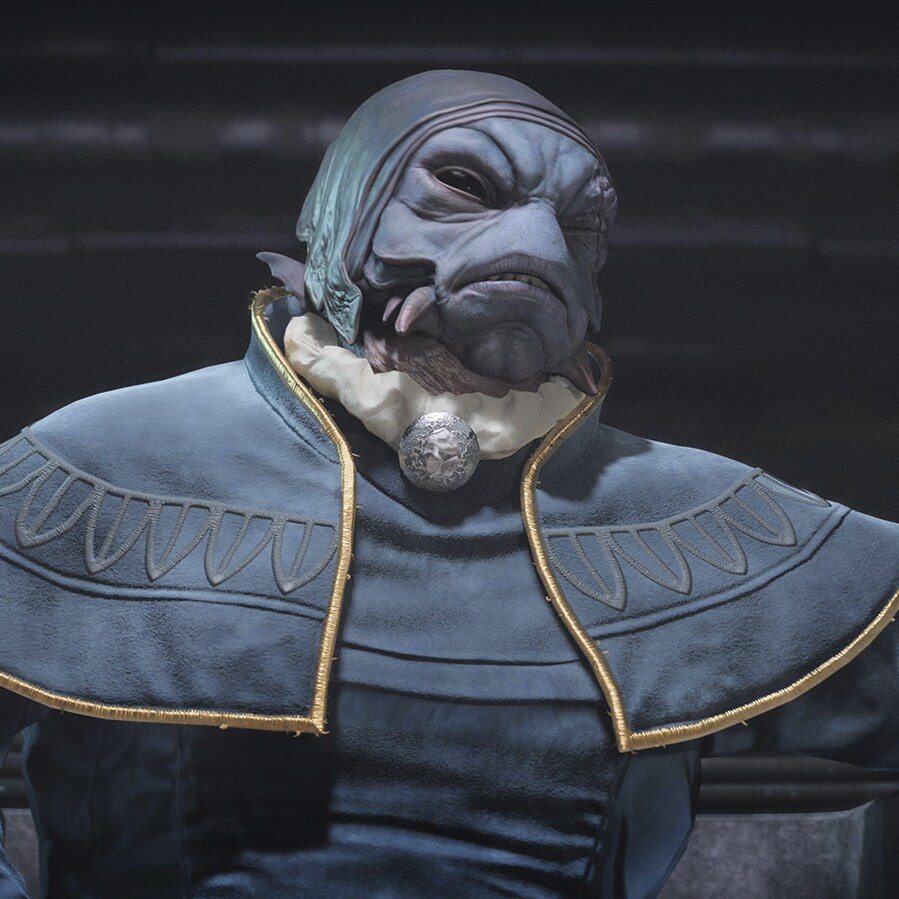
Gorak Palas is not the supreme leader of every Pyke enterprise in the galaxy. His significance is more specific. He makes the Pyke Syndicate the dominant underworld force on Toshara, while negotiating with an Imperial government that can threaten or enrich him. In Star Wars Outlaws, his authority reaches Kay Vess long before she has the influence to challenge a syndicate. Gorak’s first encounter with Kay establishes the difference between an ambitious independent thief and a crime boss who can decide whether she gets a hearing at all.
His office is the private suite above Makal’s Gambling Parlor in Mirogana. The venue is important. Wealth, gambling, guards, introductions and information meet in one public-facing commercial space. The suite above the parlor turns the ordinary act of entering a room into a test of rank. Getting past security is not the same thing as receiving Gorak’s recognition; a visitor must prove they offer something valuable enough to justify his attention.
Lucasfilm’s Databank identifies his political method directly: he understands social manipulation and the appearance of power. That description matters because Gorak’s command does not depend only on physical force. He controls access to work, information, protection and reputation. His enemies can strike at those resources without ever trying to defeat him in a conventional battle.
FILE 02 / TOSHARA
Why the Pykes dominate Toshara
Toshara sits in a criminal and Imperial economy, not outside either system. The Pyke Syndicate’s prominence on the moon depends in part on an understanding with its Imperial governor. That arrangement produces an uneasy division of power: officials can claim lawful authority, while syndicate personnel exercise practical control over markets, smuggling and coercion. The official Outlaws syndicate guide describes Gorak’s bribes as one reason the Pykes are a political authority on Toshara.
An Imperial bargain is never the same as independence. The governor can ask for more money, favor competing factions or cultivate a subordinate who promises greater returns. The syndicate, for its part, can withhold payments, redirect its personnel or retaliate against interference. Gorak must negotiate this unstable relationship while making his own subordinates believe he is secure.
Crimson Dawn offers a different kind of challenge. Where the Pyke presence on Toshara is visible and established, Dawn agents favor espionage and carefully placed bargains. A thief who learns something embarrassing about the Pykes can trade that knowledge for a different syndicate’s protection. Kay’s ability to move between employers turns intelligence into a marketable resource.
This is why the island of control implied by a private office is deceptive. Gorak commands people and territory, but his influence is always mediated by informants, paid officials, dependent workers and rivals seeking an opportunity to defect. The more valuable his position becomes, the more tempting it is for others to reorganize it.
FILE 03 / TOSHARA
Meeting Kay Vess at Makal’s
Kay approaches Gorak because she needs access to the criminal networks that control useful work and supplies on Toshara. Her visit is an encounter between unequal parties. Gorak has guards, status and an established position. Kay has initiative, nerve, a capable companion and little standing in the local underworld. She can reach his suite and still fail to win his backing.
During their first exchange Gorak measures her claim to competence. He is not simply deciding whether she seems fearless. He is asking whether her associations and experience make her worth the political cost of hiring. Kay’s reliance on the mechanic Waka does not give her the introduction she expects. The rebuff shows how reputation can precede ability in a labor market shaped by patronage.
Nix, Kay’s merqaal companion, adds a very different complication. The encounter can leave Kay carrying Gorak’s ring because Nix steals it. The ring is not a magic key to the Pyke hierarchy. It is a small possession whose return or retention gives the player another opportunity to think about property, trust and the personal symbols of an otherwise impersonal organization.
FILE 04 / TOSHARA
The traitor inside the syndicate
The early quest Underworld brings the conflict into sharper focus. Kay enters Pyke-controlled space to obtain information for a competing contact. Her investigation reveals evidence of disloyalty within Gorak’s organization. Instead of ending in an unquestioned moral victory, the mission creates a choice about where that evidence should go. The same information can be useful to the Pykes or to Crimson Dawn.
Gorak’s own concern is an internal traitor. For an organization that sells protection and secrecy, betrayal is more dangerous than the loss of any single shipment. It reveals that the leader may no longer know whose messages, guards or commercial decisions he can trust. Kay becomes valuable because she can cross boundaries that loyal insiders may be watched too closely to cross.
The story also places local Imperial politics behind the conspiracy. An alliance among ambitious subordinates, political officials and criminal rivals could remove Gorak without replacing the entire Pyke network. A different boss might preserve the operation and redirect its payments. Gorak therefore has reason to be suspicious even when a transaction appears routine.
The player’s decision about revealing the evidence affects syndicate reputation in the game. It should not be treated as a universal statement that every possible playthrough occurred in one single canonical order. IDS presents the underlying conflict as established story material and the reputation consequence as a selectable gameplay path.
FILE 05 / TOSHARA
The people around Gorak
Kay Vess is a potential contractor, thief and messenger. She is useful precisely because she is not yet a securely attached Pyke employee. When she works for one syndicate, a competitor may still approach her. Gorak’s effort to recruit her is a practical response to a dangerous information gap, not evidence that he becomes a trustworthy guardian.
Danka Orsato introduces Kay to the contracts and contacts that make Toshara’s underworld navigable. Eleera Soi represents Crimson Dawn’s competing effort to collect intelligence. Governor Thorden represents the Imperial authority that bargains with and pressures the Pykes. Tizlak Sharr, a subordinate implicated in an attempt to undermine Gorak, demonstrates the risk of internal competition. Each relationship is shaped by a different form of access: employment, secrets, political protection or control over personnel.
Gorak’s relationships are especially useful for reading the game as a story about institutions. A syndicate is not a single character with a single intention. Guards may protect its headquarters, brokers may sell work, lieutenants may seek advancement and allies may demand a higher price. Their decisions can diverge from the interests of the leader whose insignia they display.
FILE 06 / TOSHARA
Uniform, room and the appearance of rank
Gorak’s blue formal clothing with metallic trim marks him visually as an administrator of power rather than an anonymous soldier. The costume is not evidence for an invented Pyke coronation ritual or a formal universal dress code. It is visible character design that helps the audience distinguish his social role: he receives supplicants, issues commands and does not need to perform every dangerous task himself.
His suite, its guarded approach and the casino beneath it are material arrangements of hierarchy. Visitors can see that power is concentrated in a controlled space. The expensive surroundings also give the impression that the organization can afford to reward its supporters. Yet neither wealth nor guarded architecture proves loyalty. The plot’s insider threat makes that separation clear.
Information consoles, access routes and surveillance form a second material system. Kay can move through the Pyke compound, extract data and deliver it elsewhere. In a game about stealth, these mechanics are not incidental decoration. They make players practice the differences among being allowed inside, being unnoticed and actually having authorization.
One official Ubisoft image accompanying the syndicate material shows Gorak close-up, with a scarred face and the same richly trimmed clothing. It is a second view of the character, not a replacement for the Lucasfilm Databank portrait above.

FILE 07 / TOSHARA
IDS anthropology: coercion, patronage and reputation
Political anthropology asks how authority works in practice rather than assuming the person with a title controls everything. Gorak provides a compact case study. He can command guards and dispense contracts, but his standing depends on negotiated payments to officials, the behavior of his subordinates and the information possessed by outsiders. His authority is powerful and contingent at the same time.
Patronage describes an unequal relationship in which an influential figure distributes opportunities or protection and expects compliance or service in return. Gorak can offer Kay jobs and improved access. Kay can perform difficult work, but the exchange does not automatically make the relationship equal. Refusing a syndicate’s wishes can close routes or provoke hostility, while serving it can reduce access to a rival.
Reputation in Outlaws is a designed game system. It simplifies a complex social process into statuses and consequences that players can track. Real-world reputations are negotiated among many observers and can vary across situations. IDS therefore treats the mechanic as a useful representation of selective access, not as an exact model of any historical criminal organization.
Corruption matters because Imperial and criminal authorities operate through the same network of personal bargains. If bribery makes one syndicate dominant, an official change of allegiance can rapidly alter who appears legitimate. Law, in this story, is not absent; formal office becomes a resource that competing actors try to purchase or influence.
Finally, the traitor plot shows why institutional power is not reducible to fear. Effective command also requires dependable information. A bodyguard can stand beside a leader while an adviser undermines him. Kay’s small, portable piece of evidence becomes dangerous because it changes which actor knows about the conspiracy. The value of information comes from the unequal relationships through which it moves.
INTERACTIVE 01 / INTELLIGENCE DESK
Who receives the traitor file?
During Underworld, Kay obtains material that can help Gorak or Crimson Dawn. Choose an information route to read the supported consequence and its social meaning. These are illustrative interpretations of documented quest options.
Help the Pykes
Giving Gorak the information supports the Pyke Syndicate's interests and improves Kay's standing with that faction. In the story, the same evidence becomes a tool for protecting an established hierarchy.
Quest decision reference: Underworld mission breakdown. Reputation outcomes are game rules. The institutional analysis is IDS interpretation.
INTERACTIVE 02 / POLITICAL ANTHROPOLOGY
What actually holds the office together?
Select a pressure point. Each reading identifies an authority Gorak can exercise and a limit the game places on that authority.
Imperial patronage
Payments to the governor support the Pyke position on Toshara, but a bargain can be renegotiated. Formal political office and criminal enforcement remain separate institutions, even when their leaders cooperate.
Evidence check: Is Gorak the leader of the entire Pyke Syndicate?
No such galaxy-wide office is established by the cited sources. He commands the Pykes on Toshara and is described as the strongest underworld authority there.
Evidence check: Does the quest force one canonical recipient?
No. The documented quest presents alternatives that change faction reputation. This dossier does not collapse those playable branches into one confirmed biographical outcome.
Evidence check: Is the anthropology section in-universe history?
No. Patronage, coercion and reputation are analytical concepts IDS uses to explain the story's relationships. They are not invented Pyke religious beliefs or official dialogue.
COLLECTING / VERIFIED ITEMS ONLY
Collecting this Character
No independently verified Gorak Palas Topps card, LEGO minifigure, statue or figure has been confirmed for this dossier. The site does not assign him an invented collectible or show unrelated card art. Product links can be added when a specific licensed item is verified.
For now, continue to Star Wars Outlaws to explore the game and its clearly marked sponsored shopping section.
SOURCE REGISTER / CANON AND GAMEPLAY
Sources, boundaries and reading notes
Lucasfilm Databank: Gorak establishes his name, Toshara power, office in Makal's, style of manipulation and interest in a traitor. Xbox Wire: the Outlaws syndicates describes the Pyke bargain with the governor and the player’s information choice. Ubisoft: Star Wars Outlaws provides publisher context and the close-up image in this article. Underworld quest guide supports quest route descriptions and gameplay reputation changes.
Publication and continuity: Star Wars Outlaws (2024), modern Canon, between The Empire Strikes Back and Return of the Jedi. The information routes depend on player choice. Costume, material spaces and patronage are identified as IDS interpretations rather than new lore. No fabricated numbers, prices or combat abilities are assigned.