
- Date
- 3962 BBY
- Location
- Commenor
- Conflict
- Mandalorian Wars
- Outcome
- Mandalorian victory
- Evidence
- Atlas + Warfare
Historical narrative and evidence
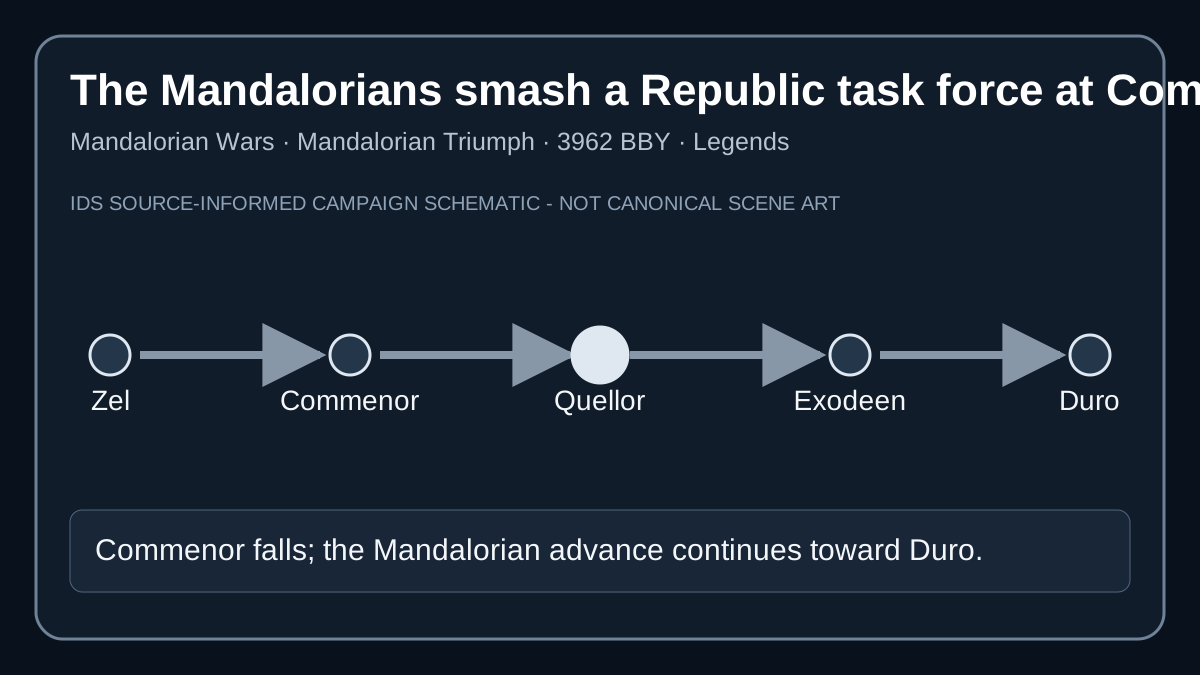
The Battle of Commenor belongs to the 3962 BBY offensive later known as the Mandalorian Triumph. The Neo-Crusaders were driving Coreward toward Duro along more than one route, and Commenor became one of the points where the Republic tried to stop that advance. The surviving record is unusually clear about one fact: a substantial Republic task force was stationed there, and it failed. The Mandalorians defeated the task force, took the world, and continued toward Quellor and Exodeen before reaching Duro.
A concentrated defense still failed
Commenor is more informative than many map-only engagements because the sources identify a Republic task force rather than merely marking a battle symbol. That means Republic planners had recognized the approach as strategically important enough to concentrate forces there. The loss therefore represented more than a patrol being pushed aside. A deliberate blocking force had been beaten.
The defeat also changed the meaning of the surrounding battles. Earlier Mandalorian victories could still be treated as raids or frontier penetrations. Commenor demonstrated that the Republic could assemble a serious formation on an expected route and still lose the position.
The road to Duro narrows
After Commenor, the documented sequence continues through Quellor and Exodeen to Duro. None of those small route battles should be inflated into a fictional campaign narrative, but together they show sustained operational momentum. Each victory preserved access to the next system and denied the Republic time to rebuild a stable defensive line.
This is why a short, source-thin battle still matters in a complete chronology. Commenor connects the outer phase of the Triumph with the final attack on Duro. Removing it would make the offensive look like an abrupt jump rather than a chain of military access.
How later history remembered Commenor
The war is partly known through later historical works, including an in-universe address attributed to Vilnau Teupt in The Essential Guide to Warfare. That framing matters. Later Mandalorian memory emphasized victories that proved mobility, aggression, and the weakness of Republic defenses. A historian using those traditions has to separate what the sources actually establish from the way later speakers used the battle to explain Mandalorian identity.
Anthropological assessment
Commenor shows how military defeat becomes a social signal. The practical loss was a world and a task force. The wider consequence was a change in expectations. Republic populations, commanders, and politicians now had evidence that a defended position could fall even when the government had anticipated the threat.
That matters because war is fought through institutions as well as weapons. Governments depend on confidence that defenses, routes, and commands will function when needed. When a visible defense collapses, people begin to revise what they think the state can protect. The Mandalorian Triumph converted battlefield victories into political pressure by repeatedly demonstrating that Republic space was penetrable.
Evidence check
What is firmly established?
The date or date range, location, continuity, broad combatants, outcome, and campaign placement are retained only where the cited Legends sources support them.
What has IDS deliberately not invented?
Unnamed commanders, exact force sizes, casualty totals, dialogue, tactical phases, and civilian experiences are omitted whenever the surviving sources do not establish them.
Why use a schematic instead of borrowed battle art?
For events without a verified source-specific illustration, this page uses an original labeled reconstruction rather than presenting unrelated comic or game art as though it depicts the battle.
Editorial field note · 3962 BBY · Legends
How to interpret the Commenor engagement
Recorded outcome: Mandalorian victory against Republic forces. The event belongs to the campaign's proximity to Core defenses. A single battle cannot describe every front of the war.
Historical method: Campaign maps and later summaries can establish an event without preserving individual commanders, tactical formations, civilian testimony or precise hourly timing. Detailed scene reconstruction without those sources would mislead readers.
Test the evidence: what can this entry establish?
It supports the documented event and stated outcome, but not casualty totals, spoken orders or motives of unnamed participants. Compare the references and related events before inferring broader causes.
Historical judgment · Legends · Source literacy
Test your interpretation of this battle
Answer both questions for a score, specific corrections and an explanation of what the record can establish.
Source method: This assessment follows the references in this entry. A later campaign map can document a system and a result without documenting conversations, exact numbers or undocumented motives.
Sources and further reading
- The Essential Atlas, Daniel Wallace and Jason Fry (2009), Mandalorian Wars chronology and campaign mapping.
- The Essential Guide to Warfare, Jason Fry (2012), where applicable to later in-universe military-historical accounts.
About these links: Publisher and Lucasfilm records identify the referenced editions. A book description or game listing is not a scene-by-scene record of this battle; map placements, dialogue, casualty claims and historical interpretations must be checked against the original pages or gameplay.