
- Date
- 3962 BBY
- World
- Halthor
- Mandalorian commander
- Dorjander Kace
- Key asset
- Signal station
- Primary story
- KOTOR: War #2
Historical narrative and evidence
The Battle of Halthor in 3962 BBY was part of Dorjander Kace's independent Mandalorian campaign during the wider Mandalorian Wars. Kace's force included Mandalorian Knights, Neo-Crusaders, and the captured Republic vessel Reciprocity. The frigate had been captured during Kace's betrayal of Republic-aligned forces at Essien. Its familiar Republic appearance gave the attackers an advantage before the defenders understood what was happening.
Deception gets the attackers through the defenses
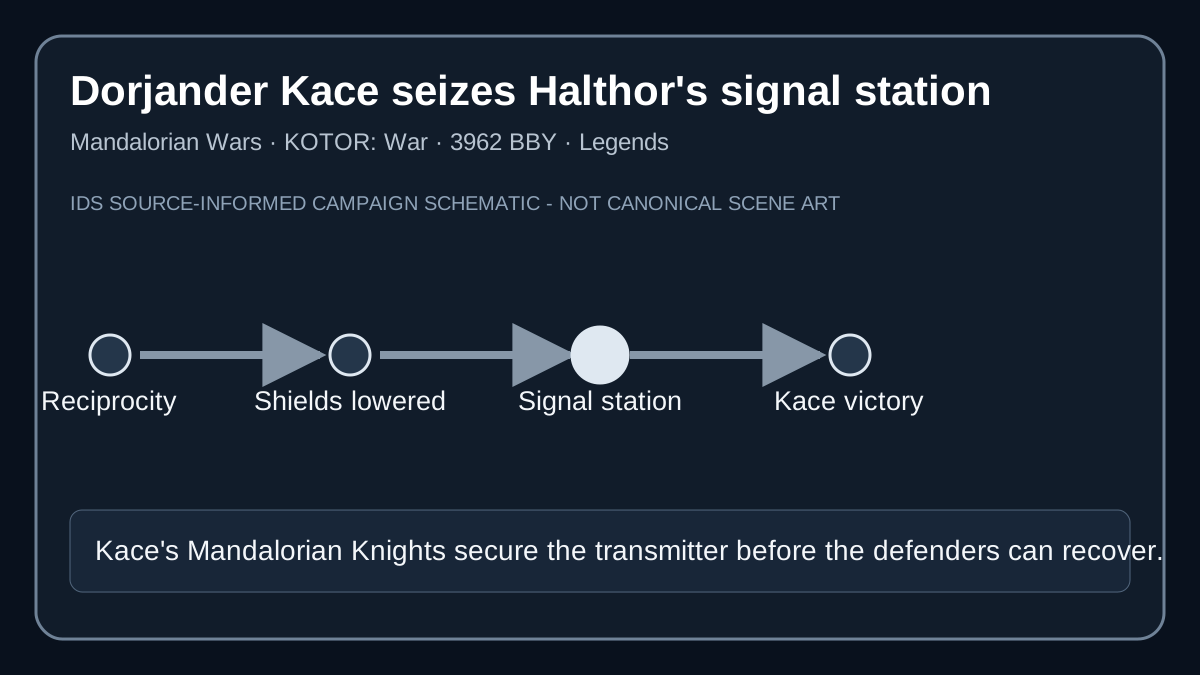
The Halthorians lowered their defenses when the captured Reciprocity arrived because the ship still appeared to be a Republic vessel. Its earlier capture at Essien explains why that deception was possible. By the time the defenders recognized that Mandalorians were aboard, Kace's troops had moved against the signal station and secured the transmitter.
The battle therefore depended on identity and trust as much as firepower. A military symbol that normally communicated friendly authority was turned into a tool of penetration.
The transmitter was the real objective
Halthor's signal station gave the battle a clear infrastructure target. Communications systems allow governments and militaries to send warnings, coordinate movement, request reinforcements, and control information. Capturing one can affect operations far beyond the immediate site.
Kace's emphasis on the transmitter also distinguishes Halthor from battles fought simply to occupy territory. Control over communication was itself a form of operational power.
Zayne Carrick is trapped inside Kace's campaign
Zayne Carrick participated while caught up with Kace's Mandalorian Knights. His presence adds a personal layer to the battle because he was neither a conventional Neo-Crusader nor a simple Republic defender. The War miniseries uses that unstable position to explore allegiance and coercion during the conflict.
Anthropological assessment
Halthor shows that military communication depends on shared signs. Uniforms, ship profiles, transponder expectations, and institutional routines allow defenders to decide quickly who belongs. Deception works by exploiting those social rules.
The battle also reveals why information infrastructure becomes a target in war. A transmitter is not merely technology. It is part of the institution that makes coordinated authority possible across distance. Capturing it interrupts the defender's ability to know, warn, and act.
Evidence check
What is documented?
The date or range, continuity, broad combatants, outcome, and campaign placement come from the sources listed below. More specific details appear only when the cited story or reference work supplies them.
What is deliberately left unknown?
IDS does not add unnamed commanders, fleet sizes, casualty totals, tactical maneuvers, dialogue, or civilian experiences unless a source establishes them.
Why is the visual a schematic?
It is an original IDS reconstruction used where verified event-specific artwork is unavailable or rights status is unclear. The diagram is labeled so it cannot be mistaken for canonical scene art.
Editorial field note · 3962 BBY · Legends
How to interpret the Halthor engagement
Recorded outcome: Mandalorian victory. The event belongs to the role of Mandalorian-aligned Jedi. Read this outcome alongside the wider conflict rather than assuming that a single battle describes every front.
Historical method: Campaign maps and later summaries can establish a place in the war without preserving individual commanders, tactical formations, civilian testimony or a precise sequence of hours. Where the published account is limited, a detailed scene reconstruction would mislead readers.
Test the evidence: what can this entry establish?
It supports the documented event and its stated outcome. It cannot, by itself, establish casualty numbers, spoken orders or the motives of unnamed participants. Compare adjacent entries and their citations before inferring broader causes.
Explore a connected campaign event →
This field note distinguishes source-backed chronology from analytical interpretation; see the references below.
Historical judgment · Legends · Source literacy
Test your interpretation of this battle
Answer both questions for a score, specific corrections and an explanation of what the record can establish.
Source method: This assessment follows the references in this entry. A later campaign map can document a system and a result without documenting conversations, exact numbers or undocumented motives.
Sources and further reading
- John Jackson Miller, Star Wars: Knights of the Old Republic—War #1–2 (Dark Horse Comics, 2012), primary narrative and Essien context.
- Author's commentary on issue #2 (supplementary context).
- The Essential Atlas Online Companion, Halthor location context.