
- World
- Deneba
- Target
- Jedi convocation
- Attackers
- Krath war droids
- Major death
- Arca Jeth
The Jedi gathered on Deneba in 3997 BBY to decide how to respond to the Krath threat. Concentrating so many Jedi created a rare opportunity for collective deliberation—and a single point of vulnerability. Satal Keto exploited it by sending specially designed war droids disguised among ordinary service machines. The attack turned a council into a battlefield.
3997 BBY · Legends · Comic source edition
Deneba: a council becomes a trap
What the story confirms
The third issue presents the Krath striking what was meant to be a Jedi meeting. Service machines and defensive assumptions became part of the attack's method. Master Arca Jeth died while helping protect Ulic Qel-Droma, and the surviving Jedi defeated the immediate attackers. That makes the result impossible to capture with a simple win–loss label.
What the usual retelling overlooks
For Ulic, his teacher's death changed the acceptable limits of retaliation. A tactical victory for the defenders and a severe loss for a community can occur simultaneously. Deneba also offers a case study in institutions treating familiar infrastructure as inherently safe, even when attackers can repurpose it.
Did the Jedi gathering fail solely because the Krath brought more soldiers?
No. The Krath smuggled weapons into a meeting by hiding war droids among service equipment; the attack exploited expectations about routine objects.
Publisher's issue record: Marvel — Dark Lords of the Sith #3 →. An issue synopsis can verify the story's broad premise and publication details; specific scene details in the full comics still require panel-by-panel verification. The hero is an original labelled IDS illustration, not reproduced comic art.
Institutional concentration creates vulnerability
Large assemblies are useful because they allow leaders to debate, coordinate, and establish shared policy. The same concentration also places many important people in one location.
The Krath recognized that attacking the meeting could inflict strategic damage far greater than attacking an ordinary military outpost.
Service infrastructure becomes an infiltration route
The war droids' disguise exploited assumptions about mundane machines that were expected to operate around a Jedi meeting without attracting attention.
Security failed not because the Jedi lacked power but because ordinary infrastructure had been socially classified as harmless.
Arca Jeth dies protecting Ulic
The Jedi ultimately defeated the attackers, but Arca was killed while shielding Ulic Qel-Droma. For Ulic, the death was not an abstract casualty. It was the loss of a teacher whose judgment had shaped his adult life.
That personal loss became the emotional context for Ulic's insistence that he could infiltrate the Krath and destroy them from inside.
Why a battlefield victory became a strategic disaster
The Krath failed to eliminate the Jedi convocation, yet they succeeded in killing a major Master and destabilizing one of his most talented former students.
Strategic effects therefore depended less on who held the field at the end than on whose relationships and decision-making had been altered.
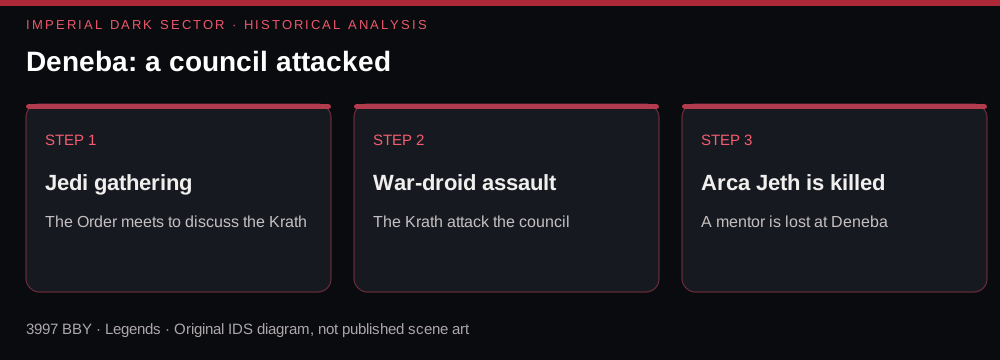
Event sequence
Jedi convene on Deneba to address the Krath.
Disguised Krath war droids strike the gathering.
Jedi destroy the attackers.
Arca Jeth is killed while protecting Ulic.
Ulic decides to infiltrate the Krath.
Explore this entry
Why would Jedi miss disguised war droids?
The attack exploited ordinary expectations. Security systems are often weakest where objects or workers are categorized as routine and therefore receive less scrutiny.
Did the Krath win?
Tactically, no—the attackers were destroyed. Strategically, Arca's death helped trigger Ulic's fall, making the outcome much more consequential than a simple victory/defeat label suggests.
Why is Arca's death so important?
Because grief pushed Ulic toward a plan that his companions considered dangerously overconfident. One death changed the trajectory of the entire Old Sith Wars.
Anthropological assessment
Deneba demonstrates that institutions depend on relationships as much as formal structures. The death of one mentor can change how surviving members interpret risk, duty, and acceptable methods.
The attack also highlights mundane infrastructure as a security problem: what societies label routine often becomes the easiest channel for infiltration.
Primary comic / historical analysis
The convocation that became an ambush
Arca Jeth had helped train Ulic Qel-Droma, so the killing of the Master during the Krath attack on Deneba was more than the removal of a famous Jedi from the field. The ambush struck an institution in the act of deciding what to do about the Krath and their growing use of Sith traditions. Droids moved through ordinary service roles before becoming weapons. The gathering offered an unusually dense set of targets because so many Jedi had arrived for consultation, not battle.
The gathering survived, but the political consequences were severe. Ulic began to believe that direct infiltration could succeed where debate and military intervention had failed. His judgment combined anger at Satal Keto with an expectation that he could enter Krath society without surrendering his identity. That expectation was itself the central risk. The death of a mentor did not force Ulic's later corruption, but it changed the circumstances under which he made decisions. The Jedi therefore won the immediate fight without regaining the same capacity for unified judgment.
What a service droid could conceal
The Krath exploited the assumption that ordinary machines near a meeting were less dangerous than armed visitors. The attack was effective because a social classification of objects—harmless support equipment—became a security weakness. This differs from a conventional fleet assault on a defended installation.
What the survivors knew at the time
The Jedi understood they had been attacked and that Arca had died. They could not yet know all the consequences of Ulic's decision to become involved with the Krath. Later chronological summaries can connect the events, but should not imply that everyone at Deneba possessed that hindsight.
Does defeating the attacking droids mean the convocation achieved its political purpose?
No. The physical threat ended, but the loss of Arca and Ulic's response undermined the Order's ability to act together. Tactical defense and institutional recovery are different outcomes.
Issue evidence: Tales of the Jedi: Dark Lords of the Sith #3, 'Descent to the Dark Side' (1994). The narrative distinguishes the comic's directly depicted action from historical consequences and IDS interpretation. Publication year is not the in-universe year; 3996/3997 BBY labels belong to Legends.
Sources and further reading
- Tales of the Jedi – Dark Lords of the Sith.
- The New Essential Chronology.