
By the 11,500s BBY, the Pius Dea Republic had developed cathedral ships as the defining warships of its theocratic military system. Vessels such as Illorbion's Hammer, Shining Pathway, and Glory of Kamgeddon carried military force and religious symbolism together, operating from a network of Ordnance/Regional Depots along the frontier.
Warships as religious monuments
Cathedral ships were not designed as ideologically neutral naval platforms. Their architecture and names expressed Pius Dea religious authority while their weapons and crews enforced it.
The ship itself became propaganda visible at planetary scale.
The Ordnance/Regional Depot network
O/RDs served as bases for cathedral ships pushing beyond the Republic frontier.
The same depot concept that had supported earlier Republic expansion became infrastructure for crusading warfare.
A fleet spread across millions of worlds
Later accounts describe cathedral ships darkening the skies of millions of worlds. The phrasing emphasizes the enormous geographic reach of Pius Dea military power.
That scale depended on generations of crews, shipyards, administrators, and supply systems, not only on the vessels themselves.
The fleet contains the seed of Pius Dea's downfall
In 10,966 BBY, the Bureau of Ships and Services would exploit the cathedral ships' dependence on standardized navigation systems by inserting rogue code into their computers.
Centralized technical infrastructure made the fleet powerful but also created a shared vulnerability.
Anthropological assessment
This event shows how political institutions, infrastructure, and collective identity interact across deep time. IDS separates documented facts from later reconstruction and avoids filling gaps with invented detail.
Legends · 11,500s BBY · Historical source comparison
Warships as moving institutions of religious rule
The Pius Dea cathedral ships were not merely military hulls. Their design and naming expressed the state's religious authority, while their deployment was supported by the Ordnance/Regional Depot network. In historical terms, they were both weapons and mobile public symbols. A fleet built for crusading can project a government's categories of loyalty and impurity far beyond its capital.
The vessels' later fate demonstrates a different dependency. At the fall of Pius Dea rule, a compromised navigation system helped the anti-regime coalition overcome a much larger fleet. This event belongs to the 10,966 BBY Battle of Uquine, not to the original 11,500s BBY development of the ship class. Treating the two moments as distinct avoids moving a later technological vulnerability into the circumstances of the original design.
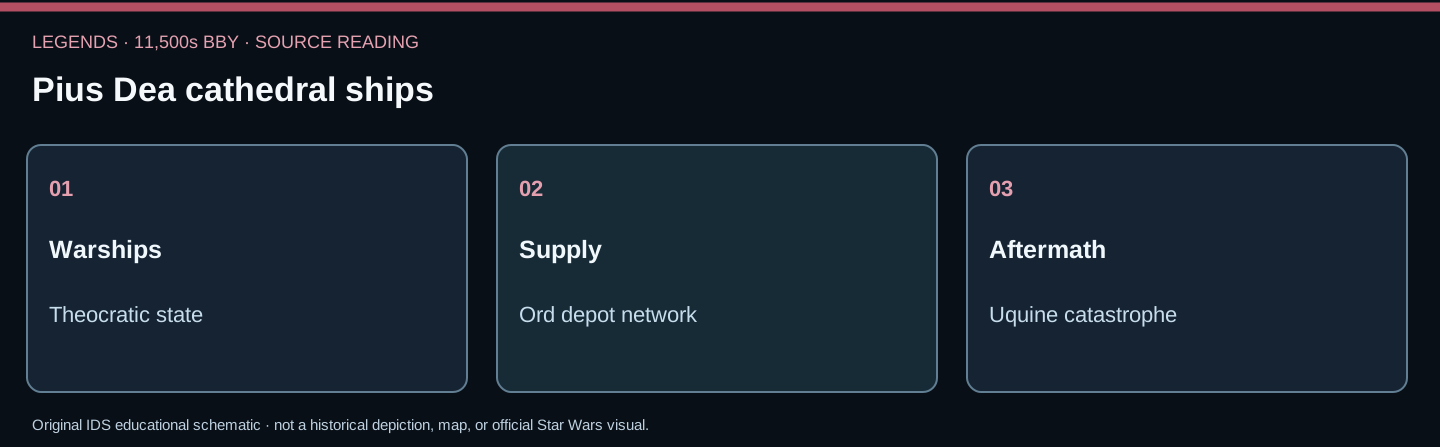
The warfare reference establishes the general class and its institutional role, but not an exact hull blueprint for every named cathedral ship. The figure below documents three dimensions of the institution without claiming a licensed reconstruction or showing invented gun placements.
Check the evidence: Does a cathedral ship's religious name prove every person aboard believed the same thing?
Explanation: No. A state's symbols and a crew's individual beliefs are different categories of evidence.
Related timeline event → · Pius Dea research guide →
Primary reference tradition: The Essential Guide to Warfare, Pius Dea fleet and Ord system. The current research has not verified every original printed page; no source-thin numerical detail is invented.
Sources and further reading
- Jason Fry with Paul R. Urquhart, Star Wars: The Essential Guide to Warfare, Del Rey, 2012.
- Cathedral ship, Wookieepedia