
11,987–10,966 BBY · Legends · Historical institutions
The Pius Dea Era: religious rule, rebellion and reconstruction
A guided investigation into the Republic's thousand-year crusading regime, its treatment of alien societies, the internal resistance that helped defeat it, and the institutions left for its successors to repair.
Continuity and sources: The Pius Dea dates and events in this guide are from the Legends reference tradition, above all Jason Fry and Paul R. Urquhart's The Essential Guide to Warfare (2012). They are not a chronology of the current Canon Republic. When there is no surviving detailed narrative of a battle, the individual file says so rather than inventing one.
Crusades are a system, not a single battle
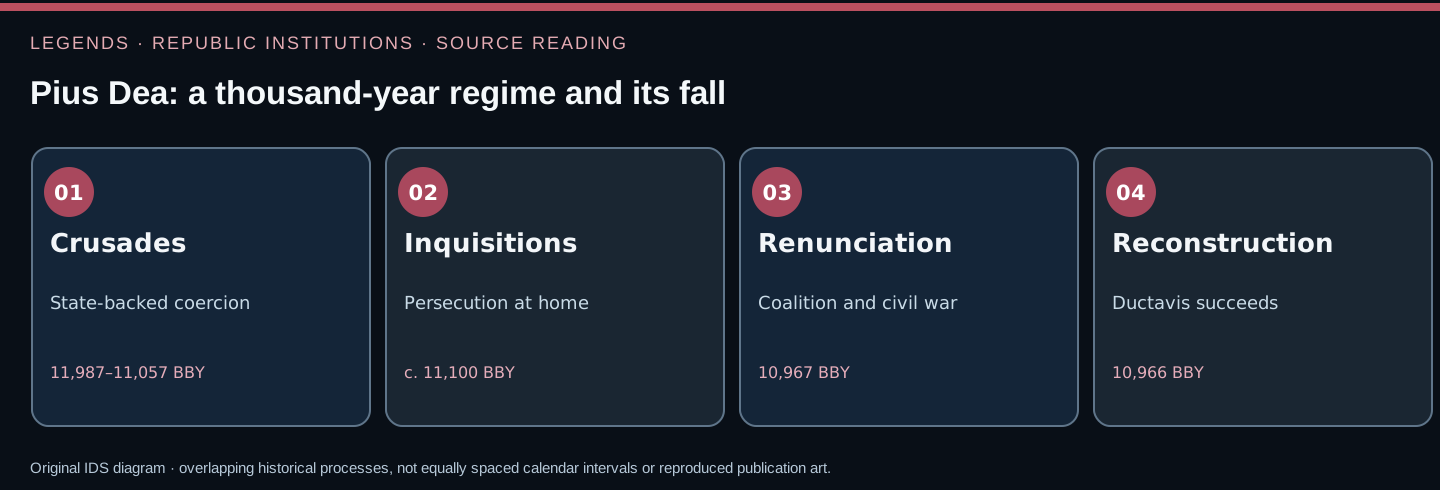
For more than a millennium, Pius Dea governments exercised control over the Galactic Republic and used official institutions to pursue a humanocentric religious program. Political succession, fleet organization, diplomacy and military installations helped make repeated crusades possible. This was not an isolated outbreak of violence but an institutional framework for deciding which populations deserved the Republic's protection and which could be classified as its enemies.
The Twenty-Third and Thirty-Fourth Crusades illustrate that the government could mount operations in different regions through an established network of Ord worlds. Those installations were not simply dots on a map. They gave a military bureaucracy ways to move people and equipment across generations. A source map can document staging areas and target worlds without revealing what every civilian experienced or proving that every expedition achieved its stated aim.
The crisis becomes internal
The Inquisitions beginning around 11,100 BBY widened religious persecution within the Core and Colonies. A regime's official categories of apostate or impure were not neutral descriptions of the people accused. They were classifications tied to punishment. The Jedi's decision to end the Recusal, influenced by Caamasi intervention, opened a different path: organizing with dissidents and communities harmed by the government rather than framing the crisis exclusively as a battlefield problem.
That distinction matters in comparative political anthropology. Religion supplied the Pius Dea regime with a story of political obligation; opposition eventually took shape inside the religion itself. The Renunciates divided the Faithful from those who rejected their direction. The broad coalition in the Seventh Alsakan Conflict included Jedi and Alsakani as well as non-Human peoples who had previously been targets of official discrimination. These groups had different reasons for opposing the regime, even though the later war joined their efforts.
Defeat, removal and the problem of rebuilding
The final Pius Dea crisis culminated in 10,966 BBY. Records describe the Bureau of Ships and Services using compromised navigational code to disrupt cathedral ships. Other surviving vessels were engaged by Renunciate forces at Uquine, and Contispex XIX was captured by the Jedi. These connected events should be distinguished: a covert technical operation could weaken command over a navy while a separate battle brought the remaining armed struggle to its conclusion.
The accession of Biel Ductavis as Chancellor is a clear dating marker, but replacing a ruler did not immediately reverse the consequences of generations of exclusionary policy. Offices, officers, trade routes, local loyalties and cultural memories survived any single change in leadership. The Ductavis Era is therefore best understood as a broad period of reconstruction rather than a one-day political reset.
Research judgment
Does defeating Contispex XIX prove that every Pius Dea-era institution ceased to operate that day?
No. The regime's removal and the task of reconstructing public institutions are distinct processes. Individual reforms and later policies require sources that identify them.
Did all Pius Dea opponents act for the same reason?
No. Religious dissidents, Jedi, Alsakani, Caamasi and other allies brought different experiences and interests to the coalition. A coalition's success does not erase those differences.
Browse the nine connected dossiers
The Twenty-Third Crusade
Two operations targeted Bothans and Lanniks, using the Ord system as military infrastructure.
Read the source-critical dossier →The Pius Dea Inquisitions
Expansionist persecution also became an internal legal and religious campaign.
Read the source-critical dossier →The Jedi end their Recusal
Caamasi mediation helps turn nonparticipation into long-term coalition building.
Read the source-critical dossier →The Thirty-Fourth Crusade
Pius Dea warfare persists through institutional logistics and expeditions into Hutt Space.
Read the source-critical dossier →Republic rocket-jumpers
Military technology and elite troop identity change across generations.
Read the source-critical dossier →The Renunciation
The regime divides, with dissidents and former opponents joining in a broad coalition.
Read the source-critical dossier →Battle of Ord Carida
Jedi, Alsakani and alien allies take a Pius Dea fortress world.
Read the source-critical dossier →Battle of Uquine
Compromised navigation systems and a final fleet engagement bring down Contispex XIX.
Read the source-critical dossier →Ductavis Era begins
A change of Chancellor opens a long and uneven process of institutional reconstruction.
Read the source-critical dossier →Sources and further reading
The core print source is Jason Fry with Paul R. Urquhart, The Essential Guide to Warfare (2012). The publisher's catalog confirms the book and its content scope; it is not a substitute for examining each original reference page. Jason Fry's official Author's Cut on StarWars.com supplies unusually detailed material on the Rocket-Jumper Elite Advance Unit, its approximate 11,000 BBY reinvention and involvement at Ord Carida. This published outtake is identified as such rather than falsely presented as pages from the 2012 book.
Images on the nine dossiers are original IDS evidence diagrams. They visualize specific reported relationships without copying publisher artwork or implying archaeological certainty for fictional geography. Exact print-page collation, image raster social previews and mobile browser checks are open editorial tasks.
Return to the Old Republic research hub → · Browse the complete chronology →